So… Is Starbucks Evil?
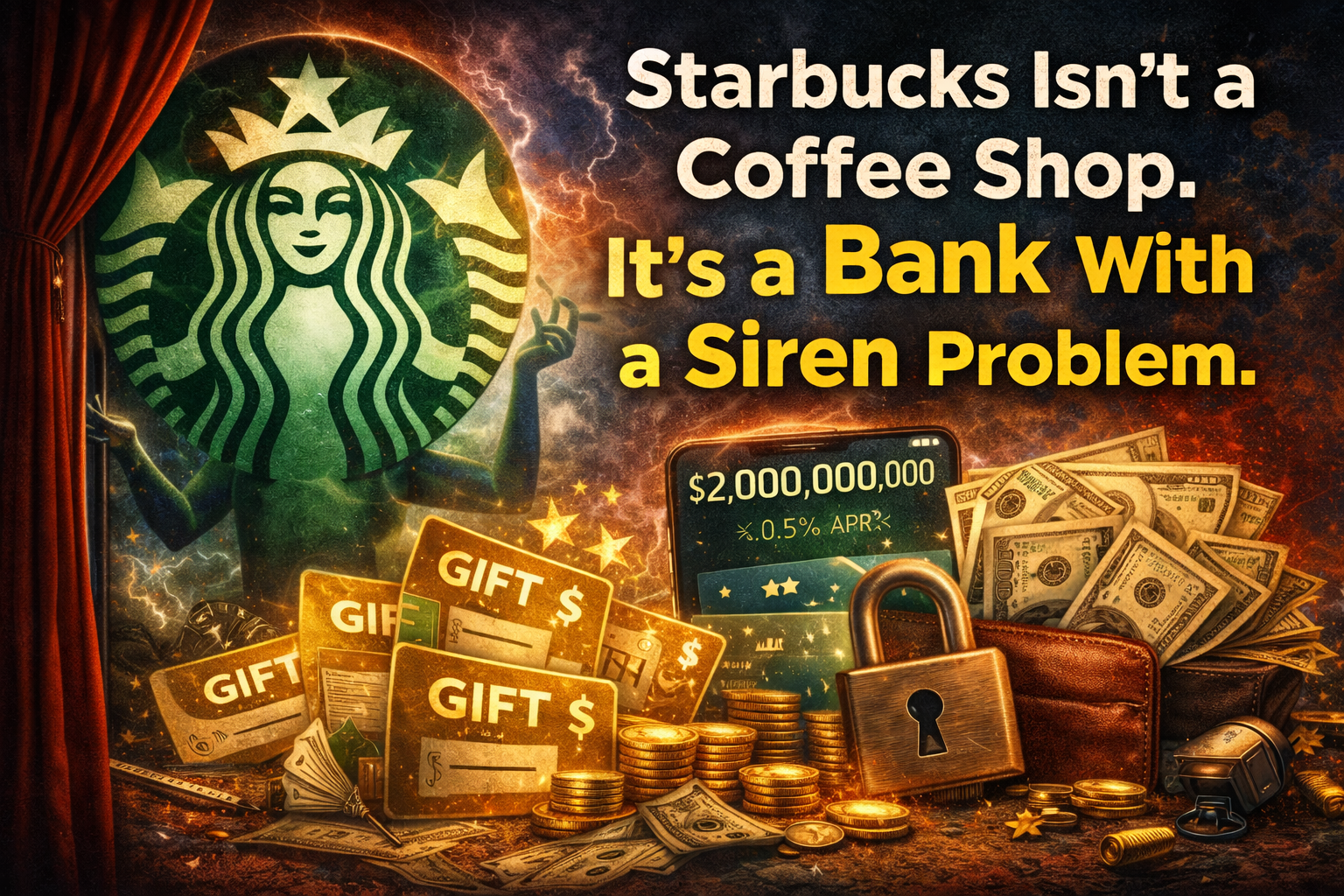
Starbucks Isn’t a Coffee Shop. It’s a Bank With a Siren Problem.
Let’s get something straight right out of the gate: this is not an anti-coffee post. We love coffee. We need coffee. Half of America would collapse into a heap of sweatpants and unpaid bills without it.
But at some point, you have to ask the obvious question…
Why does my coffee shop want me to preload money, store it in an app, earn no interest, and feel rewarded for forgetting about it?
Congratulations. You’ve entered The Bank of Starbucks.
The Coffee That Acts Like a Checking Account
Starbucks customers currently have billions of dollars sitting on gift cards and in app balances. That’s not a typo. Billions. With a B. That money sits there as “deferred revenue,” which is accounting speak for “thanks for the free loan.”
You load $25 onto the app. Starbucks uses that money immediately. You get… stars. And maybe a free drink after spending $200 more.
Banks call this float. Starbucks calls it rewards. Same concept, way better branding.
And here’s the fun part: a chunk of that money is never redeemed. Lost cards. Forgotten balances. Half-used gift cards sitting in junk drawers next to old Batteries. That’s called breakage, and Starbucks quietly recognizes hundreds of millions of dollars from it.
No vaults. No tellers. No FDIC insurance. Just vibes.
Are They Investing Your Latte Money?
Is Starbucks taking your unused $7.43 and investing it in treasuries? Corporate bonds? A secret underground volcano lair?
Officially, they don’t say. They don’t have to. But when you’re holding nearly $2 billion in customer cash at any given time, you don’t leave it sitting in a shoebox.
So, when people jokingly say Starbucks “operates like a bank,” it’s not actually a joke. It’s a corporate structure wearing an oat-milk mustache.
Enter the Siren
Now let’s talk about the logo.
That’s not a mermaid. That’s a siren. A mythological creature whose entire job was to lure sailors to their financial and literal deaths with irresistible songs.
Starbucks says the logo honors maritime trade and coffee’s seafaring roots. Totally reasonable. Completely normal. No notes.
But also… the siren tempts, entices, and pulls you toward the rocks — which feels eerily similar to an app that pings you with “Double Star Day” notifications until you reload another $50.
Coincidence? Almost definitely. Funny metaphor? Absolutely.
The real conspiracy isn’t occult symbols. It’s psychology. The siren isn’t summoning demons. She’s summoning your thumb to hit “reload.”
Workers, Executives, and the Optics Problem
While customers are loaning Starbucks billions interest-free, baristas are grinding through rushes for around $15 an hour, while executives are compensated in packages that make hedge fund managers blush.
Is that illegal? No.
Is it standard corporate America? Yes.
Is it a terrible look when paired with a “we’re all partners” narrative? 100%.
This is where the internet goes feral, memes are born, and every conversation turns into “late-stage capitalism” in a reusable cup.
Politics, Power, and Perception
Starbucks doesn’t directly donate corporate money to political candidates. That’s the boring truth. But they do spend millions on lobbying and industry groups, which is how grown-up politics actually works.
Add in strong public stances on cultural issues, labor fights, and union battles, and suddenly Starbucks isn’t just coffee anymore. It’s a symbol. To some, progressive corporate virtue. To others, an overcaffeinated lecture hall with WiFi.
And symbols attract conspiracies like flies to a Frappuccino.
So… Is Starbucks Evil?
No. Probably not.
Is it funny that a coffee company:
Holds billions in customer cash
Benefits when people forget about gift cards
Uses a siren as its mascot
Encourages preloading through dopamine-driven rewards
And sparks political arguments over pumpkin spice
Yes. Extremely.
Starbucks isn’t a shadow government. It’s something far more American: a brilliantly engineered system that turns habits into profit, convenience into loyalty, and coffee into a financial instrument.
And once you see it, you can’t unsee it.
Which is why we talked about it on the podcast. Because sometimes the funniest conspiracies aren’t about secret cabals… they’re about the stuff we interact with every single day.
Now excuse us while we reload the app. We’re two stars away from a free drink.
Sunday Night Soccer or Sunday Night Surrender?