
 Spotify
 Youtube Music
 Apple Podcasts
 Amazon Music
 iHeartRadio
 Deezer
 OnlyFans, Side Hustles & The Third Income | NFNP 2x29
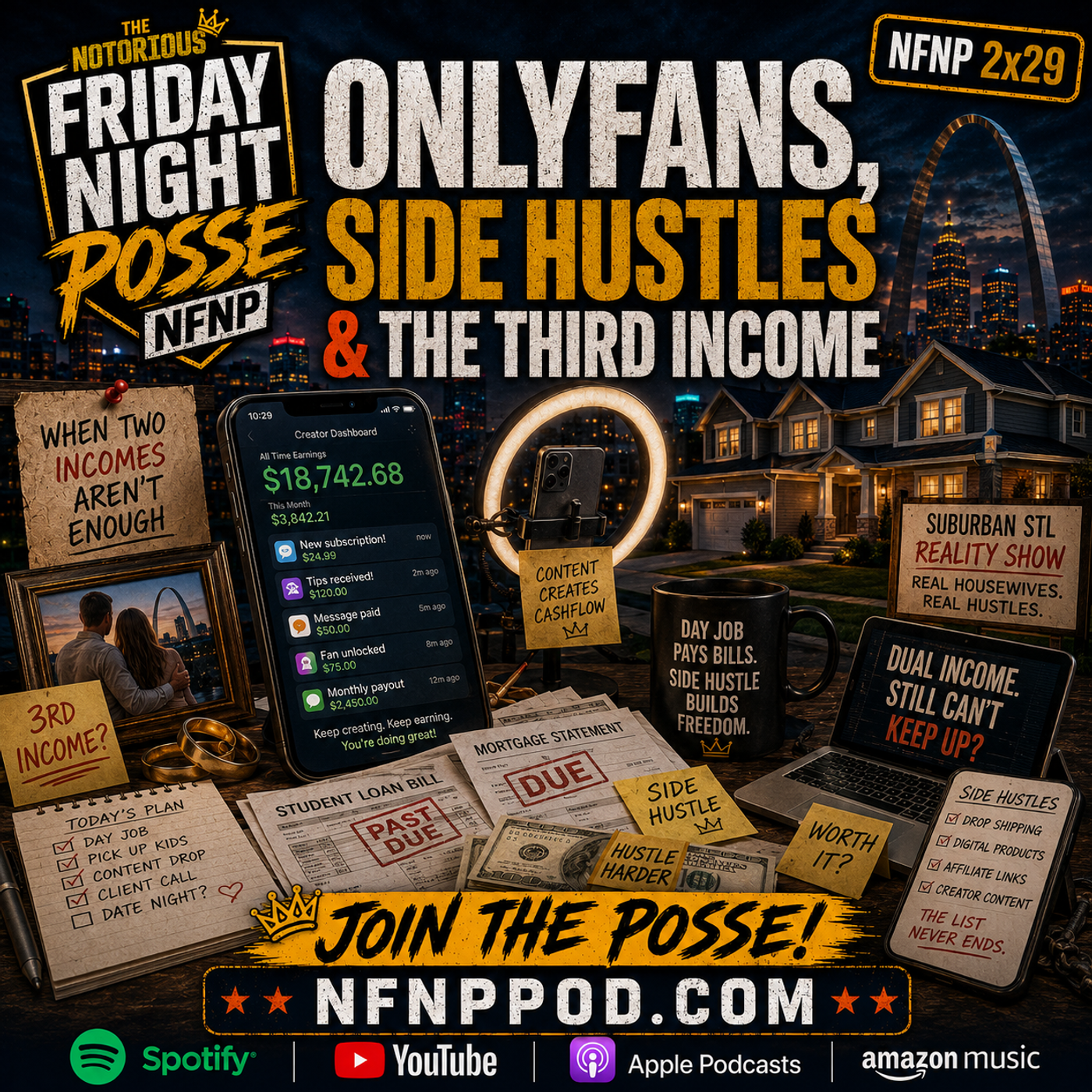
Want the St. Louis OnlyFans story? Jump to 28:17.
Bitcoin is ripping again, so Duds starts us down the money rabbit hole and somehow we end up discussing fiat currency, investing, GameStop and a $20,000 refrigerator.
Then we get into TLC’s new St. Louis-based Double Lives of Suburban Wives. Former teachers, suburban parents, adult-content careers, student loans and some absolutely wild money.
But that leads to the bigger question: did America go from one household income, to two incomes, to needing a third?
We break down the side-hustle economy, why millions of Americans are earning money outside their primary jobs, what people are actually using that extra income for, and whether the modern side hustle is about survival, lifestyle or escaping the 9-to-5 altogether.
Plus: our original PlayStation 3 side hustle, DoorDash economics, Six Flags St. Louis getting a new identity, Savannah Bananas, Venmo, Lake America and why the Great Lakes acronym is apparently now SHAME.
🎙️ NFNP 2x29
Chapters
00:00 Bitcoin Is Back, Money & Investing
28:17 Double Lives of Suburban Wives
52:08 The OnlyFans Boom & The Third Income
1:03:07 Our Original Side Hustle: Flipping PlayStation 3s
1:26:33 Around the Horn: Six Flags, Savannah Bananas, SHAME & More
Find everything NFNP at NFNPPOD.com
Like, follow, subscribe and join the Posse.
Bright: Where should we start? I know you want to talk about Bitcoin. I figure
Duds: Mm-hmm.
Bright: let let's just get right into it. Let's start with Bitcoin. We have some other stuff to talk about, but I usually kick it off with with the main topic or the stuff I've researched, but Bitcoin been on a little bit of a tear since our last episode, I think, huh?
Duds: Yeah, what's it up to now? Almost eighty thousand or so?
Bright: I I think we're over eighty eighty K right now.
Duds: Take a take a quick look here. Yeah, eighty eighty one.
Bright: Showing eighty eighty point two. Yeah. Eighty point two, eighty one. Yeah. So that's a big
Duds: So that's
Bright: jump from what it was basically up twenty thousand dollars, more or less. Yeah.
Duds: Right. Yeah, I think it jumped up like twenty five percent here in the last week or so. So
Bright: Is there any any reason for that? Anything that you know of in particular, or just just standard stuff? I mean, we've s it's been volatile obviously in the past, but up it what it reached its all-time high and then had this major drop, and it's been pretty steady around that sixty-two to sixty-five K range for the better half of of the entire summer, if not longer than that.
Duds: Yeah, I don't know if there's been anything like specific. I was gonna actually take a trying to log into Groc here. I've somehow got logged out, so give me a second and I'll
Bright: Yeah. Don't you hate that? Well, I mean, obviously you got standard st stock market stuff. I mean, stocks have been up a little bit, w which is good for everybody. Iran, you know, Trump kinda came out and said that he's ending the war and moving towards economic something. I don't know what you want to call it. Economic war. I don't know,
Duds: Mm.
Bright: sanctions. Really tight sanctions, all kinds of stuff. So I don't I don't know if
Duds: I thought he was just re n renaming lakes and and gulfs and
Bright: I do want to talk about that. I do want to talk about that, but we'll get there. That's that's for later in the episode.
Duds: You know what I love is all the the two factor authentication codes that you have to do for everything now.
Bright: It is the worst. And you know, I will say while you're while you're logging into
Duds: What's the point of a password anymore?
Bright: there there really is no point and even using text message as your second factor of authentication is not great anymore. AI has we you know we kind of talked about this is AI making fraud better or worse. The The people on the other side of the th of the thing are they're making AI detect different things. So they they'll get your passcode. So the the text message isn't even all that great anymore. So two factor authentication is more or less just annoying.
Duds: I just had to do like a three factor. So I was trying to log in and it asked me for my or four factors, I guess. Had to put my email in and then it asked me to confirm my username. I did that, and then it sent my email a six digit code. And then after that
Bright: Right.
Duds: it said, get on your two factor app and give me the six digit code.
Bright: I think that's probably the best two factor authentication is the authenticator app, maybe that generates the random code
Duds: Yeah. I like that.
Bright: and yeah. And then it also you can do it in combination with your biometrics, whether it's a a face scan or a
Duds: Thumb for it.
Bright: a fingerprint, a thumbprint. Yeah, yeah. I do it a lot for work. It it is super annoying, but when you work for a publicly traded company and all this
Duds: Gotta do it.
Bright: stuff, y you gotta do it. Right. So but but it ain't fun.
Duds: Let's see, so let's ask Grock here, what's what's the reason for the most I the recent Bitcoin
Bright: Bitcoin surge.
Duds: surge. See what they say.
Bright: Certainly helped my portfolio over the last couple of weeks. That Tesla's up, SpaceX is up, NVIDIA's up like ten percent. They had
Duds: Yeah, I think the stock market in general is kind of at a high right now, isn't it? So
Bright: Yeah, yeah, yeah. It's it's definitely been on the climb, which is good. So let's just see if we can keep it that way.
Duds: So everything's up. So let's see. Okay, it says B Bitcoin's recent surge is a sharp rebound. Not a new all time high, obviously. yeah, trading in the sixty two to sixty five thousand dollar range for months. rallied
Bright: Mm-hmm.
Duds: to yeah, about eighty one thousand here. So let's see, treasury buyback and debasement. So that's you know, typical. I think we did see what's that guy's name? The new the the Treasury Secretary, Bessett.
Bright: Scott Bessant. Yep.
Duds: Yeah. He was saying that they were just gonna, you know, print their way out of this this debt problem. So so I think any time that the treasury is gonna come out and say that or the Fed, you know, says that they're printing more money is gonna be good for Bitcoin in the long run. So
Bright: We've talked about this before and we don't have time to go down th on that tangent. But that what sense does that make? That print more money. I I actually I wrote it up in in the blog and I don't know if you had the chance to read our blog from the last episode. It was kind of the joke on taking credit card loan or credit card debt, student debt, and just adding that to the national debt. And the joke that America's in this this debt crisis So what do you do? You take out another loan.
Duds: Sure, yeah.
Bright: Why not just do that, right? And I a lot of Americans do that. It's it's very American. Just take out an another loan to to curb your spending habits. It it eventually it all collapses. And so it doesn't make much sense to me when when Besson says that.
Duds: So I'm reading or listening to an interesting book right now called Broken Money by Lynn Alden. And the chapter I'm in right now talks about the quantitative easing. And it actually I need to look up the it gives you like a PDF you can follow because there's a bunch of graphs and like diagrams and stuff. But it talks about
Bright: Right.
Duds: when the f like the Federal Reserve does that and when the quantity quantitative easing, how they actually do that and the reserves that are held by the the Treasury. and like the treasury bill or the I guess what would those be, like treasury treasuries that you can buy, like bonds and then yeah, and then
Bright: Bon Right. Bond, yeah.
Duds: deposits at banks and how all that works and like how it moves around in the banking system and then how the Federal Reserve basically acts as the central bank and it's the bank of the banks, right? So that's how
Bright: The Bank of the Banks.
Duds: That's where the banks keep all their reserves and their deposits are with on the ledger of the central bank. So it's really really
Bright: Well and that's
Duds: interesting how that all works. It's very complicated. I don't think most people, I including myself, don't know all the ins and outs of like what's really going on behind the scenes.
Bright: Well, I I kinda joke about it all the time with with corporate America that nobody really knows what they're doing. Everybody's making it up. I mean, we consider ourselves to be pretty smart individuals, but I mean we're not geniuses. We're not the smartest, I think we'll say that. But we're relatively spar smart by average standards.
Duds: Sure.
Bright: And sometimes I'm like, What are these people doing?
Duds: Mm-hmm.
Bright: Whether they're other companies I don't want to say my company, but But it goes without saying, the government official like what is going on in through these people's heads, it it doesn't make sense. And
Duds: I think so so much focus is on like continuing growth and they're not really thinking of like sustainability.
Bright: Remember when we had Greaves on, and I think this was in his first episode, he talked about that. He talked about the machine of the company that he worked for, and it was all just trying to build off of that. We need to have more growth, more growth, more growth. You couldn't have a flat year 'cause
Duds: Right.
Bright: that would scare the investors and the whole thing would come crashing down. So he was talking about how how much pressure there was
Duds: Mm-hmm.
Bright: to do something that would move the needle forward. And I I
Duds: And I think that all kinds of it all kinds of lends itself back to the inflation, you know, question is if you're not inflating the currency, if you're not inflating every all these numbers, the worst thing that you could that could happen in a this fiat economy is a recession, right? Or a depression. So deflation is like the enemy of the fiat currency. But the the problem is, we've gone back to this before, is like technology is inherently deflationary, right? As technology gets
Bright: Yes.
Duds: better, the curve for technology is exponential and you can start producing more microprocessors, more, you know, whatever, even cars, like the better the cars get over the years, they're they're better to produce, they're they're more efficient, and over time you get better at building things and that's how how cap capitalism's supposed to work, right?
Bright: Look at all the stuff that we have. Yes. There was actually just a great article, and I can't remember if it was the New York Times or the Wall Street Journal, but there was a a female author that wrote this op-ed about capitalism and how capitalism works. And it's funny because we've been talking about refrigerators, and she used refrigerators as her example about like how the the process of making refrigerators, working on refrigerators. Has gotten so much better, has driven costs down, and the reason that it happens is because of competition and
Duds: Mm-hmm.
Bright: technology improvements. And basically the reason that all of us average Americans can afford a refrigerator is because of capitalists.
Duds: Right. And it you look at the prices of refrigerators and it like it seems they're high and they do go up, but they still don't go up at the same rate that the inflation is happening in in actual terms.
Bright: Sure.
Duds: Like
Bright: And refrigerators are long term purchases. I mean, in theory a refrigerator should last half your lifetime?
Duds: Well, I doubt the new ones do. They maybe they used to. Yeah. Ten to fifteen years probably.
Bright: No, that's that's what everybody says. Well I mean, even when I say half your lifetime, half your lifetime of buying a refrigerator, I I like I don't I don't know that I've ever really bought a primary refrigerator. I've always inherited one. The one in my kitchen currently, I inherited. The my old house inherited. Now I've bought beer fridges. They've never gone out. A a beer fridge is just a a four hundred dollar refrigerator to keep my beer cold. Runs perfectly.
Duds: Yeah, it kinda depends on where you keep it too.
Bright: Now my main fridges
Duds: Do you keep it in the house or do you keep it in the garage?
Bright: I have one in the basement, one in the garage, two two beer fridges. Yeah.
Duds: So the garage one, I've actually bought one for the garage and it was specifically made for a garage, like a that
Bright: Yeah.
Duds: environment, because it does affect the compressor and that on the refrigerator in those hot
Bright: Yeah.
Duds: and cold environments, right? So you need you they'll last longer if they're built for that. But a normal fridge going in your
Bright: Sure.
Duds: house, you'd think it would last, you know, twenty years. We actually had to replace ours after eight. A new Samsung. Yeah.
Bright: Yeah, the one so I just had I just that now see that's crazy. I had mine just worked on. It needed a new compressor and it's working great right now. And it's a very expensive refrigerator. And again, I inherited it. But it's the second time that I've had it worked on, so it's probably cost me about sixteen hundred dollars since twenty nineteen
Duds: Mm-hmm.
Bright: to to get it all back up and running. So
Duds: Yeah, most people buy a new fridge for that.
Bright: yeah, I know, but like I said, this is an expensive refrigerator. It's like it's
Duds: What brand is it?
Bright: one of those GE monogram. I wanna
Duds: It's like the higher end higher end line.
Bright: I wanna say if I wanna no, I would never replace my refrigerator with this model again because I wanna say it's about twenty thousand dollars.
Duds: man, really.
Bright: I know. Who buys a refrigerator for twenty thousand dollars?
Duds: I wouldn't be that guy.
Bright: But it w it the refri the fridge that I have n now was built in two thousand eight. So how many years are we at right now? We're almost at yeah,
Duds: Yeah, eighteen years, nineteen years almost.
Bright: we're almost at twenty twenty years. So I figure if I
Duds: And if you get another twenty years out of it, I mean
Bright: well, I should get if I have to buy a new refrigerator, like I said, it won't be that one. But I'm assuming it may my next refrigerator will last twenty years. At that point, I mean, I guess we'll still be in the house. I'll be I'll be at retirement age, right? So
Duds: I guess you get what you pay for, you know, if you spend two grand, you might get ten years out of it.
Bright: Yeah, but sometimes people say you get like these washer dryers. They're more expensive, but then they have more computer chips and more
Duds: Mm-hmm.
Bright: things that can go wrong. I yeah, I don't know. But we've kinda we've kinda gone on a tangent now on refrigerators. But
Duds: Well yeah, so I I did pull that up. So the the main reasons it's saying is that the treasure treasury buybacks, you know, in debasement. So Bessett he increased I think the two billion dollars I don't know if that was a day or when how often that was, up to four billion dollars just recently. And then there's like a lot of ETF inflows and institutional buying. so River River
Bright: Sure. Helps drive up the price.
Duds: Financial, is that who you you're using too?
Bright: No, I use Robin Hood.
Duds: Okay. So River, I looked at their their they they show their assets and their liabilities and you can view them on the blockchain,
Bright: Right.
Duds: right? You can see how much they are saying that people have purchased with them and then so that's their liabilities, and then they show their assets
Bright: Right. Right.
Duds: what they actually own in Bitcoin. And going from July to August, I think it jumped from like twenty five thousand is roughly what they had Bitcoin. Up to thirty one thousand. So it was like a six thousand Bitcoin increase, which is
Bright: Okay. Right, right.
Duds: insane. Like in one month.
Bright: And again well again when the price is down, you wanna buy more and
Duds: Yeah, I think people maybe started seeing it going up and then everybody started buying it.
Bright: Th th I think that's kind of what happens too, right? Like, especially when we've seen it at all time highs of one twenty six. Did it I don't know. I can't remember if it got any higher than that. One twenty six or so. so it's still got a lot of room to go. And I know you think it's really gonna go, but I love it. I love seeing it because I th I think the last time I bought in was like one hundred two or something like that.
Duds: is that right? You haven't bought any since then?
Bright: Well, no, no, no, no, no. That was my last big buy.
Duds: Okay.
Bright: But yes, I buy I buy a little bit every week.
Duds: Okay.
Bright: But I did a I did a big buy at 102 because it when it had gone
Duds: Never gonna go lower.
Bright: what it w it went from 126 to 102, and that's what I said. I was like, it ain't going lower than this. Like I need I need to, you know, drop ten K and and get to myself some Bitcoin. And then it just tanked and I'm just like, you gotta be kidding me. But I think my first big purchase for Bitcoin was somewhere around like the the high sixties. So I think
Duds: Okay. That's not bad.
Bright: I think the first time I ever bought Bitcoin, like five K or something like that, was like sixty eight thousand. And then I bought every week and then I had another big purchase at one two. So that might put my average around around what it's trading at right now. Right? Yeah. Somewhere
Duds: That's funny, that's about when my averages too, right? About eighty.
Bright: in the The mid I think the mid eighties. I might be my mi my average might be like eighty six or eighty four.
Duds: It's funny because when I first started buying it, the guy that I was kind of talking to a lot and was like got a lot of confidence to start getting into it. He's like, It will, you know, you gotta be prepared, you know, dollar cost averaging is the best way to go. because it'll test your resolve, you know. There's nothing there's
Bright: Yeah, sure.
Duds: nothing stopping it from potentially dropping eighty percent. So don't go
Bright: Mm.
Duds: all in, you know, just do what you're comfortable with and and start just transitioning some money into it like any investment. And he was not wrong, like, because it you see it go down. But the thing is, even when it's sitting at sixty thousand, I'm still like, hey, I'm still buying every day and I still feel good about it, you know, like it could go down
Bright: Yeah.
Duds: even more. And I the nothing's nothing's changed with with with the Bitcoin.
Bright: it's just right. It's
Duds: So
Bright: it's similar to any investment in the sense that and Bob Katman is a big proponent of this, is you invest in the companies that you believe in. Now I know Bitcoin's not necessarily a company, but if you truly believe in it and you invest in the money, you don't worry about dips and and things like that because you believe in the product and you think eventually it's gonna it's gonna pay off. And that could be True certainly about brands like Tesla or SpaceX. I know Bobcatman, I won't give away all of his portfolio secrets, but he made a lot of money on Panera
Duds: Mm.
Bright: and Buffalo Wild Wings. because years, I mean, we're going back years ago. I think B dubs has has had some swings in their market value, but Bobcatman invested at the right time when he was like, This this is gonna go national, it's gonna be huge. And it did. I think he made a lot of money. Now I don't
Duds: Caterpillar is another great one. I mean, they've got a great, great history. And they've but they've done
Bright: Sure. Yeah.
Duds: the same thing. They've gone up and down. Like any good company does that too. Even G E. I was looking at GE a couple
Bright: Sure. Sure. Well Nike
Duds: of years ago when they tanked, right? They went from a
Bright: Yeah.
Duds: few hundred dollars down to like twenty dollars a share. And I was like, that that's probably a great
Bright: Yeah.
Duds: time to get into it. Now they're back up to over two hundred dollars or something a share.
Bright: Well and and that's and that's the thing, you know, if you know you have a good product and so like Nike right now is I think at at like I don't want to say all time lows, but they've had massive drops.
Duds: yeah.
Bright: And some of that could be related to their their political statements and and things like that. But but they're way down. But I part of me was like, maybe maybe now's the time to get in on Nike because they're a brand that's not going anywhere.
Duds: Right.
Bright: Right. There's like there I know this is a tough thing to say, but are they too big to fail? They will eventually kind of like Apple, right? Apple really hasn't had a lot anything new in a while. Right? I mean, the iPhone comes out every year, it's great, whatever, people love it. But when was the last time they had a huge invention? It was probably the iPhone, right? Two thousand seven?
Duds: Look at this.
Bright: Like they're they're due.
Duds: This chart of g this is GE. So yeah,
Bright: What are we looking at? G E, okay. Well you can see, right.
Duds: so here back in it was before COVID. So it was like twenty sixteen. I mean they were hitting they they had gone they'd trended down. I don't know what these other dips were,
Bright: Yeah.
Duds: but they were going back up and they were up, you know, about a hundred and forty dollars a share. But then they tanked, right? And I think they had a lot of they had acquired like
Bright: Yeah. Huge huge covet dips. they were already down a little bit before COVID.
Duds: I think their GE financial division and everything. was like I don't know if they were going bankrupt or what the big deal was, but they went down to like thirty or forty dollars a share. But look at now. I mean, they're up to all time highs of three hundred and forty
Bright: Mm hmm. Yawza. All time highs.
Duds: three now. So
Bright: Yeah, so if you invested in GE at COVID times, which I'm sure a lot of people did actually because there was
Duds: Sure. Yeah. you've ten x ten extra money now in six years.
Bright: Makes me sick. Why didn't I do that? Why not me?
Duds: So then short squeezes, you know, there's a lot of people shorting Bitcoin,
Bright: Yeah.
Duds: even at sixty thousand, getting I
Bright: Yeah.
Duds: think a lot of it is you know, the stuff going on social media, a lot of people saying that Bitcoin's going to zero and they they follow these people that they convince to short this, which is very dangerous, you know.
Bright: The the shorting any company really to me seems like a gamble. It's a bet, right? Like not not that many big companies anyway that you're gonna make a lot of money shorting are gonna really fail, right? But but you l
Duds: Right. So that with GameStop.
Bright: yeah, r I mean, and that was that was the complete opposite, right? You had all these people that were shorting GameStop thinking it was all gonna be all that good, and somebody What was his name? Kitty Roaring Kitty.
Duds: Yeah, right.
Bright: I mean he he just got he just got social media behind him. That's essentially what it was. And and
Duds: We saw the technical setup too of the short squeeze. He said there's way too many shorts
Bright: Yeah.
Duds: out here and they're not gonna they're not going bankrupt yet. You know, they were I think they're kinda on
Bright: Yeah.
Duds: the verge, like they didn't know what they were doing. as far as like maybe they were gonna have to close a bunch of stores, but
Bright: Right, right.
Duds: I think they j he kinda just caught those institutions with their pants down a little bit and got enough people
Bright: Yeah and I think
Duds: involved that started buying it and then when that short squeeze happens, those guys have to start covering and then they just add to the the price going up.
Bright: It's we talked about this an episode or two ago, I think. But it's a great movie. both of There's the the true story and then there's the dramatization. I highly recommend them both. Go check that out.
Duds: Which one?
Bright: but great movie. I can't I can't remember the name of but the GameStop movies. Yeah. The yeah. Yeah,
Duds: These are GameStop movies. I think I saw something on Netflix about that. It might have been
Bright: yeah. Have you not seen either one?
Duds: I don't know if I watched that or not. I don't think so.
Bright: go w well watch the the dramatization. It has Seth Rogan in it. He he plays the billionaire hedge fund donor that does the short on on GameStop. Of course it's all based off of a true story and it's a dramatization, but it's really good. And then go back and watch the the documentary. I think they're both on Netflix, if I'm not mistaken, but super interesting stuff.
Duds: see what that was, what the name of that is. So I think that's kind of the those were the big reasons. And then there's always the question of that Clarity Act, you know, going through Congress. That's been on the table for a long time. So that can add to
Bright: Yeah. Ongoing. Right. Right.
Duds: it. But
Bright: Well, you mentioned it in the group chat earlier that you kind of wanted to start a ask me anything about Bitcoin. So maybe maybe we'll launch that this week. and if any of our listeners have questions about Bitcoin, they can message us. you can submit those messages through nfnppod.com. You can submit them on social media. We're primarily on Facebook, TikTok. and X any of those and we'll answer some questions on Bitcoin. Dudge, you'll be the the quote unquote expert. I I might have to put an asterisk on it that that we're not really experts. But we'll
Duds: No, not experts, but we'll do our best.
Bright: do our best. We'll answer some questions. So let us know your your biggest Bitcoin questions in the comments. Like, subscribe all those things. And and we'll we'll answer any questions that you may have about about the the ups and downs, the blockchains, the all the all the things. So
Duds: I really like how the how it works too, the the technical theory behind it and and what it represents
Bright: Yeah.
Duds: and and really the whole theory of money in general. I think a lot of people kinda just think money is money and don't really even understand what money is supposed to represent, you know, as a store of value for people. It just we've gotten
Bright: Well let's do it.
Duds: away from that in our in our economy. So
Bright: Sure. Let's see if let's see if we get any questions. our our viewership is more or less at an all time high. we have some episodes that outperform other episodes, but I think I sent it to you the other day that we're up about seventy-eight percent on the summer, which is awesome. So if you're a new listener here, thank you so much for joining. Some of that might also be related to C S C posse, and it's still
Duds: We'll carry over.
Bright: at the It's it's I hope that there's some carryover. certainly City S C posse, which is very specific, but it it is currently outperforming NFN Peapod. Not necessarily by a lot, but by ten or twenty percent or so. And I'm sure that there there is some carryover. And it's funny because when I launched City S C posse, of course it was to talk soccer and and just to have some fun with it. That's really what this is all about. but I thought you know, I always
Duds: We've had a lot of good things to talk about on there too, so Yeah. They're out they're outperforming they're outperforming
Bright: Wi with soccer? With City? yeah, it's nonstop, but
Duds: in the league, I think, so
Bright: Well, we're we moved up to sixth in the power rankings. we're sixth in the conference, but more or less we're tied for fourth, right? It's just goal differential. We're going up against Dallas on Sunday night. So we're on the national stage this Sunday, and Dallas is in fifth place, right above us. So if we beat Dallas, then I think San Jose is in fourth, and we're all tied on points. They play Van no, they play Houston, who is number one, number two in the conference that we just beat. So we have a chance.
Duds: Yeah, I gotta feel good about that.
Bright: it was it was so much fun. my wife and I were at the game. We won two to one. super exciting. We went to Befa's, so shout out to Befa's. It was our first time there, actually, which is a big big city bar before the game. It's it's right there on Olive and Jefferson, so good locations. Pretty much right where I park. but first time actually popping in there. Usually we go over to Schlafley. but yeah, it was it was a good night and now we got a big
Duds: Do you have a good crowd there?
Bright: game Sunday. Sorry?
Duds: Good grab there at the bar?
Bright: Always sold out. Or you mean a Befos? we got the last table. And we got there early. You know, we were there by maybe about five thirty and we got the last table. Now they they kind of do like cafeteria style almost. So you go up, you order, and they have some like they have like a serving station right there. So you can get some of your stuff right there ready to go. Other stuff is made to order. And then they have two bars. So we sat right by the second bar. It was perfect.
Duds: Nice.
Bright: So had a had a couple of zwickles, urban chestnut zwickles and
Duds: Is it mostly like pub food or what?
Bright: yeah, mostly pub food. We did we started with a slice of pizza, just one to share. So we shared the slice of pizza, it was pretty good. Then we got a smash burger. Excellent. And we split that. And then we got toaster raviolis that were also very good. So yeah. And the the total I know.
Duds: nice. Sounds like a nice healthy dinner.
Bright: Like not great. I get it. But Sunday, you know. but total cost, I think in and I don't even remember like forty bucks or something like that. Like yeah,
Duds: With drinks, not bad.
Bright: it was not bad. And then we went where do Where did we go next? I think we just went to the stadium or did we go somewhere else after? I think we just went to the stadium, but our next round of drinks cost us forty dollars.
Duds: yeah.
Bright: So I'm like, wait a minute. We just had food, drinks, everything for forty bucks. And then we went to the stadium and two beers, forty bucks. Yeah. Yeah.
Duds: It is crazy how much they charge. I mean you're not there for that long, so you're probably not drinking a ton of so
Bright: Yeah. Well, you know, just I usually like to
Duds: They gotta make some money.
Bright: do and you know when when we went, I like to do one beer when you get into the stadium before the game. And then I like one beer per half. So it's essentially three beers in the stadium. And my first beer is usually smaller. Yeah. Well, yeah, sixty, seventy
Duds: Yeah. So s sixty, seventy bucks, yeah.
Bright: bucks, right? Yowza. Especially when I take my wife. When I took you, you bought the beers, right? You get a free ticket, you buy the beers.
Duds: That's right.
Bright: that's the way it works. Even when I take my brother, we split the season tickets. But if if it they're my tickets, my game, he buys the beers. If it's if it's
Duds: It's a good way to do it.
Bright: his game, I buy yeah, yeah, yeah. I think so. I think it's I think it's more or less fair. All right. We are almost half an hour in. I know we talked about Bitcoin, but I do have some other stuff I wanted to talk about. so we'll get into our main segment, half an hour in. man. We always do this. But I I teased the double lives of suburban Wives last week. And this is a new show that's airing on TLC that takes place in St. Louis. And it is a it is about suburban wives that lead double lives, hence the title. but more or less they're on OnlyFans. They're making adult content, spicy content as a second job.
Duds: So before you start, well I guess my my
Bright: Yes.
Duds: initial question is they're they're wives, you said, so do their husbands know about it? Okay.
Bright: They all know. And they're on board.
Duds: So it's only a it's only a double life because of their do other people they know do
Bright: Society, community.
Duds: other people they know know they do it or is it they keep it secret?
Bright: For the most part, no, although some have been some of them have been exposed. And now the show is aired. So when they're recording it, obviously.
Duds: Completely exposed.
Bright: Now it is out there. So when they agreed to do this, they knew that it was going to go public.
Duds: We probably wanted the publicity anyway, yeah.
Bright: Well, that that is part of it, and I want to talk about that for sure. but overall, I wanted to talk about just side hustles, OnlyFans, and basically the The cost, and this is kind of continuing our economy trilogy. So now it's it's four episodes. And you know what? After this, we might be done with the economy. Maybe next week we do true crime or or some stupid story or get back to geopolitical stuff. I don't know. But
Duds: What is Trump gonna name next?
Bright: right, exactly. but yeah, it's basically like Modern adulthood costs so much money that you have to have a side gig or a second job, work in the gig economy, something like that. Now, technically we is this a side gig? I don't know. We don't make any money off of it. No. So so right. Right
Duds: No. It doesn't qualify yet. It's more of a hobby.
Bright: now I would say it's a hobby. It's a hobby. Like if we ever if we made some money off of it, maybe it you could consider it as a side gig. But right now I'd I'd say that it it's a hobby. But but that's kind of what I wanted to talk about. And I'll let you dictate the order that we go into all this. Do we want to do the TV show first and talk about the St. Louis connection and the double lives of suburban wives? Or do you want me to talk about the economy stats and facts first and then lead into the TV show?
Duds: Well, let's do the show first.
Bright: Let's do the show first. All right. Perfect. I've got it. So this will be our local in the lose segment. And and that's really what what drew me to this topic in the first place is is that this show takes place in St. Louis, which is pretty cool. You anytime I think St. Louis is in the national spotlight, it's awesome.
Duds: It always seems to be for the wrong reasons, but
Bright: That's not true. The the BMW championship last week we talked about it. It was over the weekend.
Duds: Okay, right. That's good.
Bright: Do you know we set a record for the BMW attendance? All time. Over
Duds: No kidding. Wow.
Bright: a hundred and fifty thousand fans showed up over the weekend. And if you watched any of the tournament, they made St. Louis look awesome on TV. The arch, the trains, the river boats, the crowds, the weather. Now granted the weather was perfect.
Duds: Got very lucky. Yeah.
Bright: Not always that way in the middle of August. Very lucky. Yeah, for sure. but no, we're not it's not always for the wrong reasons. y
Duds: No, I I shouldn't have said that. It's not always for the wrong reasons. Just sometimes. Some of the big national news is is bad, but
Bright: Yeah. Definitely definitely sometimes. Yeah. Yeah. Yeah. Crime statistics. Adam Swart, we talked about he said St. Louis was one of the worst run cities in America ever when we had him on as a guest. what else? There's other things.
Duds: It is a there's places in St. Louis that are beautiful though. I mean it has a great it's a
Bright: Course.
Duds: great background for, you know, Bush Stadium. It's got a really storied history, which is probably the reason that people that when they do live here, they and they leave, they come back, myself included, right? It just draws you back to it and it's I don't know, there's something about it that people here it's I like to think of it and never you know, most people would too, that it's kind of like the Biggest small town, I would say, in America.
Bright: And then that's what we say. It's this small, big city, and everybody knows everybody. We've joked about the high school stuff. going back to St. Louis City SC, we just got rid of Edward Leuven, who is arguably one of our best players, and he really embraced the city. So now he's been traded to San Jose, and we'll we'll talk about that on this week's City SC posse. But he talked about how much he loved St. Louis, how the people How nice everybody was, how
Duds: Mm-hmm.
Bright: much they embraced him, how much they show up for the soccer team and the sub they support him not just as a soccer player, but as a human being. Yeah, his wife passed away from brain cancer at a very young age, definitely I mean 30.
Duds: Mm-hmm.
Bright: I don't know exactly how old he is, but let's say thirty, thirty-two. I mean,
Duds: Yeah, super young.
Bright: unimaginable stuff, right? And and St. Louis and the fans and the community. embraced him even though he is he's German. He's not even American, right? And you look at hockey.
Duds: But he's a person, you know.
Bright: He's a person, of course. And I I think for the most part, St. Louis it's that Midwestern charm, right? Look at how many St. Louis Blues players find themselves back here. Wayne Gretzky, Brett Hall, Chris Pronger, Al McKinnis. They they didn't grow up here. Yeah, they played hockey here, but they they choose to make it their home. Jamie Rivers.
Duds: Something about it, you know.
Bright: ESPM one yeah, it's it's it's a it's a good city. There I don't think there's any question about that. Now
Duds: Overall the cost of living too is probably one of the lowest in the nation as far as big cities are concerned.
Bright: It it it definitely is, and that's where this show gets interesting though. So when we talk about the the characters or the the they're not even they're not characters, they're real people. So the focus on these on the show. Not all of them are from like St. Louis. I guess you would say St. Louis, but they're not from the city. They're not even from a lot of them. I c I can't speak for all of From the the immediate suburb. Some of them are from St. Clair. You can tell from where they live. They're living out a little
Duds: Mm-hmm.
Bright: bit a little bit further, right? But it's still the greater St. Louis area. But what I will say is cool. I've watched all three episodes now that I've aired. I've done my homework. And now it's become one of my my wife and I shows. She she's like, let's watch some trashy TV tonight, she says.
Duds: You're hooked, huh?
Bright: Yeah. Right. Yeah. Yeah. But They they go to some places that we recognize, Squires down in Lafayette Square, the Cardinals game for teacher night, things like that. So you're like, I know that area or I know that restaurant. So that as a local
Duds: That's pretty cool seeing that.
Bright: yeah, that's always pretty cool as a local Saint Saint Louis in. But just some real quick background on the show. So it airs on TLC. It's filmed in the St. Louis area. it's it's about six couples that are balancing their marriage, parenthood, suburban life, and adult content creation. There's been three episodes so far. It originally aired on August ninth, and every Sunday there's a new episode. Airs at ten Eastern Nine Central again on TLC.
Duds: So you have to like cable to have that, right?
Bright: You gotta have like cable to have it. I'm sure you could probably watch it online or or something like that. Kinda has like that real housewives kind of a vibe to it. I don't I don't watch that, but that's kinda how I envision it, you know? But
Duds: Wasn't Jim Edmonds' wife a real housewife of something?
Bright: She was. She was. Yes. Yeah, yeah. For a while. And Jim was on the show, I think. And
Duds: Was it?
Bright: I don't I don't think it ended all that well. I think did they get a divorce or he cheated on her?
Duds: I believe they did.
Bright: Yeah, yeah. And that that is all Andy Cohen, of course, which is
Duds: Yeah.
Bright: from St. Louis, graduated from Clayton, all of those things. Now The show itself, again, all of these women on the show, some of them are are doing this in secret. At least like I said, when the show is filming. Some of them have been outed, and you'll probably remember the big one. And her name is Brie. She's one of the main characters, and she was the Saint Clair teacher. that that got exposed. Do you remember that?
Duds: Yeah, I do. Didn't her students find it or something and
Bright: Something something like that. So here's the I'm gonna share my screen here. Here she is, right?
Duds: Yeah, I do remember that.
Bright: Yeah, homely, attractive.
Duds: Looks like a school teacher.
Bright: Looks like looks like a school teacher. man.
Duds: Virtual sex work.
Bright: Well, there she is on the right now.
Duds: Not the same.
Bright: Looks a little bit different, right? So I've got some stats about that. Now some of these other so this is the other gal. So she was also a Saint Clair teacher, so they were both teaching at Saint Clair. Earning around
Duds: You're gonna have to make that bigger. I can't I can't see it.
Bright: I know. Well can I I don't know. Well the w the one that's kind of on the right there. I can click into it, but I don't there we go.
Duds: There you go.
Bright: Yeah. So this was teacher
Duds: Was that second? Both of were Saint Clair? wow.
Bright: Yes. And that's some of the drama in the show. but they were both doing this adult content on OnlyFans, and they were they were best friends, and I guess they they didn't necessarily really know that each other were doing this. At some point, I think before they got exposed, they did find out, but it started separate. So Brie was doing it, and this is Megan, and she was doing it too, and then eventually they figured out they were doing it, and then Brie got exposed first. And then Megan got exposed second. So that's but you remember that story.
Duds: I mean to each to each their own whatever, but I feel like when you're a school teacher, you can't be doing that on the side.
Bright: Yeah, you probably shouldn't. And they both lost their job because of it. Right.
Duds: Right. 'Cause I mean, there's no way that's gonna stay a secret forever.
Bright: Mm. But here's the thing for Brie. She had about five hundred subscribers before that story broke. She has forty thousand now. Five hundred to forty thousand overnight. And that was before the show aired. Now the show has gone national and I'm sure it is higher than that. So she said in her first three months after getting fired, she made one point five million dollars.
Duds: Yeah, she's like, well.
Bright: Who cares? Right? Now,
Duds: First month.
Bright: yes. Now, Megan, on the other hand, so the the second one that I showed, the one with the dark hair, she loves being a teacher, I guess. And it's her calling, it's her passion, and she is devastated
Duds: yeah.
Bright: that that she was fired and she can't be a teacher anymore. So she's still doing the adult content creation. Now, here's the craziest thing, and
Duds: So she didn't love teaching that much.
Bright: Well, sh it wasn't her she didn't plan on getting fired, right? She has two masters degrees, college educated, and the reason that she started doing content creation, call back to last week.
Duds: Can't afford living without it, right? Yeah.
Bright: Student loans. Yeah. Yeah. She couldn't afford to pay her student loans. So she's
Duds: I mean yeah, I'm not like condoning it or like saying that it's okay. I can't it's condoning
Bright: Right.
Duds: saying it's bad or good, I can't remember.
Bright: I'm not condoning it. If you were gonna condone it, you would say it's okay. I'm not condoning it would mean no. Right.
Duds: Yeah. So I'm not condoning it, but I I do understand that like you don't teachers don't make anything. Like it's it's hard to
Bright: Well and and that's kinda the point. And
Duds: to survive on a teacher's salary, you know?
Bright: Especially in St. Clair, and my wife and I talked about this. She was making like thirty five thousand dollars a year with student loans, two masters degrees, and and we talked about you have to have a college degree to be a teacher unless
Duds: Right.
Bright: you're gonna teach at a private school. So if you're gonna go teach at any public school, you have to have a degre a four year college degree. She had also had two masters, making thirty five thousand dollars a year, severely unemployed. I know how much my wife makes, and it's it's I won't give exact numbers, but double that.
Duds: It's silly.
Bright: Not right. I mean, and again, St. Clair is a little bit further out there. It's a smaller school district. What thirty five thousand dollars a year?
Duds: Yeah, no.
Bright: That's crazy. All right. And then there's there's this other gal, and I don't I don't know them all yet. I can't so there's Macy and Jim. Macy is the former nanny, stay at home mom, Heather. yeah, this is He Heather. So I think it's Heather. I don't know. It doesn't it doesn't really matter. Like making no money, vet techs,
Duds: Mm-hmm.
Bright: making making twenty-eight thousand dollars a year or something like that, like
Duds: They they probably have to have college education too.
Bright: Maybe a tech, I don't know, maybe not a tech, but ugh. I'm like, so that that's part of the whole thing on the whole show is is they can't afford their lives in St. Louis,
Duds: Yeah.
Bright: which we'd already talked about is one of the more affordable cities or states in the country. But if you're not making money, if you're making twenty eight thousand, thirty five thousand dollars a year, they all have kids. Some of have four kids. They
Duds: I mean that's
Bright: seem to all also have kids young. So I think that that may have certainly played a part in in their lives and and where they are. Their husbands do make money, but it wasn't enough. And the big thing they also talk about in the show is the time. So like the husbands would wake up before the kids and they'd go to work. And then they'd come home in the last hour that their kids were awake because they they were in sales or whatever, and they'd be working eleven hour. days to support the family. And so they they were like, where what kind of life are we living?
Duds: Mm-hmm.
Bright: And then their wife, who had a job but wasn't making enough money to really justify the job, they were like, well, we can turn to adult content and and make a little bit of money. Now, of course, some of them make more than others. And I don't have all the stats, but one of the gals, Heather, says that her best month she made five thousand dollars. So that's not like drastic. She's not making
Duds: Not huge, yeah.
Bright: F you money. She's not making quit your job money. But five thousand dollars extra a month, that I mean, that certainly could be a full time job.
Duds: And I'm doubting that like I mean, how many hours are they putting into it, you know?
Bright: Well that I mean that's that's certainly a good question. And it's kind of funny when you watch the show, they all have their content creation rooms that they keep hidden. They have all their materials down there, they're doing all this stuff. But what's interesting, one of the gals, and again, I don't I don't know all of their names just yet, but she is the the kinkster of the group. So she does a lot of the the videos, the kinky videos, not just traditional nudity and stuff like that, I guess. And she talked about how one of her videos, here we go, Emily maybe, she got paid two thousand dollars to do one video from one person. And
Duds: So how does that work? Like a person pays you?
Bright: Correct. So OnlyFans, they send in a custom request. And I guess you can accept it or not accept it. I mean, you don't have to do it as a content rec creator. But she's like, Yes, I'll do that. He pays her two thousand dollars. She does the video and sends it to him, but she owns the video.
Duds: Right.
Bright: And now she can post that. She can send it out to other people. So she she did it once and now she can reuse it over and over again to continue making Residuals, if you will.
Duds: She's like pouring maple syrup on her feet and stuff.
Bright: Stuff like that. Yes. She I just this last episode, she was talking about giant fetishes where she pretends to be a giant and it's all about the camera angle. She pretends to feed p fat men, I guess, food. She farts into balloons. like
Duds: What?
Bright: we're I don't know, man. It's some of it is weird stuff. Weird stuff.
Duds: I mean who's who's paying for that?
Bright: So that that is part of my greater conversation is who's paying for that, the discretionary funds, how much money is being spent on this, how much money are are content creators making on this. I mean, like again, a lot of the husbands, not only do they know about it, they're into it or they help, or they are also content creators. So some of them they have their own pages, basically piggybacking off of their wives. Or they're involved in their wives' pages. And then the whole thing is that they collaborate. So all of these women that are on the show, they're all friends now and they work together to increase their viewership, increase their numbers, their subscribers, and then they they do these collaborations, which make them a bunch of money. And then they're also making money on TikTok and and things like that too. It's not just OnlyFans. So It probably takes more time than you think. I know how much of time it it takes just to create a little something from this podcast.
Duds: Sure.
Bright: And it it does take some time. I won't say that it's a full time job. W again, we do it as a hobby. I do it mainly as a hobby. But but if if you r Yeah, I
Duds: Guess we're in the wrong business.
Bright: well and and I think I think again that's part of it, but not everybody blows up. Not everybody is making a one and a half million dollars within three months. And even if
Duds: I think I saw that like ninety five to ninety nine percent don't make hardly anything, you know.
Bright: Correct. Correct. And I'll get into that. I do have some of those stats. But like the bigger question, and it's not really a question that I want us to answer, but maybe a question for our listeners. It's more about that thought process. Like, is there any amount of money where you would go do this? Where you would promote your wife on social media where you would also get involved, where she could quit her job. Like if if you were making one point five million dollars in three months, would you be like, All right, man, go all right, wifey, go go do some feet pictures.
Duds: Sac sacrifice some of your morals. Yeah.
Bright: Yeah, sure. And that that is an even that is an interesting aspect actually of the show. Almost all of them are really religious
Duds: Right.
Bright: and have gotten kicked out of their churches, which to me is also kind of crazy because isn't that the whole point of a church? Like we we accept everybody. I guess not.
Duds: I mean, it depends, I guess. Certainly depends on the church.
Bright: Yeah, well they're a lot of them have getting Yeah. They've gotten kicked out of their churches. They're worried if they if they're not out there yet that they will be exposed and then will be kicked out of their churches. So religion is a major aspect of the show.
Duds: So here's my take on that, I guess. because I I've considered myself religious and I would say it's hard for it would be hard for me to say one way or the other because you know we're obviously not in the position where we would need to do something like that. So if you and I don't know what these you know, families, these women and their husband, if they have kids or whatever, what their financial
Bright: They almost all have kids. I think they all have kids.
Duds: what their financial situation is, if it it truly is a, you know, a necessity, or if if it is just I want some additional money 'cause I want to go I want to be able to buy nice things, you know.
Bright: Well, and I I think it's a little bit of both. I think it started as a maybe necessity to pay bills and the grocery bill from what I've from the three episodes I've seen, but then it starts to transition into, I'm making a lot of money. I mean, even one of the gals talks about her new Corvette, her new Escalade. there they have new houses. You could tell
Duds: Right.
Bright: they have nice houses that new houses, new cars. So it it started, I think.
Duds: You're beyond the necessity thing. Right.
Bright: Yes. So yeah. It's gone beyond the I need to pay for groceries to wait a minute, like I can live the life that I've always dreamed of. I just again I have to sacrifice my body or my wife or my morals.
Duds: Yeah, so it's it kind of it probably starts out that way for a lot of these people. And you know, you don't want to judge. I don't want to judge anybody. I don't think that's my place to do it. But I don't see it ever being a you're never going to stop. You know, if you start making money, you're going to just continue to do it and continue to go further and further. It's you might need it as a necessity, it might need be something that he just is just to survive to get by. But if the money starts coming in and you get more and more, it's not like you're gonna, well, we're fine now, we can quit. I don't think that's I don't think that's gonna happen,
Bright: Well, isn't that just like anything else? If
Duds: you know.
Bright: that's how it would be if you were a drug dealer, a gambler,
Duds: Right.
Bright: like all these things. Once you get on a roll and you're making a bunch of money and you tell yourself, I will do it until I make a million dollars. Well
Duds: Right.
Bright: then you make that million dollars so fast. I mean breaking bad. I mean you can you I know it's that's
Duds: Sure.
Bright: Not real. But isn't that the whole thing? It turns into this bigger story. He made enough money for his family, right? Walter White did. But
Duds: Could've stopped. Could've quit.
Bright: he he he couldn't stop. It changed to who he was and he liked h who he was. And
Duds: Right. So I think it it does go back to, you know, you can't really use the you know, the need for the money, like we're poor, we're we've gotta get by as a justification because it it never it won't end there, right? That that's not gonna be your
Bright: Yeah. Yeah.
Duds: your justification later on. So I don't think that you should ever sacrifice your morals and ethics, you know, at all. So regardless, right? But that's not my place.
Bright: Yeah. Yep.
Duds: It's their decision, you know, they have to live with it. And I don't think it's right. I don't think that I think that that's probably one of those sites that is a detriment to humanity in general. but
Bright: It is interesting and I I kind of agree in the sense that like who am I to judge? I don't care what you do. Make money, do fine. I've never I'll say this, I've never been on OnlyFans. I've never paid for OnlyFans. I don't really know anything about it. And there are people that do, and again, if that's how you want to spend your money, so be it, right?
Duds: Your decision, right?
Bright: That's that's your decision. I have some OnlyFans stats here. And and again, I got more stats on the gig economy, second jobs, side gigs. We can get into some of that. But the OnlyFans stats are interesting. And the the first part at the aspect of it, if you will, is COVID. COVID poured gasoline
Duds: Probably blew up. Yeah.
Bright: on the OnlyFans fire, right? So in twenty twenty one. OnlyFans revenue hit at the time an all-time high, nine hundred and thirty-two million dollars, saw a hundred and sixty percent growth. creator earnings was four billion dollars. So well, yes,
Duds: Hm. And probably mostly by the top one percent.
Bright: and I don't have those exact stats, but yeah, that's usually how it works. creators, there was roughly two point one million creators. And a hundred and eighty-eight million fans. Right? So a hundred and eighty eight million fans paid the four billion dollars. Right. I don't know. You have to do the math. You want to do that real quick?
Duds: What is that? So four billion. Yeah. Four billion divided by what? One eighty eight?
Bright: One hundred and eighty eight million. How much what is that on average?
Duds: Twenty one dollars.
Bright: that's it. It doesn't
Duds: Yeah.
Bright: seem like that much. All right. That that jumps real fast from one eighty eight million to four billion. Twenty-one bucks. All right. I you know, anybody can afford twenty one dollars, I guess. but it's just it's exponential, right? So COVID created the perfect conditions. People were stuck at home, people lost their jobs, strip clubs were closed. Entertainment was closed. You were spending more time online. Consumers sitting at home with money to spend. Creators looking for extra income. So the supply
Duds: All that stimulus money went right to
Bright: that a hundred percent. Yes. and that was what the government was looking for, right? They were like, let's just feed it into
Duds: Stimulate the economy.
Bright: the economy. They didn't care what what the economy was.
Duds: As long as it was getting spent on something.
Bright: That's right. Supply and demand showed up at exactly the same time. Now, here's the new numbers. They were released just this week. OnlyFans
Duds: Lamb on me.
Bright: this is for twenty twenty five though. So but the numbers were released just this week. Revenue one point six billion dollars for OnlyFans. So for the company.
Duds: Okay, so not the creators.
Bright: Not the creators. The creators, six point two billion dollars. Lifetime creator payouts. So since OnlyFans started in twenty sixteen, OnlyFans has paid out thirty billion dollars.
Duds: And they probably justify it as like, look, we're employing people. We're helping the economy too. These these
Bright: Yeah. Exactly.
Duds: women wouldn't have jobs otherwise.
Bright: Do you remember the CEO at one point came out to say, like, hey, this isn't about porn? And I think they almost tried to get away from porn and then they very quickly realized, like, no, we are porn. Like we are synonymous with
Duds: That's what you are.
Bright: porn. Yes. All right. The US is by far and away the largest market for OnlyFans.
Duds: really? I would have thought like India or China.
Bright: Yeah, well, you think larger people, but I betcha it's not even allowed in China. I betcha it's blacked
Duds: Why not?
Bright: out in China. It's not even Not even a thing, so Yep, yep.
Duds: They're too busy building iPhones. No time for no time for yourself.
Bright: Exactly right. Yep. All right. So we have about a half an hour left at most. I got a hard stop here tonight. should we go into some
Duds: You say that every time.
Bright: I do say that every time. It's when this beer is done and I'll do a call out, I'm drinking a double dry hopped hazy IPA called Fallen Flag.
Duds: I should go to the beer store, get
Bright: by Narrow Gauge Brewing Company.
Duds: myself some some craft beers. I've just been stuck on this, trying to clear these out of the fridge.
Bright: Yeah. Yeah, yeah, yeah. I know. I I d I had these, I actually found these and kind of hidden away and I was like, I'll drink a couple of those tonight. So
Duds: I don't know how many years old this beer is, but it's been in there for
Bright: Well
Duds: a while.
Bright: This one's probably been in there for a while too, but I wonder what the alcohol percentage is if I can find it. I mean dru double IPA, usually that means
Duds: Yeah, like nine percent.
Bright: Yeah, usually that means higher. But I am not seeing it. Hm. Usually they tell ya on these craft beers.
Duds: Going back to that though, I think the the thing that kinda upsets me the most about it is the I guess the enticement to younger people to to try it, you know? And
Bright: Well I think that a lot of that's what it is. It's these eighteen year olds, these college age kids that th they're desperate for money.
Duds: Right. And once it's out there, it's out there, you know. And you know
Bright: so OnlyFans offers I think a little extra protection, but it doesn't stop things from getting leaked. There's no doubt about that. I mean, yes, if you make it, if you record it, if it's digitized, it will it will be out there in some form. Now it is behind
Duds: Well, and even if it's
Bright: a paywall. There are there are some other things with OnlyFans that make it a little bit more exclusive, I think.
Duds: I guess beyond just the content, you know, being out there, like the fact that you've done it and you're associated with
Bright: Associated with. Yes.
Duds: it, that is gonna be out there and that will follow you around forever, right?
Bright: Hell, people people could say that about this podcast, Duds. They will. Yeah.
Duds: They will. They will. Look at these two idiots. This is gonna follow us around forever.
Bright: That's right. That's right. Yeah, like this guy wants to be a VP?
Duds: Ha ha.
Bright: The guy drinking beer and talking about OnlyFans? No chance.
Duds: I don't think so. Good thing he bought Bitcoin when he did.
Bright: That's right. That's right. Okay. all right. I'm gonna r blow through some stats in the interest of time and then you just call it out if you think it's interesting. And so this is just general I need a second job stat, right? So married couples with child children under the age of eighteen, sixty six percent in this those situation, both parents are employed. So
Duds: So say that again.
Bright: that Two thirds of all parents with kids both have a dual
Duds: Okay.
Bright: income household. Both parents have to work to be able to support those kids.
Duds: Lifestyle, yeah.
Bright: And when the kids are under 17 or between six and seventeen, actually, that number is up even higher. It's up like seventy percent. So only only
Duds: So yeah, that's quite a bit.
Bright: one one third of married families have a single income.
Duds: Do you happen to know what that has increased from, like say back in the fifties?
Bright: I do. In nineteen seventy, only thirty-one percent of households with children.
Duds: So it's flipped. Yeah.
Bright: Yes. It's completely flipped. That's exactly that. That's exactly it. So nineteen seventy to today, it's completely flipped. So it used to be one third was dual income. Now it's two two thirds are dual income. So did two incomes make families richer, or did the economy eventually just price itself into requiring two income? I I think it's the latter. Yeah. Especially
Duds: I go to the latter too. Yeah. I think there was a very big push for women in the workplaces and and
Bright: Yeah.
Duds: that pushed for a you know, a dual income just by itself. I mean, if women were going out and getting more jobs and they were, you know, don't be a homemaker, don't be a you know, a housewife, go get yourself a career and do that. That lent itself to saturating the market with more employees, right? It had to. You've
Bright: Yeah. It probably increased the GDP. I mean, we know it's increased
Duds: Right.
Bright: the GDP of the country and the economy, but it's probably also contributed to our massive debt that
Duds: Right.
Bright: we've talked about in recent episodes, inflation, cost of consumer goods, child care costs.
Duds: Mm. Sure. Yeah, because if you're both working, the childcare's gonna increase
Bright: Yeah.
Duds: as well. And there's a limited supply of that as well. So you're gonna have to pay more. So yeah, I do think that it's probably priced itself in significantly now.
Bright: Yeah. five point three Americans have two jobs, and that is not counting side jobs or gig economy work. Two
Duds: Five five percent, you said?
Bright: five point three percent. Have two jobs. Two
Duds: Two jobs. Mm-hmm.
Bright: jobs. You're you're a employed, you're an employee of a company. Yes, five point three percent. Yeah, you could be full time and part time.
Duds: So how would that work? Like your part time? Couldn't be two full time jobs, right? Like a full time and a part time?
Bright: Yeah. So four hundred and seventy three thousand Americans have two full time jobs. That doesn't seem like
Duds: How do you do that?
Bright: a whole I mean you're working sixteen hours a day. I don't know how you do it. Or you're working weekends, you don't have a
Duds: Yeah, working weekends probably putting in twelve hours a day. Yeah.
Bright: yeah, you don't have a day off. Yeah. Yeah.
Duds: I guess you could have jobs where you're working twelve hours a day and have a couple of jobs and work seven days a week, you know, and
Bright: Yeah, if yeah. Some jobs don't r you don't have to work forty hours to be full time. Like a nurse, for example, you work three twelve hour shifts. It's thirty six hours
Duds: Yeah, I it's like over thirty is over yeah.
Bright: in that situation. It depends for for s whatever reason. Like I remember Best Buy back in college, if you worked over thirty two hours, you were considered full time. is that the law? I don't know.
Duds: Mm. I think that's the law. Yeah. I think.
Bright: Yeah. Yeah. All right. Then you have the side hustle economy, which is drastically bigger, right? So that Those numbers don't account side hustle. Side hustle could be Uber, Lyft, DoorDash, Instacart, consulting, Etsy, eBay, Airbnb, YouTube, TikTok, Podcasts, Photography,
Duds: Everybody's got something.
Bright: Lawn Work OnlyFans. So ba yeah. Yeah, I had
Duds: Slide that one in there.
Bright: to. Basically anything that monetizes your time, skill, possessions, audience Or body. All right. The Federal Reserve found in twenty twenty four that thirteen percent of adults earned money selling goods. So selling something. So Facebook Marketplace or I d you know, I don't know. N
Duds: I used to sell more on like ebay and that, but I don't really do much of that anymore. Just became such a hassle.
Bright: Yeah. yeah. No. You know, so y I have one good eBay story and this will be a little bit of a tangent. It was me and Nilla. Do you know the story when we camped out and bought PlayStation
Duds: I think so.
Bright: threes? Yeah. Yeah.
Duds: Buy an extra or something?
Bright: Well, so I had a little bit of inside info at the time I was working at Best Buy. Although there were there were rules I I couldn't buy from my store. So we had to go to another store. and I wanted to do it because I knew what the stock was. I knew what position we needed to be in line at said store to get it. And I knew more or less that it was going to sell for double the price. Now we were pretty young. So I think it cost $600 at the time. And I knew that we were going to get at least $1,200. But
Duds: This is right when it came out.
Bright: right when it came out, we had to camp out. And Nilla at the time had no money. Nothing. Like he had no job. He will he'll tell you. You know, not was not at a great stage for him. So I told him, I said, I will front you the six hundred dollars to buy the PlayStation. You can keep all the profits, but I need you to camp out with me. And I, at the time, I think I was taking finals. So there was a time where I had to leave the campo out.
Duds: okay.
Bright: So I needed Nilla to hold down the fort and somehow
Duds: So you needed to recruit somebody.
Bright: I had to. I wasn't gonna be able to do it on my own. Yeah. And I think I even had one four hour shift at my store that I had to work. So there were that we were like
Duds: You probably didn't have a ton of extra money either, did you?
Bright: I mean I was in college working at Best Buy. I didn't have a ton of extra money, but I had saved I had money. I had enough to buy two Playstations, so I had at least twelve hundred dollars of disposable income.
Duds: So you were only buying it to flip it? You weren't even gonna keep one. You're a scalper.
Bright: Correct. No. No intention. You know, we're Xbox guys anyway, right? So you remember that's a that's another side tangent when we b w me, you, and Nate Dog bought the first Xbox and we had to we had to b
Duds: First one. I think we had to drive over to Illinois, didn't we?
Bright: we had to drive over to Illinois, Edwardsville, Illinois to get it, and then we spent like sixty dollars of it was in quarters.
Duds: Yeah.
Bright: And they didn't wanna take it. And we were like, Legal tender, legal tender
Duds: I think we actually had Nate's dad drive us over there, remember? Couldn't even drive. Rolling in there with pocket changed.
Bright: He did. Yeah. We weren't yeah, we were not old enough to drive when the original Xbox came out. Yeah, and we got Halo and we got it was it NHL Hits, it was called or something like that. You know, and it
Duds: That sounds right, yeah. And a couple controllers. Yeah.
Bright: Yeah, yeah. Exactly what we needed that we could occupy some time. It was by the time you threw in the games
Duds: Probably cost like seven hundred dollars though. Seven eight hundred bucks, yeah.
Bright: that I want to say that the system was three hundred bucks actually. and then
Duds: The good old days.
Bright: Yeah, I know. Two games at fifty dollars apiece, that's another hundred bucks. You had to buy at least one extra controller, that's another fifty. So it was probably like five hundred bucks.
Duds: So what year was that? That would have been like
Bright: Nine nineteen ninety nine, two thousand probably.
Duds: So let's see. What was three hundred dollars in nineteen ninety eight? Ninety nine.
Bright: Ninety nine or nineteen ninety nine. No, not ninety eight. Definitely ninety nine. Two thousand at the latest.
Duds: See what that converts to to today's dollars because it probably three hundred dollars seems cheap, but you know, over twenty-seven years.
Bright: Yeah. And that's just the Xbox.
Duds: Right. Yeah, so if we spent six hundred bucks, let's see here. Do a little calculation.
Bright: I said five.
Duds: Calculating.
Bright: How long does this take?
Duds: you know, it's it's reaching through the deep web. Here we go. That's about six hundred bucks, so it's about doubled. Yeah. So if we spent six hundred dollars, that was like spending twelve hundred dollars today. So not it's not any it wasn't
Bright: Yeah. Yeah. Yeah. All right. Yeah. Yep. That's crazy.
Duds: any cheaper back in those days in comparison.
Bright: But we could only afford it because we pooled our money. It was the three of us, right? Yeah.
Duds: Because we saved quarters.
Bright: Because we saved quarters. Yeah. So that that was the original Xbox. So then the PlayStation 3. So yeah, we camped out and then we sold both on eBay. And Nate Dog's mom, who was an eBay connoisseur at the time, Yeah. She was she was big into the Beanie Baby. Yeah, yeah, yeah.
Duds: Beanie babies, remember? She was flipping beanie babies like gangbusters.
Bright: so Nilla made more money than I did. I think I made fourteen hundred. He made eighteen hundred dollars.
Duds: Are you s serious?
Bright: Yeah, tripled his money.
Duds: Wow. so sold it for eighteen hundred? Dang, that's insane.
Bright: Yeah, and well so like he he made eighteen hundred because I bought him the PlayStation.
Duds: So you you basically paid him six hundred bucks? To sit out there with you?
Bright: No, I think he had to you're right. He had to pay me back the six hundred dollars. I didn't you're right. No, you're right. Yeah, yeah.
Duds: Okay, I would think you'd want that initial investment back. Yeah.
Bright: He had to give me back the six hundred. Yeah, I w I didn't give him six hundred dollars. He cleared twelve hundred bucks, correct. Yeah, yeah. Right.
Duds: So he he cleared like twelve hundred bucks. Nice. That's still a lot. So you had to camp out all night, huh?
Bright: no, no, no. It was like two and a half days. yeah, yeah, yeah, yeah, yeah. It
Duds: It was that long.
Bright: was it was chaos, man. Chaos. And and I knew how many units there were. So we were like number eleven in line, believe it or not. And I knew that there were only like eighteen units.
Duds: Okay.
Bright: And the the total line was like thirty people. Or
Duds: So you knew everybody else is gonna get screwed.
Bright: yes, I I knew after a certain amount. And then we had these younger
Duds: And they were probably limiting it to one per person, I'm guessing.
Bright: one per person, 100%. That was that was limited. And then we were given cards. So they came out like the night the night before, and they're like, we're gonna open up tomorrow at nine AM. Here's your card. Like you've got your spot now.
Duds: Mm-hmm.
Bright: Right. As long as you're here in the morning, here's your card. And we had tents set up. We were drinking beer. people came and visited us. We went out. It was in Crestwood, picked up picked up Jack in the Box or something, you know. but but yeah, there were these two kids that knew I guess they weren't gonna get one and they were back further in the line and at like six o'clock in the morning they were like banging on the doors, like, let us in and they cops got called. Like we we didn't get a lot of sleep. It wa it's a great story, man. I don't know that I would ever do it again. But at that time in our life it was it was a good story. Yeah. Yeah, we were we were in college. I
Duds: Yeah, it's worth it when you're in college. I mean, if you could triple your money like that in a couple of days, why not?
Bright: Yeah, for sure, for sure. And and I needed help and we bonded over that. So I wish Nilla was on. So we talked I tried to get him in to join in
Duds: Damn it, Nella.
Bright: tonight, but I know, I know. But yeah, yeah, yeah. So selling goods. more than a quarter of Americans have a side hustle of some kind. And that
Duds: Yeah, I mean I would believe that.
Bright: number yeah, I know, it's crazy. That number is actually down a little bit. It was forty percent in twenty twenty three.
Duds: Are you considering a side hustle something you do on the regular though? I mean, what you guys did with the PlayStation, that wouldn't be really a side hustle. That's like a one time thing.
Bright: Yeah, it's defined as earning money beyond their primary source of income. I
Duds: Yeah, but you could do that by just selling something occasionally, you know. I mean having a garage sale.
Bright: Occasionally occasionally it would be a side hustle, I guess. A one time thing I wouldn't count as a side hustle.
Duds: I'd it'd have to be more of a regular occurrence, like you're doing it consistently.
Bright: Yeah. Yeah. Sure. It's even higher with parents that have kids. Younger Americans are more likely to have a side hustle. Gen Z is thirty-five percent, millennials thirty-one percent, Gen X twenty-three percent, boomers twenty-two percent.
Duds: How many of these younger
Bright: So w
Duds: generations do you think are gonna wanna get into like the corporate type settings anyway?
Bright: Well, I that's the th I think a lot of know. with the invention
Duds: They're probably like, Screw that.
Bright: of the gig economy, you have more free time, you work when you wanna work. I I think that has a lot to do with it, the the nine to five concept. even work from home.
Duds: Not appealing for a lot of people.
Bright: No, it's not it's not a pe I w I don't know that I could ever go back to a standard office job. I've been working even before COVID, before remo remote work was a thing. I've
Duds: Mm.
Bright: been doing it since twenty fourteen. And it's completely changed my lifestyle. And I joke about the Sunday depression. I don't have Sunday depression anymore. It's
Duds: Just another day.
Bright: just another day. Monday, like, all right, I gotta work. But I don't have to I don't have to wake up, get in a polo and slacks. I do dress up. I don't wear my pajamas to work. But there's no I I put
Duds: You put pants on, that's good.
Bright: pants on. I I shower. I have to I ha I cannot do like sweatpants. Like, unless I'm really struggling or under the weather or something like that. Like, I I want to be dressed for work. But that doesn't necessarily mean I'm dressed to the nines. Like, I remember working in an office and I had a different polo for every day. it was the worst. Right? You had to like iron your pants.
Duds: Right. That's what I do.
Bright: you don't have to dress up. What do you wear to work? Yes.
Duds: No, I wear jeans. Jeans and polos. And tennis shoes.
Bright: Jeans and a pole. Right, right.
Duds: Yeah.
Bright: That's easy. That's what I would wear anyway. That's my normal outfit now. But right. Right. But Yeah, and I do get it. I'm
Duds: Yeah. Clothes are the clothes thing doesn't bother me. I actually don't mind going into the office either, but it's kinda nice. You know, you you get you know, you got your other coworkers there and
Bright: there are things that I definitely miss about it, but what I don't miss is the requirement. Like I remember
Duds: Sure.
Bright: the job I had before this one. I worked in the office, and I had to be at the office at eight o'clock. They made me take a one hour lunch, even though I didn't need an hour lunch. That's what I ha that's the thing I hated the most,
Duds: Mm-hmm.
Bright: right? And so then I'm I didn't get out of 'til like eight or 'til five thirty. It's just like, no. N No, no. Like
Duds: Don't wanna do that. You got a good setup though. I think if you're gonna work from home you need to do like what you do and have a specific office space.
Bright: I had a I do and I got my office space. I had a a rough day today where it's the middle of budget season. Oof. I got down into my office at seven fifteen AM and did not leave until the kids got home at about five forty five.
Duds: full day.
Bright: I mean, not that's more that's way more than a full day. That's is that a is that a ten and a half hour day? Seven fifteen to five forty five?
Duds: It's a long day. Yeah.
Bright: I I didn't even take a half an hour lunch. I I made some eggs
Duds: It's worked right through, huh?
Bright: and turkey sausage and yep, got right back to it. I was even feel not yeah. Yeah, yeah.
Duds: So how many of those days do you usually have though? It's gotta be pretty rare.
Bright: Not not often. Yeah. Sometimes I'll start early but then you get a little bit of a bigger break in the middle of the day or the kids have soccer practice I can I can take off a little early. So
Duds: I usually get to the office about eight fifteen. I come in through the side door so Lumberg doesn't see me.
Bright: Yeah. But then you go work out for three hours every afternoon.
Duds: It's like an hour and a half, hour and forty five minutes. And then
Bright: how many of those hours are on the clock?
Duds: I mean so I get there about eight. I I get now that I'm dropping the kids off, you know, in the mornings I'll probably get there around eight o'clock and leave about five fifteen, five thirty. So it's
Bright: Yeah.
Duds: a nine hour, nine and a half hours with a, you know, hour and a half lunch break in there that I go to the gym. So it's it's an eight hour day. Eight hour work day, you know.
Bright: Yeah. Right. Now, do you have the flexibility if you needed to work from home you could work?
Duds: Not really. I mean I
Bright: No.
Duds: have a laptop that I could bring home, but I just there's I can't do it. I can't I'm not at that point where I could sit down and actually do work at home. I can't focus.
Bright: Right.
Duds: I'm not set up to do that. I need my office and I don't have that at home. If I had a space like you, then I think or my
Bright: Hm. Right. Right. Right.
Duds: wife who's been working from home since shoot, I don't know, two thousand eleven, twelve.
Bright: Yeah. Right. Like me. Yeah, yeah. She's used to it.
Duds: You know, sh she's got an office set up and I think that works well when you have that. But if you don't, if you're just trying to work from a laptop, it just it can't be done.
Bright: Well that's and that's the thing. When I got the extra screens, I got three screens now. I
Duds: Yeah, same. I got the three.
Bright: put put the TV up in the office. I got the news on, which which is great. I mean I love it. I c I can take a break, do the dishes, I can throw the clothes in the laundry, whatever the case may be. So it's
Duds: Go out and mow the lawn. Yeah.
Bright: I i I do and I d I do those things for sure. So it Yeah.
Duds: If you get a break, you know, it's like, Hey, you can use your time better for sure.
Bright: Yes. Absolutely. Absolutely. And it helps when the kids are out of the house and you can get some of those things done. It's not everybody getting home at the same time and then trying to take care of all those household chores when it's impossible to do so. So that that's a big that's a big benefit. All right. The Yeah. Just not not yet. You
Duds: I would like to do it, but you know, just not with my current current position. No.
Bright: never know. Never say never. All right. The average side hustler earns eight hundred and eighty five dollars a month. Not bad, right?
Duds: A little extra change. Yeah.
Bright: But that's not the whole story. Yeah. The median is only two hundred dollars a month.
Duds: Right.
Bright: So that's a big that's a big difference. Twenty-five percent
Duds: I've wondered about like Doordash and Instacart, you know,
Bright: Right.
Duds: like those guys can't be making much money.
Bright: No, now and again, if you're doing that full time, that's different than doing it as a side hustle.
Duds: Mm-hmm.
Bright: So we're talking side hustle specifically here. So you could do DoorDash, you could do Instacart, you can do Uber, but it's your second source of income in the scenario we're talking about,
Duds: Right.
Bright: right? You have a full-time job and then you go drive for two hours after work, or you stop by the grocery store on your way home and and fulfill an Instacart order, something like that.
Duds: Just doesn't seem like it's worth the time, you know, to do it.
Bright: Right? That's the situation we're talking about. I I personally don't think it is. For for two hundred dollars a month,
Duds: Yeah.
Bright: to me, that is not worth the time. My time is worth way more than that.
Duds: Yeah, I mean, I wonder how many hours they're putting in to make that two hundred, you know?
Bright: Well and and I think that's part of it. Now I've got some other stats here. let me see if I can get to it. Well ho all right, let's keep going though. Hold on. But I I wanna come back to that. Like what was the question? What did you just propose?
Duds: Well just I mean, how lucrative is that to to do the Door Dash and and that?
Bright: How lucrative. Yes. Okay. All right. Let's let's come back to that. I don't want to lose my spot, but I do want to come back to that. 25% of side hustlers are earning more than $500 a month. Only 14% earn more than $1,000 a month. And 28% are making less than $50 a month. I mean, less than $50 a month. That ain't even doing it.
Duds: That's yeah.
Bright: So a side hustle isn't replacing a salary or anything like that. It's maybe paying a bill. It's maybe helping pay a car payment. Maybe one dinner out. Right. Fifty fifty bucks.
Duds: Fifty bucks is like Yeah. It's not even putting a dent in your grocery bill for the week.
Bright: No. Right. So the the question is, why are people doing side hustles? So 41% is for discretionary purchases. So it's that extra thing that they want. 35% are doing it for regular living expenses. 28% are doing it to save more money. And 20% are doing it to pay down debt. So it's because they've gotten themselves in a in a pickle.
Duds: Right.
Bright: Twenty nine percent of side hustlers say they believe they will always need one to survive. Six here's here we go. This is what I wanted to bring up. Sixteen percent say they want their side hustle to become their primary source of income. So th yes. So that that is it. So you're making Yeah. Yeah,
Duds: Yeah, I was wondering if they're trying to build something up, you know, trying to build a way to step away from their from their primary.
Bright: you're making fifty bucks a month. You're like, all right, but I don't want to make I want to make two hundred and then I want to make a thousand and then I wanna make five thousand. So it's a slow burn. You could say that for this, I mean Again, we said this is a hobby. We we do not make income off of this. But that's not to say that one day we couldn't make income off of this. And maybe it starts with a very little itty bitty nugget of income. you never know. And it could grow, right?
Duds: Five bucks a month, you know.
Bright: So I we could be the next Joe Rogan's duds.
Duds: It's a it's kind of a stretch. It's the lofty, lofty goal. Yeah. I don't don't see that in our future.
Bright: Lofty goal. Yes. Yes it is. Yes it is. all right. What else do I have?
Duds: So I I did look up what a typical DoorDasher makes and it looks like around twelve to eighteen bucks an hour. So it's you know.
Bright: Terror. I mean, that's almost minimum wage by today's standards. Yeah. Yeah. But
Duds: about minimum about minimum wage ish, yeah. I mean you're not really doing, you know, anything complicated. You're just gonna be in a courier, yeah.
Bright: You know, it's not it's not hard work. You're listening to your podcast, you're listening to a book or music, you're driving. a lot of people find it relaxing, right? You just gotta get from point A to point B.
Duds: I do think it's kind of shitty though, like you see some of these videos where people stiff these guys on tips. Like, if you're gonna get something delivered to your house, you gotta tip these guys. Like I know they charge you a delivery fee, you know, but if you're not gonna tip, then go pick it up yourself. You know what I mean?
Bright: Well, I think that's a that actually has a lot to do with it. Like I never Door Dash, I never do an I've only done it once, and that was because we got a gift card after we had our second kid.
Duds: Mm-hmm.
Bright: It costs way too much money, all the menu items are are inflated,
Duds: Right.
Bright: then you have to you have to tip and if you want to get it hot, you have to pay a rush fee and you still don't know what's gonna happen, it's still completely in the hands of your DoorDasher or Uber Eats, right? You don't know what they're gonna do.
Duds: Yeah, I'm not lazy enough to to do it. I go kick pick my own food up. I pick up if we order a pizza, I'd
Bright: No No we Yes.
Duds: drive up and get it myself typically.
Bright: H hardly ever do we get anything delivered now. We drive and go get it. Because the f the fees are just too much. We'll order Domino's and it might be fifteen dollars for the pizza, but if you want it delivered, it's twenty seven ninety nine.
Duds: Have you heard of some of these people though? Like how much they spend per month on DoorDash? It's insane.
Bright: Yes. And it it's it's primarily these it's these Gen Zers. It's the generation below us.
Duds: Mm-hmm.
Bright: They don't know and that's just become part of their their normal spend and they rationalize it. It is out of control.
Duds: You're gonna pay an extra fifteen bucks to save yourself ten minutes of driving down the street.
Bright: cooked pork chops for dinner tonight and I got some thin sliced pork chops, like a pound and a half or something like that. And I'm trying to think it was probably Seven pork chops cost me eight dollars. Now they were thin slide, they weren't like these massive, thick cut pork chops, but I ate two, my wife ate one, and my kids split one. I still have three left over for lunch tomorrow. Eight eight bucks.
Duds: For eight bucks. Yep. Now the one thing I I would say that we've used, I don't think we have it anymore, but is Instacart, like the grocery deliveries. That can save you some time because going to the grocery store usually takes you a so.
Bright: I enjoy going to the grocery store sometimes.
Duds: I don't mind it either, but sometimes it's like we don't you don't have time to do it. So put
Bright: Yeah.
Duds: an order in, have deliver it. You might pay an extra fifteen bucks, but at the end of the day it saves you having to go for an hour or so and if you're busy, you know, you get your groceries.
Bright: I never did it, but I did it for my parents during COVID. It was like I they couldn't figure out how to do it. So I set up the Instacart. I ordered for them and had it delivered to their house and then they like paid me back because they they were high risk, I guess. They didn't want
Duds: Ha ha
Bright: to go out, right? And I would always get the calls of like, they don't have any good avocados. Do you want the giant avocados? They're good giant avocados. I'd be like, Yeah, all right. Get the giant ones.
Duds: Is it an avocado? Yeah.
Bright: Right. And and then it would be like, all they only ha all they have left is organic bananas. I'm like, Leave me alone
Duds: Yeah.
Bright: J just buy it.
Duds: Is it banana? Yes.
Bright: I'm like, I don't want text or phone calls every time you have a little question about what I ordered, man.
Duds: You said three pounds you said three pounds of bananas. I mean, was three and a half?
Bright: How loud was that? I feel like I screamed into the boy.
Duds: Is that too much?
Bright: All right. Five minutes left. I I did have other stats, but we don't necessarily have to get to them. definitely go check out Double Lives of Suburban Wives. Get get your OnlyFans fix in without having to subscribe to OnlyFans. get your St. Louis fix in for sure. figure out what this whole creator life is like and second income life is like and and even
Duds: I'll have to look it up. I mean T L C I don't know where to watch that, so
Bright: You don't have cable? Yeah, watch it all
Duds: Hell no, we don't have cable. We got like six streaming services.
Bright: Yeah. Watch it online. I betcha one of those streaming services probably has a partnership with TLC. Probably.
Duds: You think? Maybe. You know, I looked up what those movies were too on GameStop. It was Dumb Money was the dramatized movie. And then I think
Bright: Okay. Yep. That's great.
Duds: the one that I started to watch, I don't know if I finished it, was GameStop Rise of the Players or Eat the Rich, the GameStop saga. That's what it was. On Netflix.
Bright: Hmm. Eat the rich. Yep. That's the one I yep. Eat the rich. Yep. Yep. Dumb
Duds: Yeah.
Bright: money and eat the rich. That's it.
Duds: Yeah, Seth Rogan plays that it doesn't
Bright: So definitely go check those out. Yep.
Duds: even look like in that picture.
Bright: All right, I got a real quick rundown. Dark Matter season two comes out Friday. Did you watch any more episodes?
Duds: You know I didn't.
Bright: You gotta get back to it, man.
Duds: I know. I've been trying to watch actually I finished it I think last night. I rewatched Speed with Keanu Reeves. It was on Netflix. Took me four nights to watch it.
Bright: Okay. I mean the first one All right, that's a problem. Are you falling asleep? Is that what it is? Yeah. Yeah.
Duds: It is a problem. I turn it on for yeah, I mean twenty minutes, twenty five minutes, I find myself falling asleep, I just turn it off. So it takes me four four
Bright: Right, right. All right.
Duds: nights to watch a movie.
Bright: Well, now that you got Dark Matter season two coming out on f tomorrow.
Duds: So I can't really get into those series and during the week. I'll just fall asleep. It'll take me forever to watch
Bright: Yeah. Or w did you watch that what did you start that with Jenny or no?
Duds: Dark matter? No.
Bright: Yeah. No. So that's just on your own.
Duds: Yep.
Bright: Yeah. Sometimes that's harder.
Duds: It is because I mean, when do I do it? the kids are always in control of the T V and Right.
Bright: Right. Ga Gotta Gotta wait for like a business trip or something.
Duds: Something.
Bright: Yeah, a plane ride to knock out knock out a bunch. All right. Well, I'm looking forward to that. The book ends at at the end of season one, so this as far as I'm aware, this is all just made up at this point.
Duds: Total new stuff, huh?
Bright: Yeah, but I'm looking forward to it. six flags. Did you see they officially rebranded? I know we Well, they I mean they just
Duds: Yeah, I think they did that this year. The Enchanted Parks or whatever.
Bright: Well, no. So we talked about in the pod probably like a year ago that Enchanted Parks purchased Six Flags, like six of anyway, including St. Louis, but they've announced how they're rebranding it. So next year I think it won't be Six Flags. It'll be Mid America Adventures.
Duds: Mid America Adventures. Are they gonna change like the theme or anything?
Bright: They'll have to change all the rides. I mean the rides themselves will be the same, but they can't call it Batman anymore. It can't be called Mr. Freeze. Those were all
Duds: Are they losing that? Like
Bright: Yes, they have to. Unless they have separate contracts or something like that. That was all negotiated with six flags. It's a deal. It's a rights deal. And I'm sure those ri Yeah,
Duds: We're not gonna know what these these rides are. Like how are we gonna do that?
Bright: it'll it'll just be called the the black and yellow roller coaster or whatever, right?
Duds: People aren't gonna they're gonna call it the Batman. Like
Bright: Black and yellow, black and yellow. Yeah, I don't know. I don't know how we missed this last week in our sports roundup. Savannah Bananas were in
Duds: Mm-hmm.
Bright: St. Louis last weekend. Sold out
Duds: Yeah, Matt Carpenter made an appearance, I think. Matt Adams. Yeah.
Bright: Yeah, Matt Matt Adams, David Eckstein. last year Adam Wainwright. I'm trying to remember if anybody else was on no,
Duds: Have you ever been?
Bright: this year David Freeze. No, I've never been. Yeah. Yeah. Yeah. Yeah.
Duds: Me neither. My neighbors have gone a few times. They like it a lot. It looks fun, you know, they do a lot of cool stuff out there.
Bright: It maxes out at like two hours. yeah, it looks like a good time. But
Duds: I did see like a video where a guy I don't know if it was in this particular game, but it was the Savannah Bananas and the guy in the outfield, I mean it was like a fly ball and he did a backflip and caught the ball. When he was doing the backflip,
Bright: Backflip. Uh-huh. Yep.
Duds: it was crazy.
Bright: They do some cool stuff. There's no doubt about that. They're entertainers, and
Duds: Yeah.
Bright: that's what it's all about. So it's cool that cool to see that. callback to last week. This is a very small little side note. Did you see that some universities are now accepting Venmo payments as for tuition payments?
Duds: No. Really? Yeah, I don't see why not.
Bright: How do you think that works with with Pablo Pledschobar on the
Duds: Ha ha ha.
Bright: cocaine ring and all of his Cash App and Venmo money that he's getting from selling cocaine, using that to pay for his college tuition?
Duds: So I was thinking about that too with the Venmo with the Pablo Pledge Scobar guy. Isn't Venmo
Bright: Mm-hmm.
Duds: like don't you see everybody's transactions? Like, isn't that public? you can, okay.
Bright: You can make pr you can make private. No. All you gotta do is yeah, but if you don't select it as private, then it's public and it it's almost like like a social media
Duds: He's like, thanks for the cocaine.
Bright: thing. It's like so and so paid so and so for cookies. So and so right.
Duds: I've never understood that. Why is that even a part of it?
Bright: I I don't know. I think the only thing is is like you'd advertise maybe where you went. Like Duds played paid bright a hundred dollars for Savannah banana tickets at Bush Stadium. So now you're
Duds: It's like who cares though?
Bright: I I don't know who cares. I don't I don't get it. And it
Duds: I've never understood that.
Bright: does it connect to Facebook? I don't even know. So I've always done only private. I've never have a public profile on Venmo.
Duds: I don't even have that mo.
Bright: And you know, Venmo is just PayPal.
Duds: I know. That's what I've got. I've got PayPal, but I never
Bright: It's the same. PayPal owns Venmo.
Duds: It's a different app.
Bright: It is a different app, but they created it specifically because it's us old people, the eBay people, had PayPal
Duds: Right.
Bright: and they couldn't get the younger crowd to invest in PayPal. They thought it was for old people. So they created basically the same system and called it Venmo. That that's what happened. That's what it is.
Duds: So dumb. I don't get it.
Bright: But it but it caught on. It worked.
Duds: Like, yeah. I mean more people use Venmo I think than they do PayPal, it seems.
Bright: Alright, and last
Duds: I refuse. I refuse to do it.
Bright: you refuse, huh? Last but not least. And I'm gonna have to open this up. I wanted to talk about very briefly.
Duds: Feel like I'm a boomer that uses PayPal now.
Bright: I wanted to talk about Donald Trump renaming Lake Ontario to Lake America.
Duds: What do you think about that?
Bright: I could care less.
Duds: I know. I think it's dumb, but I think it's also hilarious 'cause it pissed like the left off so bad in Canada.
Bright: what what's going on? It won't is it not showing my screen? Hold on. Will it not show signal?
Duds: it probably doesn't.
Bright: You don't think so?
Duds: But I think I can pull that up if you wanted to see it.
Bright: What I sent you?
Duds: no. The picture of it, what did you send?
Bright: Hold on. I'm gonna save it. even gonna work. That that image that I sent you guys in the group chat.
Duds: the shame.
Bright: Yeah.
Duds: Did you make that?
Bright: Alright, here we go. Yeah, I made that. Well, I mean, Chat GPT made it, but So let me let me share it. I got it now. But I guess Signal won't share on the
Duds: No, it's too secure, you know.
Bright: Yeah, exactly. So so my wife and I were talking and sh and I was telling her about about how he renamed Lake Ontario and why he renamed Lake Ontario. And she was like, Well, how are we gonna be able to remember all of the lakes? Like the old acronym was Holmes, Huron, Ontario, Michigan, Erie, Superior. And I was like, yeah. I was like, it has to be Haymes. I'm like, okay, what that aims obviously ain't gonna work. I was like, what works? And I go, shame. And my wife was
Duds: Perfect.
Bright: like, shame. I was like, lame. And I was like, no, it's shame on Canada. Like it it does work. And so I typed this into Chat GPT and first try, this is what it pumped out. And I was like, this is perfect. I was like, it's
Duds: Not bad.
Bright: spot on. It's not, it's not bad. So shame on
Duds: Shame on Canada.
Bright: Canada. it is now Lake. America and you bet this is gonna be posted on social media tomorrow on NFN peepod. I feel like this could go viral. I was like this this is
Duds: You might you might be able to get it too. That'd be pretty funny.
Bright: a good good meme. Yeah. So I don't have He might. I know
Duds: Trump Trump might repost that.
Bright: it. I know it. I I gotta get it. I gotta get it to his people. I'm gonna I'm gonna work on that tomorrow. You gotta retweet it. I'll tell my brother. I don't have a lot of people on X or I don't you know, I'm not a social media guru. It's not my side hustle. So
Duds: might be your best AI photo yet. Yeah, it's
Bright: Yeah, you think so?
Duds: a good one.
Bright: It is it is a good one. I w so I gotta get it out there before somebody else thinks of it. Let it be known here that I thought it up first.
Duds: You gotta patent that.
Bright: Yes. Shame. Shame.
Duds: You don't have an N F N P pod logo on there.
Bright: I could put one on. It I could do that.
Duds: Yeah, you gotta you gotta do that. You gotta brand it.
Bright: Yep, I will brand it a hundred percent. I will get it out there tomorrow. Let's see what happens. Maybe I'll post it with Game of Thrones. Shame. Shame.
Duds: I like it. It says it's America now.
Bright: I'm surprised that ChatGPD did it. Normally it'd be like, this is our against our policy. Aye, aye, aye. All right, man. Well, I'm five minutes, six minutes now, past my hard stop.
Duds: Not a very hard stop.
Bright: No, I know it. Anytime we get to chatting
Duds: More of a guideline than a rule.
Bright: it is a guideline. I will say, so I guessed I was a guest on a podcast this week. We
Duds: yeah?
Bright: can wrap up with this. And I won't plug it just yet because it's not going to go live until like the middle of September. No. No, I was a guest. I was I was a guest. And you
Duds: I thought you had another guest that you just interviewed by yourself. wow, look at you. What for?
Bright: you better believe it. I plugged NFNP pod. I plugged. Our most recent scam economy episode, actually that was like two weeks ago. And I plugged the Rexum episode, which is our our most viral episode for CDS C posse. Far and away, it it's achieved like ten times our normal viewership. so I I plugged that, see if we can get any momentum. This was a little bit more professional,
Duds: Okay.
Bright: so mixing a little bit of my professional life with my NFN peap pod life. so we'll we'll see how that goes, but
Duds: So no deets yet? You just gotta you're gonna leave me hanging?
Bright: Not yet. It's just yeah, just a teaser for now, but when it comes
Duds: When's it gonna go out?
Bright: out, two two to three weeks, it'll get it'll get posted, but when it does,
Duds: dang. Must have like must have editors and stuff.
Bright: it could be serious. I don't know. I c I kind of joked with the host a little bit. I was like, I'm used to to being in charge and I told her, I was like, I can talk. I I hog the mic a little bit sometimes. I know I do it. But it it is what it is. So I I thought it went
Duds: It's what the host is supposed to do.
Bright: that is true. That it but I was the guest on this one. So I I don't know. We'll we'll see. I thought it went pretty well. It
Duds: So how'd it go? Okay. Good.
Bright: was it was a good it was a good topic. It it kinda intertwined not only some of what I do in my professional life, but also just general general knowledge, consumer branding. scams and frauds, AI, all of that stuff. So
Duds: Well let me ask you this. You can't say what it is, but how did you how did it come up to be? Like
Bright: it was somebody I met at a conference. so we were we were at an industry event and we started talking about fraud and how it related to our our industries. And of course we have fraud in the industry that I'm in. And that's part of what inspired my idea about the scam economy.
Duds: Mm-hmm.
Bright: Now this podcast took it a little bit more in detail with regard like A more specific niche of fraud called friendly fraud. So I'll tease that. So this episode was about friendly fraud specifically. but that's what inspired, and I didn't want to steal their idea, but inspired my thought process of like the scam economy.
Duds: Right.
Bright: Right? Like fraud has become a whole part of this larger global economy. And and so that's what inspired our episode a couple weeks ago.
Duds: Yeah, it does seem like it's becoming a very big problem and it's affecting us a lot.
Bright: Well, and and we we learned that, and I even called out some of the stats in this podcast that we referenced about how much fraud has grown since the invention of AI.
Duds: Mm-hmm.
Bright: It it's up twenty-five percent or something like that in the
Duds: Yeah, just getting worse.
Bright: last four years. It's just getting worse. And and the host even posed the question, and I had the answer because we had already talked about it, is AI making it better or worse? So So I I said, hey, go check out the NFNP posse episode, the scan economy and the daily admin tax of life. And and I threw out some of the stats that we referenced. So it was it was a good podcast. I I will go
Duds: Good, you had your homework already done.
Bright: for 30 minutes. Yeah, I did. I was prepared, man. So it w it was fun. We chatted for about forty minutes, not nearly as long. I asked her, I was like, How long do you go for? She's like, thirty minutes, forty at most. I was like
Duds: Got that. We bullshit for that long.
Bright: Piece of cake. Yeah. We we talk for hours. Right. Exactly. I was like, we I we can't go down the tangents. I said, you gotta keep me on track. Cause that's part of our MO.
Duds: 'Cause I will. I'll go off on a tangent.
Bright: I I I I thought about that the other day. I said something, maybe it was even in the blog. R O modus operandi, or maybe it was in the group chat, O for Missouri.
Duds: Mm-hmm.
Bright: I was like, this works. This could be part of our branding.
Duds: Perfect.
Bright: That's It's all coming together.
Duds: R O.
Bright: RMO. All right. Let's end there.
Duds: All right, buddy. Until next week.
Bright: All right. Another one in the books. Next week is episode thirty of season two. I know. That's that's a lot of traction there.
Duds: Nice. You know, we're coming up on when did you start the new season? Was that the beginning of the year? Okay.
Bright: The first of the year, I think. So anything anything in twenty twenty six started season two and
Duds: Shoot, we're already almost in September.
Bright: right, right. So we we took probably a couple of weeks off. I don't know what week of the year it is, but for the most of this year we've been pretty much on target. So thirty thirty
Duds: I like it. Give ourselves a little
Bright: episodes next week. Yeah, pat on the back, celebration. All right. Well, until next week, adios.
Duds: Alright buddy. Have a good night. Later.


