

 Spotify
 Youtube Music
 Apple Podcasts
 Amazon Music
 iHeartRadio
 Deezer
 Bail, Bounty Hunters and Murder Suspect Lee Gilley’s Escape to Italy | Ken W. Good
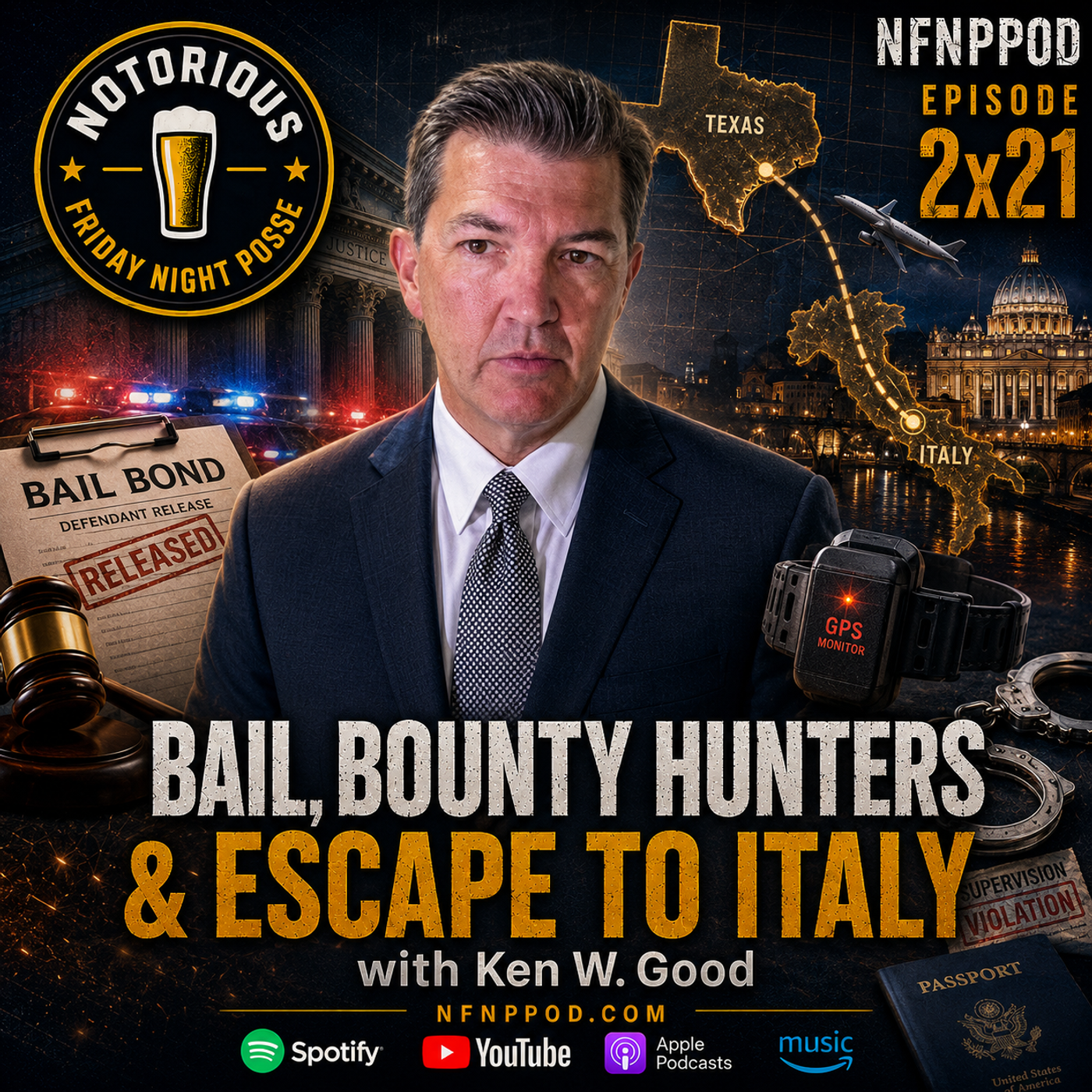
A Texas murder suspect posted a $1 million bond, surrendered his passport and was placed on GPS monitoring. Then, according to authorities, Lee Gilley cut off his ankle monitor late on a Friday, traveled from Texas into Canada and boarded a flight to Italy using a false passport.
The monitor reportedly detected the tampering. The surrounding system reportedly did not respond until roughly 60 hours later.
On NFNP 2x21, Matt and Duds are joined by Texas bail attorney Ken W. Good, a board member of the Professional Bondsmen of Texas and host of The Bail Post.
Ken explains how Gilley was legally released, what a $1 million surety bond actually means and why an ankle monitor cannot physically stop someone from fleeing.
The conversation covers:
• The accusations against Lee Gilley
• His alleged escape route through Canada
• Why Italy may have been selected
• The Friday-night monitoring gap
• What should happen after a strap-tampering alert
• The difference between bail and bond
• Cash bonds, surety bonds and personal release
• Who may owe the $1 million if Gilley does not return
• How family property can be used as collateral
• When bounty hunters or recovery agents become involved
• Why warrants may sit unserved for months
• Whether ankle monitors provide genuine security
• The difference between violent and lower-risk defendants
• How bail policy affects victims, courts and public safety
After the interview, Matt and Duds react to the Gilley case and discuss a shooting near Energizer Park during a CITY2 match, including reports that one suspect was already wearing an ankle monitor.
They also recap a major St. Louis Blues draft weekend featuring Tynan Lawrence, Maddox Dagenais, Mason McTavish and Brandon Carlo.
Plus:
• Downtown St. Louis safety
• Alexander Steen taking over as Blues general manager
• World Cup reactions
• A tease for the next NFNP guest
• Fourth of July plans
What do you think? Did the ankle monitor fail—or did the people and agencies responsible for responding to it fail?
Learn more about Ken W. Good:
Professional Bondsmen of Texas: PBTX.com
The Bail Post: TheBailPost.com
Subscribe to NFNP and join the conversation.
Bright: All right. Tuesday night recording here because we have the â the fourth of July coming up this weekend. So I thought, you know, instead of recording on a Thursday night, we record on a Tuesday night. â but also it worked â fantastic for our guest today and worked for his schedule. â Ken, â we appreciate ya joining us today, â late on a on a Tuesday night and and spending some time to to chat with us.
Ken W. Good: â well thank you so much for having me. I'm glad to be here, even though it's getting close to my bedtime.
Duds: Yeah.
Bright: â that th that's not true. It's it's the summer, right? It's I mean it's too hot to to go to bed where we're from. We're from St. Louis. It's like I don't know, ninety eight still outside right now. It's crazy hot. I think you're down in Texas, right?
Ken W. Good: Yeah, it's crazy. I am. I'm in yeah I'm in Tyler, Texas, but it's in the nineties every day. But I've got a pool in my backyard so you know, f right before I go to bed I go jump in the pool and cool off.
Bright: Yeah, you know it. Ugh.
Duds: â man. I know where Tyler's at, actually, if you would believe it. I've been there. â I had a buddy who lived there for a number of years, actually.
Bright: That's the way to do it.
Ken W. Good: Look, I grew up in Texas, but I grew up most I mean, I I've lived pretty much everywhere in Texas growing up because my dad was a football coach and I used to say it'd take him one or two years to piss everybody off so he would have to go find another job. But that lasted till probably I was in seventh or eighth grade and then my mom put her foot down and we lived in the same place the rest of the time I was â going through, you know, high school, elementary middle school and high school. But I'd never been to Tyler.
Bright: Ha ha ha.
Ken W. Good: I mean, I'd never seen East Texas until my job brought me to Tyler and just the drive. I mean, you know, you come from West Texas where it's flat. I mean, you have circle crop systems and then you come to Tyler where you got these little hills and you have all these trees and you have azaleas that in the month of April just turn colors and you can't even see the plant and it just it's and it's you know, I joined a golf course when I was a lot younger, younger than y'all and â You know, sixteen of the eighteen holes had water and so I mean I just never seen something so beautiful and I've been here ever since.
Bright: It's it's crazy to think, you know, I've always heard that, you know, the distance from West Texas to East Texas is longer than I don't I don't know, like driving across half of Europe or something like that, so that you get a completely different climate as you make that drive.
Ken W. Good: Yeah. Yes. Well I my sister one one of my sisters lived in Hobbes, New Mexico, which is just on the other side of the Texas border, but it's you know, from Tyler to Hobbes, New Mexico was thirteen hours. And I drove that one time, got a ticket going and coming, and I never drove it again.
Duds: Ooh.
Bright: Yeah, it's crazy. Yeah, I could see how that would happen, right? Gotta turn this thirteen hour drive into a twelve hour â drive.
Duds: It's a bad sign.
Ken W. Good: Ha ha. No, you just not thinking.
Duds: So are you guys going through a heat wave down there too right now?
Ken W. Good: Well, you know, I was trying to think what kind of summer we've had. It's very hot right now, but I mean, is it really I mean in the nineties is not really hot for this time of year. I mean, it's a hundred, it could be easily be a hundred, but I'm telling you, you know, I have a I have â you know, one of those split mini splits on a on on a outdoor room and â I I have it programmed to come on when it gets over eighty four outside and then â a d an hour after dust to go off. Well
Duds: Mm-hmm.
Ken W. Good: Now it won't it just comes right back on 'cause it's still A V four. So now I just changed it to go off whenever it gets to eighty two in the middle of the night. So it's just is y but it's crazy. It's â and you know, it's that time of year where your pool cannot stay I mean, it's just sucking up so much chemicals, it's just â to to keep up because the heat just burns off all the the ble â chlorine.
Bright: Sure. Cool.
Duds: How's your hum how's your humidity? How's your humidity?
Bright: I'm thinking about going to the Go ahead.
Ken W. Good: No, humidity's fine. I mean in hu in Houston it's bad. I remember the first time I ever flew to Houston, you get off the plane and you just get hit by it's like a w you're walking into a sauna, you're w carrying a folder and it just melts. And I was like, I I don't have anything to compare that to. And, you know, Tyler, the rest of Texas is fine, but when you get down to Galveston, you get down to Houston and it gets this time of year, you just feel like you're in a sauna all the time.
Duds: Mm-hmm.
Bright: Yeah. Yeah, that's how St Louis is. We get that that humidity and you you get that with the the ninety eight degree temperatures. It feels like a hundred and ten. â so I was gonna say I'm thinking about going down to the river this weekend for the fourth and that spring fed, you know, â river that's yeah.
Ken W. Good: â yeah. Mm. Well, we have we've been getting all these reports from Europe where they don't have air conditioning and they're having a heat wave. And I'm like, I I really can't complain. I work in an air conditioned building. I go home to an air conditioned home and so â my f my attic is is foamed, so if even if I went into my attic it's not that it's not hot. So I really can't complain.
Bright: Yeah. You know, it is it is crazy to think that, you know, these places they don't I was just over in England actually and s a lot of the places didn't have air conditioning. Luckily we missed any of the heat wave. It was actually quite nice. â but I heard they're up to like thirteen hundred something deaths â across Europe from this heat wave and like eighty percent of them are over the age of sixty five. So â you know, this is a big deal for them.
Ken W. Good: Mm. Whoa, whoa, whoa, 65. You're getting close to me. Well, I'm a young 65, and you know, somebody from my Sunday school c class keeps asking me, Do you dye your hair? I'm like, No, I'm first of all, I'm too lazy to dye my hair. And and I used to I had a grandfather whose hair turned white in his 30s, and I used to pray to God, please let me have hair like you know, Papa.
Bright: I know, sorry. Sorry, that's why we have air conditioning â here in the States, right?
Duds: Yeah. Yeah. Yeah.
Bright: Ha ha ha
Ken W. Good: And I'm like, No, no I'm really glad God did not answer that prayer and as long as he as further he puts it off, that's okay with me. But I'm not trying to keep it anything other than what it is.
Bright: Well, you look great and I know you lead a a busy lifestyle still at at sixty five. You you know, you have your own podcast, â you're you're you sit on a board, â a bondsman's board there in Texas, I think, and â y you're â you're a lawyer, you're still practicing, I assume, so
Ken W. Good: Yes, sir. Yeah. â very, very busy.
Bright: Yeah, well tell us tell us a little bit just, you know, about yourself and and about the the conversation that we'll kinda jump into. You know, we definitely have some questions about, you know, some of the cases that â that you referenced â to us privately, â but but also just the you know, the business of of being a bondsman in general.
Ken W. Good: Well, I'm an attorney. I'm also married to an attorney and my wife is much smarter than me. She's a staff attorney for a United States magistrate judge. And â we have two kids. My oldest just got married ten days ago. â and you know, if she's listening, I need grandchildren as quickly as possible. but â I've been an attorney for a long time. I've graduated in nineteen eighty nine. I
Duds: Hint hint. Hint hint.
Bright: Ha ha ha.
Ken W. Good: Like you say, I've always been kind of hyper. I argued my first case at the Supreme Court of Texas when I was a four year attorney, which is something you have to do before you can be board certified in s in s civil appellate law. Well, you have to do that by your, you know, you can't get you cannot get that credential before you've been an attorney for five years. So I was eligible to take the test when I was a four-year attorney. And so I took it when I was five year and then I, you know, got it. But I end up giving that up. probably ten or fifteen years ago because I'm in private practice and it's hard to keep that. But â so I I started out as an attorney doing medical malpractice defense. â I was on Court T V very young. â we had a very good trial team. â but I I started doing a lot of appellate work. â have always enjoyed appellate work. I kinda have a legal mind some about these issues, although I would say if you do, don't quote case law to your wife in bed. I learned that very early after our marriage.
Bright: Mm-hmm. Yeah.
Ken W. Good: Some people would say they wouldn't have to learn that, but I had to learn that. â Yeah, that's well, I thought it was. I mean, and of course â when she was like, Are you quoting case law to me in bed? My response was, Well, it says what I say it says. So yeah, I am. But â a bondsman got in trouble, needed some â help, and so someone suggested a pallet attorney, and that's how I kinda got started in this wor little world. And â you know, I represent several â
Duds: That's not good pillow talk, huh?
Bright: No, yeah. Ha ha ha.
Ken W. Good: clients statewide. I represent bondsmen across the state. â there's probably three attorneys in the state of Texas that do what I do â statewide. And so we're very specialized, very busy. â but we enjoy it. We everybody knows everybody. â several, you know, years ago I was asked to go to federal court to watch a a hearing on which essentially is, you know, the the beginnings of bail reform, criminal justice reform.
Bright: So very specialized. Very specialized, very busy. Mm-hmm.
Ken W. Good: And I got very concerned as a w after watching the hearing. I thought the judge was wrong. I thought she was going down the wrong path. And â I thought she did that many times in that case. And I think I've been proven wrong. She's been reversed seven or eight or nine times in that case. â and so I've I I told our industry we had to become experts on these issues because if we don't tell our story or we don't tell the opposite story of what the activists are saying, no one's gonna say it. So we set out to become experts on these issues. I mean, the perfect example is the Dallas Morning News, the activists were quoting some case where some trial court ruled in their favor. And I r I ended up writing you know â you know, and they said, Every trial court that's looked at this issue has found the private industry bail unconstitutional. Well, the problem is every court of appeals that has reviewed those decisions has reversed. And so I'm like so I wrote a letter to the editor and it was published and and so it's that's just an example of how one-sided the debate can be. And â so we've decided to get in there with the data and show so when AOC says we need to defund the police and we'll be safer, we c we have the data that shows when you defund the police, the first thing that happens is crime goes up and it goes up substantially. And the very people you say you're trying to help are the ones that get hurt the worst. So you know, so we're here to really to talk about criminal justice reform, bail reform, what works, what does not work, and the overpolitizate politicalization of th these issues so that it doesn't ch you know, to to the activists, they don't care whether it's gonna create crime. They just care about you know, the the results and and that's what it we're putting the stops to.
Bright: Yeah, and we â we've covered, you know, certainly topics like this â before on the podcast. Just â you know, just Duds and I and we actually had â just a couple of weeks back we had Adam Swartz, â he's the CEO of of a company that â does paid protesting and organizes protesting and â he was a great guest and he talks about â you can go back and listen to the episode if you want, but â he talks about how he works on both sides of of different issues and tries to stay out of some of
Ken W. Good: No.
Bright: the bigger issues. But you what you bring up, you know, activism and and things like that. And we've certainly covered it before when it comes to social media and the mainstream â mainstream media and the misrepresentation, I think a lot of the times of the facts. And you know, as I've gotten a little bit older and started to pay attention to â judges and court cases and I think you know prime example of you know you see a ruling and you're like, okay, well, you know, that's going to get appealed and and it's going to get get kicked back and and then you start looking at records for some of these judges. â you know, where they're like, â well this this judge has been wrong on this issue three or four times or, you know, why is he ruling this way or she ruling this way, you know, after making I don't want to say a mistake, but, you know, after, you know, these these superior courts are saying like, No, no, no, no, like this is the way it has to be done. And of course they're usually they're usually panels too, right? So you have a you have a system that's in place. And I think, you know, growing up, I may have been a little naive, you think of you think of you know, judges, â justices and all of that stuff of really being â bipartisan and but it turns out that, you know, a lot of them have â I don't want to say agendas per se, but you know, they have their ideologies built in and they tend to lean one way or lean another way and it's it's very interesting to me to s to see that sometimes that it's not always the letter of the law. â and and it can be political pressure, it can be activism, â you know, me Media pressure, all kinds of different things that that influence some of these decisions, â you know, on local levels, state levels, federal levels.
Ken W. Good: know, historically in Texas, you know, judges are elected, so you know, they're partisan elections. But Texas has always been a conservative state. So, you know, the pressure of running for election has really all historically been a good good for law and order. So judges feel the pressure to err on the side of public safety.
Bright: Mm-hmm. Sure.
Ken W. Good: That's really changed in the last decade, especially in some of our urban areas, especially as the activists have gotten involved in it in elections. But this last election, you know, we've seen a kind of a full circle. So th in our urban areas there was this group that ran some w you know, great commercials talking about, you know, the judges that are over politicizing you know, â are getting over politicized and and they're looking for specific results not for public safety. And like in Harris County, every contested judge, so Houston, Texas, â that was that had a a Republican opponent lost. And â you know, just probably four years before that, every Democ every Republican judge that had an opponent got
Bright: Mm-hmm.
Ken W. Good: defeated by the you know, because of the activism because, you know, the you know, certain minorities were being mistreated and so we had to correct that. Now, you know, it's self correcting to public safety. And that's what you see over time is the public is can't s stand for more crime. They they demand public safety.
Bright: Mm-hmm.
Duds: seeing I was gonna ask are you seeing a rise in â just outside money coming in to these elections to try to push these activist judges into these positions?
Bright: Yeah, and I think we're go ahead.
Ken W. Good: Well y we have seen that for a while now. You know, â you know, the Soros group was throwing money at DAs. They discovered that they could change criminal justice very quickly with just a little bit of money by throwing, you know, the equivalent of four times what a would normally be raised for an election, but they raise it in, you know, Democrat strongholds and they do it in these urban areas. You know, look at â Gascon from â LA. â I mean th they come in and they s say, Well we're no longer going to do all these things. We're not gonna seek you know, enhancements for drug charges. So if he's got twenty bounds twenty pounds of meth, we're gonna treat him just like possession and so it's two weeks in jail instead of twenty years. And
Duds: That's crazy.
Ken W. Good: â yeah, absolutely crazy. And so â but I think the problem or what they're d discovered is that those people have a short shelf life. â they don't last but one or two terms and when they get defeated, they get replaced by a law and order DA. I mean, we've seen that in Bear County in Texas where the the DA in Bear County was, you know, a soft on crime guy and probably a little bit soft on crime light because it's Texas, â but but he's being replaced by â a Democrat who said he went too far. And both candidates that went into a runoff on the Democrat side when he decided not to run for reelection, both said he went too far. One said they were going to continue some of its policies. The other one ran saying he just was in the you know in the pocket of the activists and she's the one that won the runoff. So â I I think they have a short shelf life and they're getting be replaced by law and law and order candidates that are repudiating what they do. And so the activists didn't even get involved in that runoff because neither side were going to support them like they wanted.
Duds: Gotcha. Have you seen any push for like zero cash bail or anything like that? Like they do out in L or out in California?
Bright: We had â
Ken W. Good: â well they they say they support it, but the problem is, you know, we've had a fight between Harris County, Houston and the legislature over who controls bell policy in the state. Is it The commissioner's court in h in Harris County or is it the state legislature? And so I mean the legislature just enacted a new statute that says if a judge is not following state bail policy, you know, once that under state statute, that can be a grounds to have a complaint with the state â the co judicial commission and they're to be removed while they're investigating it. So I mean, if they won't listen to the public, they'll they don't want to lose their job. They don't even want to be removed. So I I mean that just went into a
Duds: That's nice.
Ken W. Good: fact, you know, after this last legislative session. So I mean there's been a fight. I think it's kind of ending and it's reverting to the legislature sets policy.
Duds: Seems like there needs to be some repercussions for not following the the law like they should.
Ken W. Good: Yeah, you would think so. But you know, s â historically it's been really hard to penalize judges. You know, I mean this is kind of a little known fact, but in Houston one of the things they were doing is judges were just not finding probable cause. Well, okay, we're gonna dismiss this case because we're gonna find there was no probable cause. You don't the state doesn't have any right to appeal a lack of probable cause because you can just refile. But when you've got so many cases, you know, a thousand cases being filed a week, if a judge dismisses a hundred of them for lack of probable cause, you're not gonna but go back and refile them because you got another thousand cases you got to get ready. And so that's one of the things that, you know, the activist judges or the activists we're pushing the judges to do is just, hey, find no probable cause. They can't appeal. And so we had that for a while and that had to have some people stepping in and explaining away or the legislature putting some guide g posts on that. And so it's it's crazy. They're creative. They're willing to stick their neck out.
Bright: We â certainly here in St. Louis I was gonna bring up earlier, â Kim Gardiner. Ken, I don't know if you're familiar with that case. You know, she was our our district attorney and and is certainly â you know, no cash bail and you know, she she had a lot of issues where
Duds: Yeah.
Ken W. Good: Yes.
Bright: One, she just failed to properly prosecute criminals, and then the judges had no you know, they had to release them because â they weren't being prosecuted properly. And it turns out, of course, she was â she was going to nursing school on the side. She wasn't even doing her she was the elected district attorney of St. Louis. I mean, a pretty big position, and of course it was all Soros funding that got her elected. â but I think you've started to see more and more of a push to, you know, get back to get back to the
Ken W. Good: Yeah. Well, the problem is when they're pushing for no cash bail, I mean what that really means is they're pushing for simple release. You can call it a whole bunch of different things, but simple release carries a high failure to appear rate. And a high failure to appear rate means that criminal case cannot go forward until they come back. And if you overlap on top of that a speedy trial act requirement that the court strictly follows,
Bright: Sure.
Ken W. Good: All they gotta do is miss court, not come back until the Speedy Trial Act kicks in and that case has to be dismissed, which is usually misdemeanors, especially in California. But it I mean I mean, think about it. If you're going from a less than ten percent failure to appear rate with the private industry to up to an eighty percent failure to appear rate, I mean you can't
Bright: Mm-hmm.
Ken W. Good: require anyb I mean, you can't hold anybody accountable because you don't have that much jail space. And so that forces your local officials to dismiss cases. And when you d you're dismissing that number of cases, which they do, that I mean, criminals see that as a green light to commit more crime.
Duds: That's what I was gonna say. Yeah. Criminals now.
Bright: Well n I think that's exactly it. Yep, exactly it. We had an incident on Sunday and I think this might segue into one of our other talking points, but here in St. Louis, â at the soccer game, and Duds, I don't know if you heard about this, it was all over the news. It was the City Two game, so â downtown stadium, â I have season tickets to the the primary team, â you know, which is be like the major leagues. â but they're on break for for the World Cup, which I have on the background and waiting for the Mexico game to to start root against â Mexico here. But so the City Two game was going on and this is a little bit more affordable, lots of families, â especially during the summer. It was a Sunday evening start time, and there was a shooting just outside the stadium. And of course, â yeah, so now it's we'll talk
Duds: â I didn't hear that.
Bright: About it later, but now it's it's a whole big thing because of course can the city, you know, keep that area safe where you know on on f real match days, you have twenty-five thousand plus people downtown in one area. And â the shooter, I think they ended up arresting two people, but one of them, they were both young, nineteen and twenty, â one of them had an ankle monitor on them.
Ken W. Good: Yeah.
Bright: So he we I don't know what, you know, or why he had this ankle monitor, but it certainly did not prevent him from out there shooting shooting people up. Now this wasn't a mass shooting, this was a you know, it was a dispute between him and other people or whatever. So but still there were stray bullets that, you know, were right outside the stadium where you got a bunch of people with families and and so now it's a big thing. But, you know, you wonder the you see these criminals that that do get out and and like I said, I don't know why, you know, he was out or what his bail was or you know why he w had the ankle monitor. But clearly it it didn't matter. He was still out there committing crime and putting innocent people at risk.
Ken W. Good: Well but I mean they think that I mean, you know, the activists sell, you know, the ankle monitor as the cure all, be all cure all, and it's the placebo. I mean, there's a perfect example right there. It's just window dressing. I mean, we I mean, we've got a great example from Houston where a guy's on mur you know, on trial for murder or fixing to go on trial. He's charged with murder of his significant other and I think it their child and â you know, so
Bright: Mm.
Ken W. Good: Friday at 5 30, he cuts off his monitor and he drives or somehow goes to Canada. And in the meantime, he gets a fake passport from another country. So he's grown out his hair for eight months. He's grown out a beard for eight months. He's now got a fake passport. And he flies from Canada to Italy. And in Italy, they finally discover that he is.
Bright: Mm-hmm.
Ken W. Good: not who he says he is and they're now, you know, fight he's fighting extradition. But I mean, he got a three day head start because he waited till five thirty. Well the GPS monitoring company immediately sent an email. The problem is the people that are gonna receive the email aren't going to see it till Monday morning 'cause they're gone for the weekend.
Duds: Mm-hmm.
Bright: So did he know that? So this is the this is the Lee Gilly case and I did some research on it. It's actually a fascinating case, â you know, just in general, â but certainly the aspects we're talking about, but you know, this is not a good dude. â ki like you said, killed his wife, killed his unborn baby. Allegedly, you're right, allegedly. I he phoned it in.
Ken W. Good: It is.
Duds: Legitly.
Ken W. Good: In my opinion he killed her, but yeah.
Bright: Yeah, yeah. I mean, based on the research I've done, it certainly leads that way and now you've got him running. So yes. Yes. Yes. So I was gonna ask you about that, right? So this was not a a situation of no cash bail or anything like that. A million dollar bond his his family put up â property, I think, and â did he know though
Ken W. Good: Well, there's strong evidence they posted I mean, they re posted a million dollar bond. So there's strong evidence that in qu you know, that he's No, no. He posted a million dollar bond.
Bright: at Fr Friday at five thirty that nobody was gonna see this notification that like, â tampering and that he was gonna have that three day head start. Like or was he just playing the odds? Like what?
Ken W. Good: You know, this is something This is something that people argue all the time. How would he know? I mean, my God, he knows the courthouse is not open on the weekends. He knows the court staff doesn't work on the weekends. Do I mean, and this guy sounds like he's really intelligent, maybe psychopathic intelligent. But I mean he grew out his hair, grew out a beard for eight months, and then somehow figured out how to get to get a fake passport and get to Canada and fly to Italy and picked Italy because of their extradition laws and you know, their â
Bright: Sure.
Ken W. Good: o opposition to the death penalty and immediately claimed that he was being prosecuted under the death penalty and that's the reason why he went there when that was not true. That was a lie. And so I mean I mean he's he is.
Bright: The death penalty, yeah. So he's still in Italy. They haven't sent him back. I know we've tried â you know, I don't know, Texas or federal or
Ken W. Good: No, they've they've been waiting for the United States to issue a you know, a warrant, â either what do you call it, Interpol warrant or some kind of â international warrant that's been done. So they have a hearing schedule. â you know, I'm being told that, you know, they're gonna have a hearing and â we should expect that they will decline his â claim for asylum, put him on a plane and send him back to the United States. I just don't believe it's gonna be as quick as everybody thinks it is, because I don't think the wheels of justice â
Bright: Mm.
Ken W. Good: you know, turn very quickly â in these situations.
Duds: Is he is he apprehended? Is he in jail over there? Okay.
Bright: You it's funny
Ken W. Good: Yes, he never made it into the you know, outside of the airport. He got taken into custody. Now he's asked for bail in Italy and they said, No, you're too much of a flight risk. I mean, and can you imagine if they had released him, he'd he'd be gone the next day. I mean, he'd
Duds: Yeah, a little bit. Mm-hmm.
Bright: Duds, we were talking â we were talking about a case in England a while back, â where in what, six months, nine months time it was after a murder. He was in jail. I w you know, the US system I feel like sometimes works so slow, you know, like you need three years to try a murder case these days. Like it you know, and so you're right, to this point, like how long is it gonna be before he comes back? You know, the the case is the trial is obviously on hold. Then he comes back, maybe, hopefully, then how long to kick everything off again? you know, it could just delay everything by years and
Ken W. Good: Mm. Yeah, yeah.
Bright: Meanwhile the family of his his wife, you know, so his in laws or whatever and his kids, he has two other kids, you know, they're all going through it right now.
Ken W. Good: Well, you I think it's a valid criticism the length of time it takes for the criminal justice system to get cases resolved and especially in our urban areas. And it's just a sheer numbers game. â I'm and and I think that's a valid criticism, but Okay, so why would we then use release systems that make that worse? Why wouldn't we look at the statistics and say we're gonna use this release make we're gonna lean heavily more heavily on this release system, the private industry that has the lowest by far failure to appear rate, which means just by the release mechanism we can get cases to trial and to resolution quicker to get resolution for victims. But that's not the way the activists look at it. When you tell them that it's not working, they're like
Duds: Mm.
Ken W. Good: Like, â well, we just need more time. No, you don't need more time. I mean, now you're seeing them make a different argument. Now they're a I mean, and I take this as a tacit admission that they're recognizing that their release mechanisms that they're proposing have high failure to appear rates because now they're saying, Well, we shouldn't look at every failure to appear. We should only look at the willful ones when when they intended to miss court, not when they stupidly attended miscourt. I'm like They're both the same. They both do the same damage to the criminal justice system. And what hap what do you do with the stupid little Johnny that starts out oversleeping but then gets scared and run? When did that bec did that become willful? I mean, both of â create the same damage to the criminal justice system. And when they're arguing we should focus only on willful, which is what they're doing, it's an admission that their systems come with high failure to appear rates, and so now they're trying to
Bright: Yeah.
Ken W. Good: differentiate between those so that they can still argue their systems better. It's more fair.
Duds: Seems like a common thing is trying to manipulate the statistics in their favor, right? Yeah.
Bright: Well that's exactly what I was just about to say.
Ken W. Good: â yeah, yeah. And I think they've you know, they've been doing that for years without anybody really realizing it. I mean, last October You know, I wrote an article because â these people were always saying, â you don't have to believe us. We say crime is not increasing because of this bell reform, but you don't have to believe us, just look at the FBI statistics because they're showing that crime is down. Well, I mean, there was a whole host of reasons why the FBI statistics were wrong. And I wrote an article about that last October and then ten days later, shock of all shocks, the FBI statistics were updated and suddenly they showed crime was increasing, and they're still out of they're not Accurate because you know they're switching over to a new system that all you have to get new equipment to report on the new system. And so the largest law enforcement operations in the country weren't using the new equipment. But I mean, suddenly in the election, presidential election, you never heard anything about crime anymore. All you heard was people yelling Trump is a fascist, Trump is Hitler. â and it's because the FBI statistics were updated and they couldn't talk about crime anymore.
Bright: I do think it's strange that you know, being anti crime now is is almost, you know, from you know, from the from the left. It's considered to be â whether it's it's racist or or whatever the case may be, you know, yeah, fascist, you know, it's just like, no, I d I just wanna feel safe when I bring my family downtown to a soccer game, you know? Like we shouldn't have situations where, you know, young people are being murdered and you have â attacks that
Duds: Crazy fascist.
Ken W. Good: Yeah.
Bright: that are completely you know, non what's the word that I'm looking for here? Non provoked attacks, you know, on on people for no reason. â you know, there's â there's a lot of crazy people out there. There's you know, there's a lot of criminals out there and â to me it just makes sense. Like, yeah, keep â keep â in jail. So go you know
Ken W. Good: Well, you know, fifty fifty percent of all murder victims in the United States are young black males and by and large their murderers or the people that killed them were young black males. Somewhere in this criminal justice reform debate, you know, the activists d have decided to favor the young black male murderer over the young black male decedent and
Bright: Sure. Mm-hmm.
Ken W. Good: You know, we've done that before in our history. We did that in the sixties. We felt safe. We became more forgiving in our criminal laws. Crime increased and we had a backlash, just like we're having now. And, you know, the backlash started within our inner cities, with pastors because they saw what it was doing to their young man. And so that's one of the reasons why Reagan was elected and with his war on drugs. And I would say this is one of the reasons why Trump was elected 2.0 because of immigration policy and crime policy.
Bright: And he and he's been successful on both fronts, â where he's been allowed to you know, to implement changes. You know, absolutely.
Ken W. Good: Well, he's done exactly what he said he would do. And and and I don't think anybody would argue he has not been successful on immigration. And I don't think anywhere where he's been allowed to do to help in our urban areas, that's been successful as well. What I don't understand is when, you know, the local elected officials won't cooperate and they don't there's no backlash from it.
Bright: You can't.
Ken W. Good: I mean it's Trump derangement syndrome to the max and also identity politics. and I think that's coming to an end. I mean, but when you get to the point where identity politics is more important than crime in your area, there there's a problem. And that won't li that's not that's not sustainable. I mean Yes. Mm-hmm.
Bright: Eventually there is a tipping point, right? Eventually people will wise up and and they'll say and you know and and I wonder specifically for Saint Louis, like when does that happen here? Because eventually the the downtown will just be a ghost town and there will be no choice. Like right now here in St. Louis, there's a big fight over the police budget. And I think most people are like, just give â the extra money. Like we're short staffed, we need overtime, we need to hire more people, you know, whatever it may be, like why are we arguing over a couple of million dollars?
Ken W. Good: Mm-hmm. Yeah. Yes.
Bright: just give â their money. Let's make the city safer. Otherwise there's not gonna be a city left.
Ken W. Good: But you know but you know, I think we've already entered the tipping point and I think it's gonna get worse. You can see that with Mamdani's â endorsing some f far I mean, not just activist candidates, far left activists on steroid candidates.
Bright: Sure. Yeah.
Ken W. Good: And if that's what the face of the Democrat Party is, they're gonna become a regional party and and that's been their past before. And you know, I mean, Texas has always been a conservative state. It used to be a Democrat conservative state, but then the Democrats didn't have room in their party for d conservatives, so it became a Republican. I mean, there's gonna be a t I mean, we're getting to a point where there's no room for anybody but far less activists in the Democrat Party. I mean, that's one of the things we don't talk about. Yeah. Yes.
Bright: Mm-hmm. Well you saw â Bill Maher. Bill Maher said it just on his last episode Friday, he had J D. Vance on. â and I've I've grown to like Bill Maher actually a lot, â lately over the last couple of years. â but yeah, had J D. Vance on and he said his vote is in play. He said if it keeps going down the you know, the Mamdami route and the socialist, you know, route that
Ken W. Good: Yes. Well but you know I understand what you're saying about Mil Bill Maher, but what Bill Maher does not understand is his program that's been on forever has is is a contribu contributor to getting us to this point. And now it's gone too far. But it's just the whole situation of when you create a mob, you can't control a mob. He's part of the Democrats that create a mob to win some elections. Now they're losing control and they don't like that. Well, you created the frickin' mob, buddy.
Bright: Yeah. Sure. Yeah, and it it is funny 'cause if you go back and you look at just, you know, his comments from, you know, six years ago or four years ago and and they're they sound crazy, you know, and now he's â he's over correcting. He's hit that tipping point. He's like, Whoa, we gotta we gotta bring it back a little bit but
Ken W. Good: But isn't that the problem on the Democrat side? They don't police themselves. The only time they police themselves currently is on a a women's issue, a women's harassment issue. And that's the only issue. Anything else, they'll defend them. I mean, that goes all the way back to Clinton, where Clinton, they wouldn't even defend I mean, they defended him against a women's issues. And so, I mean, i I think where we are is a a failure on the Democrat side to police themselves. You could argue that Republicans don't either.
Bright: Mm. Yeah, yeah. Sure.
Ken W. Good: But I think the Republicans are being pushed to that point because the Democrats won't. And so I mean I always look at it as the Democrats say what the issue what they want to do that's crazy and then the Republicans will show â how to do it 'cause they're a lot smarter. But â we'll see. Trump derangement syndrome is kinda killing everything.
Bright: We yeah, we've definitely talked about that and and I do wonder, you know, where the next election takes this country 'cause I mean Trump will more or less be out of it. â he might be â you know
Ken W. Good: Yeah, but you know f okay, so in all the Republicans, everybody's been a Hitler. From now on, everybody's gonna be worse than Trump. JD Vance, they've been attacking him for at least six months, probably a year, saying he'll he'll be worse than Trump. So â so you wait. I mean er every Republican from now on'll be worse than Trump. We can't support him. All back to identity politics.
Bright: Yeah. Mm.
Duds: Yeah, it's not gonna go away after Trump is out of office, so I can guarantee you that. It's none of this is gonna change. They're gonna keep pushing that. Everybody on the rights of fascists.
Bright: Yeah, and that is interesting.
Ken W. Good: Yeah, but â b â but then we're gonna go back to some gr regular â politicians, I'm afraid, 'cause you know, I mean I mean the regular Republican politician would not have the guts to do what Trump has done. And I'm not critical of them really because I don't think anybody would be able to withstand the the litigation, the lawfare that that was thrown at Trump other than Trump. I mean, no one else but him could have survived that. Mm hmm. Mm-hmm.
Bright: Sure. He has the resources and he has nothing to lose, you know. He's not even a politician. Exactly, yeah.
Ken W. Good: But he also knows who he is. I mean, you can they can criticize him, they can make him up to be a cartoon. But the reality is look at his family. Trump knows who he is. He's comfortable with who he is, and he's gonna make decisions based upon that. I mean, the only perse people that I know of that are like that, I would say is a well grounded Christian. They know who they are. They're not trying to impress somebody, they're not trying to be like the Joneses. And so they make decisions within themselves. I think Trump does that, especially in our urban areas where he's trying to help. I mean, what does he get out of that? Are those urban areas going to start voting Republican? No. So all he's doing is trying to help people to have a better life when the Democrats have not or the activists have not been doing that. And of course they're gonna attack him for that because if he got any credit and it worked, they would never be elected again.
Duds: That's exactly right.
Bright: Yeah, well y we kinda talked about this last â week in last week's episode, Duds, where You know, we have we have Fourth of July coming up, â big one, two hundred and fiftieth, obviously. And, you know, from from the conservative perspective, con most conservative Republicans, I think I forget what the exact stats were, but it was like ninety-six percent are proud, you know, to be an American. â and and what was that it was like eighty-nine percent are celebrating this fourth of July. And then on on the opposite side, it was like thirty-eight percent were proud to be an American. and then it was like something like forty percent of of Democrats not only are they not proud to be an American, they loathe being an American. Yes.
Ken W. Good: But isn't that a sign that they're running out they're running off people? I mean, okay, I'm old enough. I remember the two hundredth anniversary of this country.
Bright: You would think so. Yeah.
Ken W. Good: And I was in a small town. I was fifteen. We had a huge parade. We had a kangaroo court. I mean, we they were pulling people in and you know, it it was all fun. Watermelons, all the things that you would think of on a stereotypical small town parade celebration of the Fourth of July. And and then this year for our 250th, we have 10 states that are boycotting you know, the festivities to celebrate.
Bright: Mm. The f the fair, right? Yeah. Ugh.
Ken W. Good: I mean because Trump is involved in somehow. I mean really, I mean really, I mean really, I mean
Bright: Yeah. And then and then going back to the the crime aspect of it all, â my wife and I we used to love going to to downtown St. Louis. We'd take the kids and we'd do the fireworks under the arch. I mean it's an amazing experience. The air show, you got music and I mean, what a what better spot, you know, outside of, you know, over the Statue of Liberty or, you know, a couple of other locations. Underneath the St. Louis Arch is as awesome to watch fireworks. â and we had a great time. Everything was fine. But then as we
Ken W. Good: Mm-hmm.
Duds: Mm-hmm.
Bright: were leaving, chaos. You know, there were, you know, crazy fireworks, gunshots, people running all over the place, and â and now my wife is like, we can't take the kids downtown to do fireworks, you know, so â we want to celebrate.
Ken W. Good: Yeah. Okay, when I was in college when I was in college and I granted granted that was forty something years ago, but â you if you were a girl, you did not go outside at night by yourself. You always went with a group or a guy
Bright: Mm, mm.
Ken W. Good: And but I'm gonna tell you, as a guy, I never thought twice about going outside by myself. I mean, if I wanted I mean, I w you know, I was fixing to graduate. I had a dream that I was dead broke and I was gonna have to ask my parents for a loan. And so I had to immediately get up and two in the morning go to the nearest impact machine, which is what we called them at the time, to check my balance to prove that I wasn't broke.
Bright: Course. Yeah. No, no.
Ken W. Good: I would never do that to this day today. I mean, go out at two in the morning to go to a financial institution to to check my balance. I mean, let alone a girl. I mean, nobody should be doing that at two in the morning. Well, that's true. Absolutely. That's a good point. Yeah. â you just pull up with your phone and you don't roll over, you get a little light and you go, Okay, buddy, just a bad dream.
Bright: course now you can do it on your phone in about three seconds, times have changed but roll over your phone roll over your line. Yeah. Even if even if you're having a craving for McDonalds, you just hop on an app and they'll deliver it to you at two o'clock in the morning. So you don't have to be out as often, but nevertheless.
Duds: Right.
Ken W. Good: Yeah. I ha Yeah. Okay, s I somebody told me recently that they have, you know, they have a pretty good job, but they have some two sons and their two sons spend more money on DoorDash in a month than you or I would on a mortgage for a home. And I'm like
Bright: Yeah. Mm. I it's one thing I refuse to spend money on.
Ken W. Good: I'm like, you know, I don't even have the DoorDash app. But I mean, I mostly meal prep because, you know, I don't I mean, I'm at the age where if I'm not fighting gaining weight, I'm just gaining weight. So â so I meal prep, but I'm like, â god, all I gotta do is look at a w water burger or, you know, whatever, something for McDonalds and I'll gain five pounds.
Duds: you can't if you can't leave your house to go get your food from a fast food restaurant, you probably shouldn't be eating it.
Bright: Yeah, well s sure. That I mean, that's that's definitely true, I think. And you probably shouldn't be eating it anyway. Prices have gone up. Even even to have a â meal from McDonald's now costs you fifteen, twenty bucks just for one person. But then you throw DoorDash on it and now it's it's thirty dollars and you gotta get the priority delivery now, otherwise your your cheeseburger comes cold, you know, and it's like, ugh, who wants to mess with all that?
Ken W. Good: Yeah. Yeah. â I know. I mean, yeah. When I was a brand new attorney in Tyler, Texas in nineteen eighty nine, drive through Whataburger, which is the greatest, it's a Texas institution. Five dollars for the number one for the water meal. Now thirteen bucks.
Bright: Yeah.
Duds: Agreed. Yep.
Bright: The only time I ever have stuff like that is when I'm traveling for work and the company's paying for it. But I do like Whataburger 'cause we don't have â here, so
Ken W. Good: That's the hardest thing for me is when I travel is you know, staying, you know, true to true to trying to eat all your protein, not eat any snacks and it's like, Well it's just, you know, I'm traveling. I'm just I don't have anything to do but just snack.
Bright: Yep. And
Duds: That's tough.
Bright: Ken, I just went through it I just went through it all. I've I've traveled for work my entire career and I just lost thirty pounds. â I think I started started in December. â getting ready for the wedding, yeah. Yeah. I cut out carbs, I focused on protein and you know, â hydration, working out. So now I you know, I have about a hundred and twenty ounces of water every day. I hit, you know, 130, 14 â grams of protein and you know when I was when I was going hard I was
Ken W. Good: â I lost twenty five getting ready for this wedding. How did you how did you lose thirty pounds?
Duds: Yeah.
Bright: probably like less than ten grams of carbs a day. â but even now I do, you know, keto bread. I had tacos tonight for dinner and I did, you know, carb balance tortillas and light mayonnaise. Just made a couple of changes and you know, but th it's still tough when I hit the road.
Ken W. Good: Yeah, yeah, yeah. Well, I went really hard. I mean I was working out for I've been working out for two years, so â but I w did the â intermittent fasting and I tr I tried every well see I tried the to start eating till noon, but I have to have coffee in the morning with creamer in it. Well that breaks your fast. So so I flip flipped it on its head. I start eating at six thirty in the morning and I stop at lunch. And so
Bright: Yeah, â I do that too. I don't start eating till noon. Yeah, well.
Ken W. Good: â when I was losing weight and I you know, I would just lunch was my last meal of the day, but now I'm just try now I'm trying to just maintain. Just keep me at one eighty. Keep me at one eighty, I'll be fine.
Bright: Yeah, that's kinda where I'm at. Yep, yep. â good for you. Good for you.
Duds: I think a lot of people don't even realize how carrying another twenty five, thirty, forty pounds makes you feel too. You drop that weight, you feel a lot better, you know.
Ken W. Good: Hell yeah. Well I my blood pressure went from one thirty five to one seventeen over ninety. So I mean one seventeen one seventeen over seventy six, that's normal. I mean I didn't think my blood pressure ever knew what normal was.
Bright: Yeah.
Duds: Yeah, perfect. Yeah. Ideal.
Bright: Yeah.
Duds: Ha ha ha.
Bright: Yeah, all of my â lab tests and everything, you know, I had gone to the doctor, I think when I like turned forty. I hadn't been since I was eighteen, you know, so eighteen to forty, no doctor. And then I went to the doctor. Everything was still in the normal range, but like on the cusp of not, you know. And I was like, All right, and then you go back a year later and you lose thirty pounds, then boom, all of a sudden all the all the numbers are right in line. So it's crazy â what that what that can do for you.
Ken W. Good: â well. Mm-hmm.
Duds: He's gotta stick with it.
Ken W. Good: Well, my wife and I have always tracked cholesterol. So she takes cholesterol medication and I have abnormally low. So it's hereditary. So nothing nothing I do. I mean, there was probably a time, you know, twenty years ago where my cholesterol is double digits. And so now I can eat and go to the doctor and it'll still be one fifty. And then my wife will be looking at me and like, I hate you. I take medication to get mine to be that way. And so I've always been lucky with that. â And I've you know, a healthy person, just you know, I just have my grandfather's enlarged prostate. If I could figure out a fix for that, then I'll live forever.
Bright: Eventually, you know, something always catches up to us. I look at our our other co host that he he hops on every now and then. â you know, Nilla. He he was always super thin, could eat whatever he wanted, and n once he hit forty, all of a sudden, you know, and now I think we you know, we're both skinnier than him now, Dud. So he's he's like all of a sudden he yeah. That's right.
Duds: Ha ha ha.
Ken W. Good: Mm-hmm, mm-hmm, mm-hmm. Yeah.
Duds: Yeah, you know, you get older the metabolism decreases, you know, you eat junk food, you don't work out.
Ken W. Good: Yeah, when I hit forty when I hit forty I started gaining weight. But if I went to lose weight, I just had to jog for two weeks and then then my metabolism would kick in and I'd be fine for another f four, five, six months. And then I'd do it all over again. But now that I'm in my sixties, I just look at food and gain weight. And so if I'm not walking, if I'm not working out, if I'm not intermittent fasting a couple of days a week, I'm put I mean, you know, I was a hundred and eighty the day before the wedding, ten days ago. â two days after the wedding I was
Bright: Yeah.
Ken W. Good: Six pounds up. And I'm like, how can you gain I mean, Google says you can't gain six pounds? Yeah. It's â I'm like, it's all food sitting in the digestive tract waiting to be expelled.
Duds: Yeah.
Bright: That's all that's all water weight, probably, you know. Yes, yes. Yeah, yeah. When I came back from England, I made sure not to weigh myself until I had like two or three days to get back on, you know, track. And then I weighed my s and I was like only up a pound or something like that from when I left. I'm like, all right, I feel good about that. You know, you can go to England for ten days and and come back one pound up at forty two, I'll take it. Yeah, I'll take it. Yeah, yeah.
Duds: Yeah. Ha ha
Ken W. Good: Well â yeah, absolutely. I mean I would take that in a heartbeat. I mean I would pay money for that. But I don't know, I mean I'm a picky eater, so I'm not sure there's that much food in England I would be willing to eat.
Duds: Yeah.
Bright: â I I had some good food. I def certainly had the fish and chips and all that, but we went to some fancy restaurants and drank some nice cocktails and good beer. You know, I drink now I drink these Yingling flights because they're only two point six grams of carbs and ninety f ninety five calories. So Yeah, yeah. Good for you.
Ken W. Good: â I just drink water. I drink I mean, you know, I was a seven Diet Coke person a day for years. I mean, probably since I was sixteen, I was a soft drink person and I â and so in the last three years I've had one Diet Coke.
Bright: Yeah. I cut out cut out a lot of soda, that's for sure. That's for sure.
Duds: Nice.
Ken W. Good: And and you know what w what really affected me and we can move on, but when affected me is I was taking acid reflux medication because of all the soda and carbonation. And I and the problem I didn't realize when you t quit taking prodasec, you know, it's addicting. So your your body s starts increasing its production of acid and so you're like, â God, I gotta go back on and go back on and so then I ha finally research it. You have to stay off of it for two weeks.
Bright: Mm-hmm.
Ken W. Good: So it'll settle back down. So then I was like, Okay, I'm just gonna go buy a bunch of Tums and I went two week power through for two weeks and I haven't taken private six cents. So I'm like, I never dreamed that it's addicting like that.
Bright: Power through. â â nice. Sure. Yeah, it's interesting. That was g I was just gonna say that. Yeah, they know, like, yeah, like, â I don't need this anymore, and then you're like, â no, what a difference it makes and you realize that, yeah. All right,
Duds: Probably part of the plan, you know.
Ken W. Good: Yeah, part of it.
Duds: Yep. Get you hooked.
Ken W. Good: Yeah. It's crazy. I mean, you know, okay, so we get old, we gain weight, we start committing crime, and you know, we're living in a great time because soft on crime, they're not gonna do anything to us. But you know, that's not gonna last very long because the public will demand it. That's why I'm very hopeful about â what's going on, because the pub you know, we're seeing vigilantes. I mean, that's what happens when you don't provide public safety. People demand it, and that's usually vigilante justice, and that's why, you know, like New York, they prosecute those people because
Bright: my god.
Duds: Yeah.
Bright: Well that's what I was just gonna say. I'm trying to remember the the the guy's name in in the subway, you know, that they went after. â yeah, for sure. And he's just trying to help these these people on the subway from a crazy person.
Ken W. Good: Yeah, that's who I'm thinking of too. I know. But but he but he had to spend all that money to for the jury to find him not guilty. And he was a form yeah, former Marine, but I mean, they did all that so that to send the message, don't be the next good Samaritan. But that's all that was for.
Duds: Are you talking about is that Al â Alan Petty or
Bright: Petty, pretty, pretty warmer marine. Mm-hmm.
Duds: Mm-hmm.
Bright: Right. Right. Yeah. And then again it it turns into a race issue. It's all over social media. Before the f anybody can gather legitimate facts, you know, he's labeled a racist and a vigilante and
Ken W. Good: Yeah. Yeah, but you know, this is what this is the problem it gets to me. When they start saying it's a race issue, aren't they really saying that that minority group is not entitled to public safety? I mean, nobody wants to say that, but that's what they're saying. This minority group has free reign and they get special treatment, and so this minority group does not deserve public safety.
Bright: Sure.
Duds: Mm-hmm.
Bright: Yeah. I I mean and you look at the passengers on that that subway car, I'm I'm sure the majority of them were minorities. Go ahead, Duds.
Duds: Well, how can you have
Ken W. Good: Yeah. â yeah.
Duds: How can you have a you know, a set of laws that don't that are applied differently to different groups of people? It just
Ken W. Good: But you know, we've done that, but I mean, you know, that's the reason why we have a disproportionate crime problem, because is for so many years, as long as you kept your crime within that minority group, nobody cared. And so then we started caring and so â you know, we had a dispro disproportionate amount of crime, so we had a disproportionate amount of people getting arrested and putting in jail. And so now it's a a race issue. No, it's not a race issue. I mean ta I mean you could argue technically it is.
Duds: Mm-hmm.
Bright: Mm-hmm.
Ken W. Good: Because historically as long as they stayed within their race, nobody cared and nobody prosecuted. We've started to care and so that's not a race issue caring.
Duds: And I think that perfectly applies to Saint Louis. You know, we have areas of the city that are predominantly â African American black neighborhoods and that's where the crime is. And you it's so bad that you hardly even hear about it on the news. There's shootings. It's just like up in Chicago. Yeah.
Ken W. Good: And you can't go. Mm-hmm. Yeah. Well, and I look at Chicago when they start talking about, you know, â all these politicians meeting with gang leaders right before an election. I'm like, I mean, those cities are controlled by gangs. No wonder we have so many shootings, you know. It's it's gangs and you know, we we don't punish gangs anymore. I mean, why not?
Duds: Mm-hmm.
Bright: Mm-hmm. Well and I always thought Saint Louis r still, you know, gets misrepresented a lot because w you know, we have the greater Saint Louis area and and again, Duds, we've talked about this on on the pod a lot. â we have the county and we have the city, and we're one of the few large metropolitan areas in the in the country that's separated out. Well, so when you look at the FBI crime statistics, St. Louis is always the murder capital of the world. Well, or the country anyway, is because it's such a small area doesn't actually represent the three million people that live in St. Louis or in the St. Louis area. It only represents the 300,000 that live in the city. And of course that number is dropping every day and the crime is going up every day. And most of it is limited to a few blocks up in north north than the North City, right? So more times than not, you can go down to the Cardinals game. You can go down to the soccer game. And you're going to feel pretty safe, especially when there's lots of people down there. But you know
Duds: Mm-hmm.
Ken W. Good: Mm-hmm.
Bright: Exactly what areas not to go to. And those are you know, those are the areas with the the gang violence. And you know the other thing, it's sticking with St. Louis, is a lot of the time those crimes aren't even being committed by s the St. Louis population. We have people that come in from Columbia or Jeff City or Illinois to conduct their business in abandoned buildings in downtown St. Louis. And so when you look at the arrest numbers, they're not even St. Louis.
Ken W. Good: Yeah. Yeah.
Bright: That's just where they're conducting their drug dealers their drug dealings and things like that.
Ken W. Good: But you know, I mean, I think we've had a lot of statistics now showing that â you know, sixty percent of the crime is being committed by a small group of people. And so we know yes, we know what to do to â to address â sixty percent of the crime. It's just these activists are doing things that are preventing us politically from doing that, calling it racist, doing pseudo studies that are false and it's it's just ridiculous.
Bright: Mm. Repeat offenders. Yes. Yeah. And so that's what I was gonna say. Their main argument probably is is the racial argument that the justice system is disproportionate to â to minorities. What are some of the other, you know, arguments for, you know, whether it's no cash bail or ankle monitors or â early release or whatever the case may be that we are seeing these repeat offenders back on the streets and more times than not, I think, â committing another crime.
Ken W. Good: Well, you know, â I would say on the GPS monitors, you know, one of the things I would say about that I've already said it's a placebo, but what nobody ever says is that that's more expensive than the private industry bail. And you're not getting any supervision. You're just you know, if it runs the battery low, if it gets low, somebody's reporting the battery's low and then he's you know, whoever's gonna say, â well, but the problem is when you have the private industry involved, they're reporting to them. They're checking in weekly and so it has the highest level of supervision. That's what we're getting rid of. with all these â soft on crime policies, we're getting rid of all supervision because nobody's adopting the New Jersey plan because it went bankrupt or, you know, â spent more money than they budgeted for it multiple times. So I think that's a problem. And â I I just I don't know how you overcome that that w when when it's just a political argument. I think the other thing you hear
Bright: Yeah.
Ken W. Good: the the argument started out is we're gonna have to change the way we do bail because the private industry's unconstitutional and you're gonna hear the the courts are gonna eventually rule it's unconstitutional so we shouldn't wait for that. The problem is the courts have now ruled it's constitutional. I mean the tenth and the fifth circuit have ruled it's constitutional. So now the arguments have shifted to well it's just not fair. I mean it's just not fair. Well wait a minute there's â j a former judge who was a mayor that was on a â news nation town hall and said she said Until you have a replacement, an alternative that has the same low failure to appear rate and the same high level of accountability, you don't have a replacement. And so I would argue all these soft that's what we've been doing, these soft-owned crime policies, we've been trying out experiments that have failed and they won't even admit they failed. And so how do you find a compromise with people, with activists who won't even admit what they're trying is is not working? And now they're trying to shift the whole argument to Well, we shouldn't be talk all failures to appear. We should only talk about willful ones because that's the one they intended. But â by the way, they have a fifth amendment right, so you can't make â testify against themselves. So how do you ever find that any failure to appear is willful? And aren't we really just tying the hands of judges so they can't do anything on any failure to appear?
Duds: So is the is the argument to have the private you said it was the private industry or the private bail, is that like would that be a requirement? Like you have to go through that or?
Ken W. Good: Well, I think I think that the push is to get rid of it, but there's really not an alternative. That's the reason why it's hanging on. I think that we have to have under the constitution, we have to have an option for people who are first time offenders and who are poor. But I if I was a judge, I would be leaning more. I would be requiring people to use the private industry more. They would have to show me a a good excuse why not to, when there's such a difference on the failure to appear. I mean I I want my cases to get resolved if I'm a judge and I don't want you know, y potentially you're putting the defendant in a worse position 'cause if they fail to appear, you know, the they can file bell jumping charges on â And if they're charged with a misdemeanor, a bell jumping charge is a felony in Texas. And so, you know, do you really want to put â in a worse position? I mean, there's some studies on this now from COVID. There's a study from â a a county in California
Bright: Mm-hmm.
Ken W. Good: W Yolo County, California, where the DA compared releasing someone on simple release, low level nonviolent offense versus releasing somebody on the private industry. He found that persons released on simple release had a two hundred percent greater chance of being rearrested in the next eighteen months for a violent offense versus someone released on the private industry bond. And that's just because of the involvement in the family and also supervision. I mean, we're giving up families having opportunities to turn their people around and we're doing it with the activists saying, Well, we just don't need that. I mean, we're giving up on that generation.
Bright: Well and something I was gonna ask about was the difference between violent offenders and nonviolent offenders. Like there there has to be a a clear difference there. And again, you know, we go back to this Lee Gilly case w you know, where he's accused of murder and I understand he he did use, you know, private bond and and it still didn't work out and he did have an ankle monitor and â you know it it didn't work out. I understand â all of that, but certainly, you know, there there has to be an argument made here for violent offenders.
Ken W. Good: Mm-hmm. A GPS, mm-hmm.
Bright: â
Ken W. Good: Well, and you know, that's really I mean, it let's talk about the pendulum. You know, the pendulum swung really hard to the left where we weren't we were giving simple release to people accused of murder. I mean, I for a while I was arguing in Houston you got one free murder before you were gonna be held in jail. You know, like you get one free bite â before you're a a dangerous dog. But now the pendulum is swinging too far to the right where we're just gonna hold everybody.
Bright: Mm-hmm.
Duds: Crazy.
Ken W. Good: â until trial. And the public won't support more crime as a result of the first one. They're not gonna pay for everybody being held on the second one. So you gotta find a middle ground. And the middle ground is, you know, r leaning more on the private industry and having a l a level of accountability. So like this guy from, you know, flew to flew off or went to Italy, when he gets back, he will not get out of jail again until his trial is over and if he's found guilty, he'll go to the pen. And if he's found innocent, he'll be released. But once he gets back to the United States, I mean, the problem is we shouldn't wait until they're accused of murder to hold them accountable. We should be holding everybody accountable. If you've if you've gotten out of jail on simple release and you don't show up, why are we giving them second, third, fifteen, sixteen, seventeen chances.
Bright: I remember I getting a speeding ticket when I was sixteen and had to show up to court and put on a tie and you know the judge was so impressed that I was even there and dressed up. I didn't I was just representing myself and â he dismissed all the charges, â you know, for my speeding ticket. And I you cause you I there were again, I was sixteen, a bunch of other kids, even from our high school duds, and I won't name names, but they were in there for, you know, minors in possession of alcohol and drug charges, and he sees me with a speeding ticket dressed up and
Ken W. Good: Wow.
Bright: and represent myself and he's like, Get out of here you know, so so but like to not show up to court to me is just it it it does not compute.
Ken W. Good: Well I okay. â look, I have the opposite I have the opposite story. I have a really bad story about myself during COVID. You know, all these soft on crime policies during COVID. I'm like I didn't get my inspection sticker renewed. And I'm like, they're not gonna put me in jail for not having an inspection sticker. They're they've got all these soft on crime policies. You think they're gonna put me in jail? Well, I ended up getting like three tickets.
Duds: Ha ha ha.
Bright: â yeah, yeah, yeah.
Ken W. Good: for not having a inspection sticker. And it got to the point where they wouldn't even renew my driver's license. I thought I was and I just thought I was so Yeah, I was and you know, really the bureaucracy set up to punish people like us who have jobs. And so I mean, I ended up having to go before a judge to get my driver's license. And I mean, I felt so bad â you know, that I had manipulated the system that when I went to pay my fine, the guy in front of me was like,
Bright: Yeah. The bureaucracy of it all, right?
Duds: Mm-hmm.
Bright: Yeah, yeah.
Ken W. Good: Can I get a payment plan? And you know, I I really can't put down this much. And so when it came my time, I was like, I want to pay mine and I want to pay the guy that was just here in front of me. I want to pay his too. And they're like, why? I'm like, well, because I've really just used up a lot of bad karma and I need some good karma. And so I'm hoping that God will see this and he'll give me a little good karma as a result of this. So yeah. Yeah. Yeah.
Duds: Yeah.
Bright: Need some of that, yeah. Need some good karma back.
Duds: Little penance for you there. I have a couple things. â one, I'm really surprised that you could even be let out, like you said, on on bail for â for if you're accused of murder. I would think that it Well, I I understand, but I would think that if you're gonna hold anybody in in jail that it would be people that are violent, â you know.
Bright: Well, there you go. Yeah, that's right. That's right. Well Ken â go ahead. Well it's a one million dollar bail, I mean
Ken W. Good: Yeah. Yeah. Well, you know, in Texas you has to be under the Texas Constitution that you get held and under the Texas Constitution you have to be charged at the time you had to be charged with capital murder to be denied bail. He wasn't charged with capital murder, he was charged with murder, which I don't know what the difference is. It's a lesser crime. We've now since then we've amended the Constitution. So if that crime happened today, the DA's office could file a motion to d to detain him until trial and they could have a hearing on it.
Bright: Mm.
Ken W. Good: And they've had a couple of those in Houston and they've â denied bail. So I think if that happened today, especially under those facts, he would be held. But â at the time, you know, they set you know, the but they set bail with, you know, for a million dollars. They should have set it for two million. I mean, you know, everybody thinks that we it is, but you know, the pressure from these soft on crime people is we want to treat everybody the same. I'm like, the criminal justice system is not intended to treat everybody the same.
Duds: Okay. Right.
Bright: And that's all up to the judge, right? He gets to he or she gets to decide.
Ken W. Good: If he's got a million dollars in assets, then the bond needs to be higher. I mean, I don't need a million dollar bond, but he needed a million dollar bond or he needed a higher than a million dollar.
Duds: Mm-hmm. You need some incentive for him to come back and and show up, right? And that would be put the put the price so high.
Ken W. Good: Yes. And you know what? I mean, obviously he's such a crazy person. He doesn't care that his parents or his family's having to, you know, fork over and start pulling together assets to pay a million dollars if he does not come back. I mean mm.
Bright: Well, are they out that anyway? Because he's obviously gonna miss his his originally scheduled court date, so do they have to pony up now or not yet?
Ken W. Good: â so in Texas, you know, each state's different 'cause bail's regulated by the state. But in Texas, so he's charged with a felony. So if he comes back within nine months, then we'll get his case back on track and the bondsman will have to pay, but it'll be a reduced amount. They'll have to pay interest, which interest on a million dollars is a lot of money, plus court costs. But that's a lot less than a million dollars. Well, I mean the bond I mean not not not
Bright: Yeah. Okay. Sure. But that's a lot less than a really Do they have insurance for this kind of a thing?
Ken W. Good: the type of insurance you think of. But you know, like insurance no, no, no, no. It's I mean, they're, you know, they posted a million dollar bond. If he doesn't show up and he doesn't come back during the statutory time period, they're gonna write a check to the to the county for a million dollars. And Harris County, Houston is â they follow the law. So if he's back in nine months, then they'll owe this amount. And if he's not, they'll owe a million dollars plus plus court costs.
Bright: I'm thinking of like a like a baseball team when they have insurance for a player that gets hurt or something like that. No.
Duds: Ha ha ha.
Bright: Yeah. Mm-hmm.
Duds: Hm. So am I getting this right, the way that â the bond works or the bail â there's a difference between bail and bond, is that right? â is that about the same?
Bright: Interesting. Hm. It's a crazy
Ken W. Good: Yeah. No, I mean bail I mean those are I would say those are synonyms. I mean bail and bond. I mean those could be synonyms. Bail is the verb. You post bail, but you're you're posting a bond to get you out of jail.
Duds: Okay. â so you could the way I had always thought that it worked was â if a if a judge were to set your your bail at a million dollars, you could either put the million dollars up yourself and then when you'd show up you'd get your million dollars back 'cause you showed up, or if you didn't have the million dollars, you could go to a bondsman or a like a bail bondsman and they would post the bail for you and then at the end of the day you'd show up and they would keep ten percent of that. Is that how is that how it works normally or?
Bright: They have the post like ten percent I think actually at the time, right?
Ken W. Good: Well, I mean, it depends on the state. You know, Texas has three types of bonds. They have cash bonds, which is like you said, post a whole million dollars with the court and you would get it back with a small fee going to the county for having to keep up with it. Or a surety bond, which you would normally pay a premium for them posting that bond, which would b for a million dollar bond would probably be a hundred thousand, might be less. It's negotiated. But then you have personal bonds, which is a simple release, and you know, that carries â
Bright: Mm-hmm.
Ken W. Good: you know, a twenty dollar or a or three percent charge, but â a you don't see that no anywhere in the state but Harris County would they give you a a personal bond for that kind of charge. â but other states have other things where you could pay it to the court the ten you know ten percent or you know like â New York calls it release on no bail, but they wouldn't release somebody on a murder charge on no bail. California would call it release on zero bond. â Chicago, which has gotten rid of their private industry two decades ago and recently got rid of the cash bonds, which is posting cash, â now they just have a simple release. Their failure to appear rates have gone way up and you know the activists are just saying, â but you know, the clerk clerk of court for Cook County said their failure to appear rate seventy five percent.
Duds: So when would a â like a bounty hunter get involved?
Bright: So I
Ken W. Good: Well, the bounty hunter's only gonna be as a result of the private industry â posting the bond. So cause they're gonna pay them to â they're gonna pay â a fee for for return for serving that warrant. â and so it that would you know, a re we call it a recovery agent or I do. I mean, but a bounty hunter, recovery agent is th they're hired by the private industry. â otherwise, like for simple release, you fail to show up, they issue a warrant.
Duds: Post their bond for them.
Ken W. Good: I don't think the public realizes that warrant, especially in our urban areas, goes down the hall, the sheriff's office, into the warrants division, and joins tens of thousands of other warrants waiting to be served. They don't go looking for â I mean, the number one way they come back â into the system is by committing another crime. Only the private industry has the authority and taxes to go look for them and to arrest them. The bondsman can't arrest them, but they can hire recovery agents.
Bright: Mm.
Ken W. Good: to do the arrest or they can call law enforcement to get them arrested, but they can't do it themselves. But th the only the only â r release mechanism where there's an incentive to get them back is the private industry.
Duds: Seems like it would be a nice idea to maybe have some bounty hunters that could go to that office and check out all the warrants and go track these people down. Is that not ever on the table?
Ken W. Good: I mean, who's gonna pay them? I mean the government's already got police, you know, that they can serve a warrant, but they don't have people to go just serve warrants. So who's gonna pay them? I mean, we're not gonna have I mean, it's not like the old West where they post a you know, a bounty for somebody. I mean, there's no one that's gonna pay them to go do that except the private industry. And the reason why the private industry's doing it is because they're saving money, they're mitigating losses by doing
Bright: Yeah.
Duds: Well, I I just meant I thought â if they had to post the bond to get out, then so they don't actually give them the cash at that time? They don't give them the money?
Ken W. Good: No, they're just posting a bond. I mean, you know, like think of a bond as signed by the principal and signed by a surety that says, We promise they will appear. If they don't appear, then we promise to pay to the county, you know, a million dollars.
Duds: Showing they have assets.
Bright: And now in this in this Lee Gilly case they put up property as collateral, is my understanding, for for the dealing with the private industry. Right.
Ken W. Good: Well, but that's â dealing with the private industry. So you know, the family in dealing with the bonding company, they put up collateral, but that's just to protect the bondsman. I mean the the I mean the bondsman is licensed by an insurance company and the insurance you know, either he or the insurance company will pay a million dollars to the county if this gentleman Lee Gilly doesn't come back in nine months. And you know, I've said it already, I'm concerned about whether there's whether he will be done in Italy in nine months. I mean the bureaucracy
Bright: Sure.
Ken W. Good: Could keep he could still be there. I don't I'm I mean, they're pretty â they're pretty sure he won't be there in nine months. I'm not convinced.
Bright: Interesting. I â I read something and this is a little out there and a little off topic, but â that the house that they they're putting up with the bondsmen as collateral now has a squatter in it and he's he's taken up â taken up residence.
Ken W. Good: I think those are t I think those are two different issues. I think his home has now has a squatter in it, which but I'm gonna tell you something. A squatter in Texas is not a squatter in California or New York. I mean, you know, like in California, that's a cottage industry. If they can get into your house and be a squatter, you're gonna have to pay them twenty or thirty thousand dollars to get â out. â just and that's cheaper than going through the courts. No, that's not Texas.
Bright: Okay. Okay. In New York, right? Or yeah. Sure.
Duds: Yeah.
Bright: â
Duds: Not good.
Bright: Yeah, yeah. No no doubt about that. No doubt about that. Yeah.
Ken W. Good: I mean I wouldn't be surprised if they just called the police and had him arrested.
Bright: Well, f I only read a little bit on that. I I know that's not what we were talking about, but I was like, â you know, yeah. Yeah.
Ken W. Good: I I just saw the headline but yeah, I saw that headline. I was like I mean, I think that caused me to call the bondsman in that case. I was like, You gotta be freaking kidding me. I mean
Bright: Sure.
Duds: Mm.
Bright: Right, right, right. Cra well it it is a crazy case and and certainly if anybody wants to read up a little bit more on â you know, one, the murder itself, â the autopsy, all that information's out there, and then of course, you know, how we how we fled. But â Ken, we're a little over an hour. I appreciate the the conversation. I think it was a lot of fun. â do you have anything you wanna plug? â I know you're you're a published author, you have your own podcast, â anything specific before â before we We call it quits that y you wanna you wanna talk about.
Ken W. Good: Sure, let me mention our website, PBTX.com, the professional bondsman of Texas. So PBTX.com. We have our â we have a blog where we highlight important criminal justice stories. Like you've mentioned, we also have a podcast. There's a link on our menu, or you can just go directly to thebailpost.com. â you know, â other than that, I just, you know, you know, start planning your t shirt. I'm I'm a grandpa in waiting. I just, you know, I
Duds: Yeah.
Bright: We love it. And I and I do want to hear about the honeymoon, so I might I might follow up to to learn a little bit more about Aruba.
Ken W. Good: Well, I told my d I told some friends of mine I was gonna wait a week or so before I started asking my daughter if she was feeling nauseous. So Yeah, yeah. Do you need some aspirin? Do you need a vitamin? Are you feeling nauseous?
Duds: Yeah, please let us know. It'd be good news.
Bright: Sure. Yeah. Yeah. There we go. Yes. All right.
Duds: Ha ha ha.
Bright: Well thank you so much, Ken. We really appreciate having you on. â and I'll follow up. I'll certainly I'll send you a link to the episode and we appreciate the conversation and â blast it out to your â your audience and â definitely love the cross promotion but but definitely â more so than that the â the conversation.
Ken W. Good: Well, and I appreciate it so much. And I promise you, if w if and when I'm going to find out that I'm gonna be a grandfather, you will hear the eruption from from from where you are and you'll go, â Ken just found out he's gonna be a grandpa.
Duds: Yeah. Can't wait. Thanks a lot, Ken.
Bright: I love it. I love it. Yes. All right. Thanks, Ken. We appreciate the time. Have a good one.
Duds: Great talking to you.


