

 Spotify
 Youtube Music
 Apple Podcasts
 Amazon Music
 iHeartRadio
 Deezer
 The Scam Economy & The Daily Admin Tax of Being Alive | NFNP 2x27
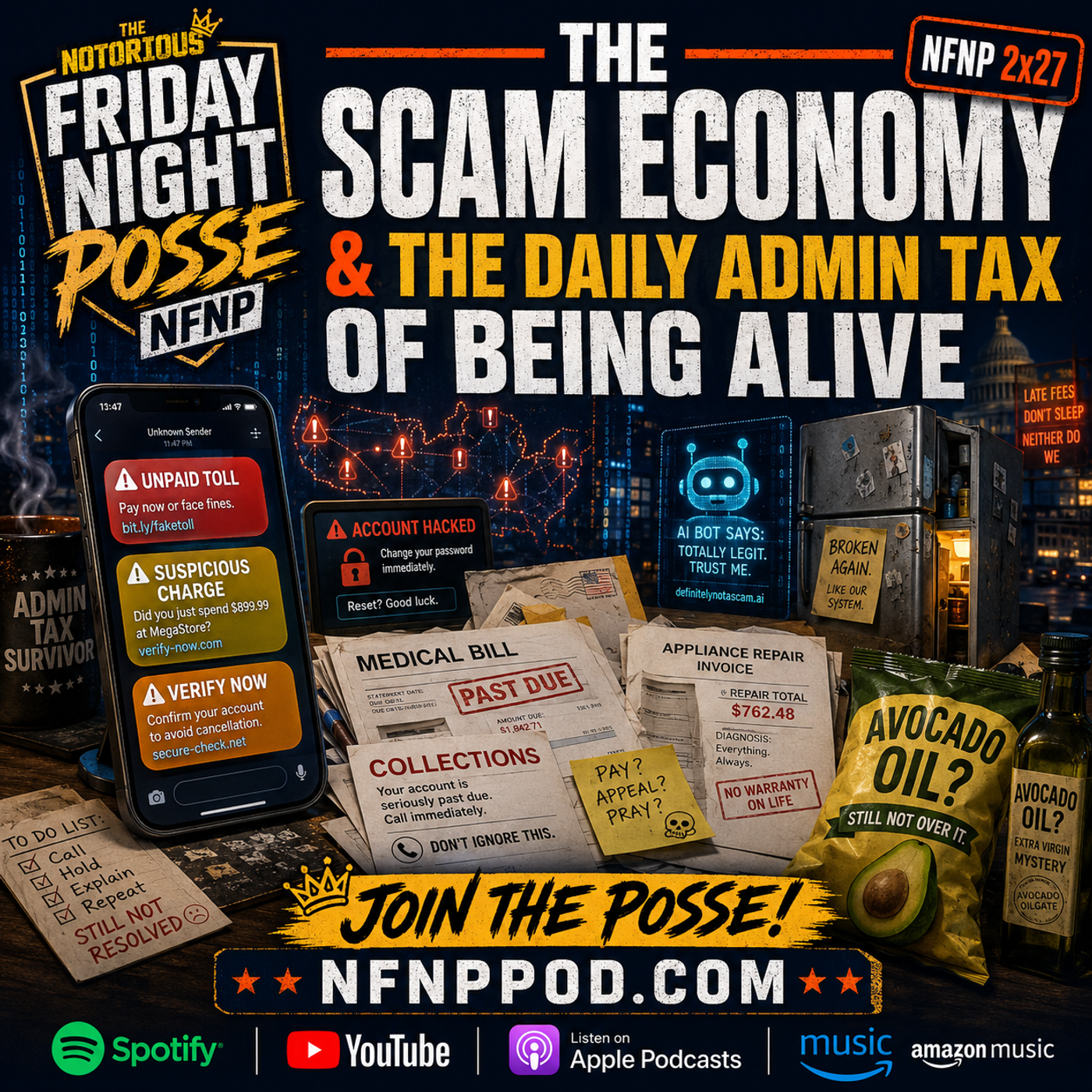
Bright and Duds are back for NFNP 2x27, and this week the question is simple:
Is everything a scam now?
After the success of the Mark Greaves housing episodes, the guys roll straight into another piece of modern American misery: the scam economy and the daily admin tax of being alive.
Fraud is not just stolen credit cards anymore. It is fake texts, fake toll notices, fake package alerts, fake fraud alerts, identity theft, hacked accounts, medical bills you cannot understand, collections calls you do not trust, insurance headaches, broken refrigerators, busted A/C units, school emails, kids’ activities, home repairs, and the constant feeling that you are one missed message away from financial chaos.
Bright brings the fraud numbers: billions lost to scams, identity fraud, account takeovers, phishing, crypto fraud and social media scams. Duds shares how his Gmail account got hacked, how a fake Walmart purchase almost went through, and why he now uses Proton Mail, password managers and email aliases like a man preparing for digital war.
Then the guys get into the real heart of the episode: how impossible it is to know what is real anymore.
Is that medical bill legit?
Is that collections call real?
Is that toll notice a scam?
Did insurance process the claim correctly?
Why does one doctor visit create four separate bills?
And why does every extension cord apparently need an app, a login, a password and your personal data?
The conversation moves from identity theft to medical debt, from collections agencies to healthcare billing, from A/C repair to refrigerator disaster, from ChatGPT helping with disputes to AI making scammers more dangerous.
Then Duds brings in the surprise perfect closer: Avocado Oilgate.
A UC Davis study found that many processed foods labeled as made with avocado oil may not be as pure as consumers think. Chips, mayo, salad dressings — all the expensive “better for you” stuff people buy to avoid seed oils — suddenly become another example of the scam economy.
Because apparently even when you pay extra to do the healthy thing, the system may still be laughing at you from behind a private equity spreadsheet.
It is fraud, spam, bills, collections, healthcare, AI, home repairs, avocado oil and the exhaustion of modern life.
In other words: everything is a scam, and your refrigerator is next.
Listen, follow and join the Posse: NFNPPOD.com
Bright: Okay, so this is our second podcast recording of the evening, and I feel flustered because the first one we recorded and the first time that you joined City S C posse episode tonight. And of course, I will post that episode on Wednesday and our episode will go live on Friday. So for any listeners, you can go back and and give that City S C posse episode a listen in advance of the the matchup Saturday night against San Francisco. Jose, but I'm flustered because Kev lost power. It put us way behind schedule. I'm leaving on vacation. So tonight was the night to record these podcasts, and it just was not off to the best start. And Duds, we were planning on on having you on CD SC Posse anyway, but you end up having to you ended up having to like officially co-host.
Duds: No. It's a lot of work tonight. I wasn't expecting all this.
Bright: I know. Me either. And and again I we I felt like we kinda had to to rush that episode a little bit and and didn't get into everything I wanted to talk about. But sometimes that's just the way it goes. And we'll roll into NFN Peapod now because I've got a whole thing here. I know you've got some stuff you wanted to talk about. Time is short, but â
Duds: And cram it all in.
Bright: I wanted to do it. Yeah yeah, I gotta cram it all in. We were coming off of a great episode last time out. Great two episodes. We split our conversation â with with Mr. Mark Greaves into two and our last episode that I posted, â Can You Can Anybody Afford a House Anymore? I think was the title. And it is now other than our special Rexham episode, our most viewed podcast episode ever. So a lot of momentum.
Duds: People must be interested in that topic. A lot of people probably don't think that they can afford a house.
Bright: I'm sure that they are. â there we don't think that they can I I that's a hundred percent true. And and even the topic I have today is a little bit about the economy and I've got some stats and and so I thought we'd kind of roll into that. And I think we're both dealing with things too that that's annoying and And I I'm curious for your take on our main topic. And our main topic is the scam economy and the daily admin tax of being alive. Do you under I d well we're we're gonna get into it, man. â what I what I mean is we'll talk about the scams, but just the constant
Duds: What do mean by that?
Bright: admin of everything that you have to deal with as a quote unquote head of household. And and I don't know how you and your wife do it and I mean school stuff, â emergency repairs, medical bills, standard finances, insurance, scam stuff that's coming through like
Duds: All the school stuff. It does make you wonder, I don't remember my parents having to deal with all this stuff. But maybe they did. There was no digital anything, right? It was nothing on a computer. So how did they do all this stuff?
Bright: Old school, you had to pay your bills, you had to write a check. I'm sure and â my mom did did most of that. They didn't. You you you mailed them a a report card. That was it. Otherwise you had to show up to like PTO meetings or you got you got the dreaded phone call, right? Or maybe Yeah, exactly. You know, now
Duds: How do the schools communicate with the families even? You know? Like we get emails every day. Otherwise you just assumed everything was going good.
Bright: Parents have their kids grades at their fingertips. Anything goes wrong, it's instantly a a text to the parents, â using a special app, an email, all kinds of different things. So yeah, as as a Of course. Yes.
Duds: It seems like we get emails every day from the school. If it's not the teachers, it's the principal or it's the secretary or somebody doing something.
Bright: And that is more or less what I want to talk about with regards to the daily admin admin tax of being alive. Emails from school, emails from extracurricular, emails from medical billing and insurance, emails from
Duds: I just ignore those. Just ignore those.
Bright: Unless you're actually dealing with something, right? And again, okay, I've got a whole flow here. So we gotta follow the flow, but I wanted to set the premise and the thesis of of what we're we're talking about. And I think something that goes into it. I know. Well part of the NFN part of the NFNP â
Duds: Terrible at going with the flow. Terrible. I love tangents.
Bright: flow, I guess, is the tangent itself. And the idea that the tangent that we go off into ends up being more interesting oftentimes than the actual main topic. And and it certainly happened with with Greaves in our last two episodes talking about Bitcoin and goldbacks and fake money and all kinds of things. So it was a pretty pretty interesting episode. Again, go check that out.
Duds: There you go. could just start talking about that too.
Bright: Nah, we'll have him back on. We'll have him back on. So, â wanted to talk about fraud and the idea that I with fraud is when you're getting all of these emails and bills in the mail and and managing all of this stuff, it gets hard to keep track of what's what.
Duds: Mm-hmm.
Bright: And I think that's that's more or less my my thesis for the episode is you can't keep track of what's what, and you don't know eventually you can't figure out what's fraud, what's not fraud, and people that fall into this fraud trap because of their daily household admin. And they're too busy. There's just too much going on.
Duds: So when you say fraud, you mean like fraudulent emails, like scammers trying to get you to click on links and stuff like that?
Bright: I that's part of it. Part of it? Absolutely. So let's get in let's get into the numbers. I'm just gonna read through â and then you just flag me down when something jumps out at ya. So, â consumer fraud losses. About sixteen billion dollars reported loss to fraud in twenty twenty five. So that's the fraud economy â in the United States right there. Sixteen billion.
Duds: Seems low. Really?
Bright: So here's the other thing. It is low because a lot of people don't report their fraud losses because they're either embarrassed or fraud like first of all. Yeah. Got scammed. Exactly. In in some fashion.
Duds: So this is consumer fraud, like personal, like got scam type of fraud. Yeah. Not defrauding the government and and that type of stuff.
Bright: I don't think so. I'll let me talk about some of this. So first off, sixteen billion, that's a lot of money. I understand your point that it seems low. And again, this that is under reported, but it is the highest amount on record ever. And it's up twenty-five percent versus twenty twenty-four. Yeah. So talk about a big jump. And I've got some hypotheses as to why that might be.
Duds: â wow.
Bright: But we'll get into that. Stay tuned. You'll have to l you gotta listen. You gotta listen to more than just the first five minutes of this episode if you wanna if you wanna hear my hypotheses. All right. Imposter scams, three and a half billion dollars. Business impersonators, one billion dollars. Government impersonators, just under one billion dollars.
Duds: Okay. Carry on. I think the key is don't trust anybody.
Bright: Well, and I think that's part of it, but if you can't trust anybody, how do you deal with the legitimate things?
Duds: Well, don't trust anybody you don't know, right? Like you have to get to know somebody before you can start to trust them. Don't just trust some random guy on the street. Some guy knocking on your door selling you something. Don't trust him.
Bright: Sure, I mean that works a guy knocking on your door. Right. That works if I get an email about â you know, Nigerian princess or whatever, right? It's like I don't know this person, like I'm not gonna send them money. But what happens if it's â my Illuminati email? Yes, â I do remember that, right? Like, okay.
Duds: Like my â my Illuminati email, do you remember that? The guy sent me an email to join the Illuminati. It was very prestigious. They're gonna give me million dollars and a a car and a house. It was pretty great.
Bright: Sure. And the text messages, all you know, but what happens when it looks legit? What happens when it's â an insurance thing or a medical billing thing or a school thing or an extra curricular thing? And you're like, â yeah, this this falls in line with what I've got going on. Let me just click this link. Let me just upload this blank voided check so that they ca yeah, I don't know. I k you know and of course, smart people you say never, but again, here
Duds: Never click the links.
Bright: And it's it's right here. I've got the numbers. This is what I have next. Report sure. â that's the thing. Smart people do get scammed, and it just gets worse with age. So losses by age group. So under twenty had sixty seven million dollars lost. Twenty to twenty nine.
Duds: Still happens. I know smart people they get scammed. They have no money.
Bright: $563 million lost. 30 to 39, 1.7 billion dollars lost. 40 to 49, 3 billion dollars lost. 50 to 59, 3.7 billion dollars lost. And 60 plus, 7.7 billion dollars lost. And and of course, I guess there's that joke, right, about grandma or whatever, right? This click of these links.
Duds: Well, I think a lot of that is yeah, they're they're more trusting and also the fact that they haven't been able to probably keep up with technology. They don't know if stuff is legitimate or not, you know. Even stuff that is legitimate sometimes doesn't look right, you know, and I question some of that.
Bright: Sure. Absolutely. Most of the time there is a little something. But again, if you're super busy and you're running around with the kids or taking care of of your ailing parents or whatever the case may be. Yeah. Yeah. Yeah. Crazy, crazy, crazy, right? â all right, what else do I have? So identity fraud. So
Duds: Just fill this out real quick. Put the credit card information in.
Bright: That that is one of the big ones. â thirty six million victims affected by identity fraud in twenty twenty five. So that was â let's see here. Ten point seven billion dollars in losses.
Duds: That's in the US, thirty-six million. That's like ten percent of the â population.
Bright: Yeah, this is all US these is all US numbers, I think. I know, right? So identity identity fraud and scams. Then there's account takeover. So I think that means like your bank account, right? Like they get they're getting control of your bank account. It's the costliest fraud type exceeding fifteen billion dollars in losses. And it's increased from five point one million in twenty twenty four to six million cases in twenty twenty five. That's an increase of eighteen percent in victims. Identity
Duds: So I tell you what I did. I got â I think I told you a couple years ago got hacked on my email, my Gmail. And it was really s it was a strange thing. Like we were going to my sister's house, I think I might have told you about this. And all of a sudden my email started getting flooded with hundreds and hundreds of emails. So I was getting like I I don't know what they call it, but it was getting slammed with they put it into a spam â bot or whatever and it started just from all these different websites.
Bright: Yeah, that's on here. Spam. Right, right.
Duds: And my email was typically pretty clean, like it didn't have I didn't sign up for a bunch of stuff. So I knew as soon as I started, like something had gone wrong. And I was going through some of the emails and I happened to find one from Walmart and it was a receipt. It looked like a receipt for a purchase. And I went to our Walmart account and I logged in. And sure enough, there it was like a Dyson vacuum cleaner, like a four hundred and fifty dollar vacuum cleaner.
Bright: Right.
Duds: That it said it was purchased. It hadn't shipped or anything, but it was purchased and it was pending. And I went in there, I canceled it, and I changed changed the email or whatever to a different email. And then I was like, you know what? I this email is compromised now, so I gotta set up another one. So I went and I got â Proton mail, which is like a different, supposedly better, you know. And they have a password manager that you can purchase.
Bright: Yeah. Right. Mm. Yep. Yep.
Duds: And then with that password manager, you can create email aliases. So now I'm very diligent about anytime I sign up for any website or anything, I go on there, create an alias, and I use the alias on the website. And that way, when I get emails from that website, I can see where it's coming from. And I can see, and if if that email gets compromised, it doesn't matter, because then I can just shut it off and it blocks all the emails to it.
Bright: You can track. Yeah. Right. Right.
Duds: So I highly recommend doing that for everybody. But I know it's it's kind of a big pain in the butt. But the password manager itself, I I was using the same password for almost every account, you know, because how else do you do it? If you don't have a password manager, there's just too many too many you gotta sign up for everything. It was ridiculous. I was telling my wife on a extension cord for our backyard for the lights. Had to download an app and make a username and and a login.
Bright: Well, so that's Sure. Yeah. It's imp it's gotta sign up for everything. It's impossible. Yeah.
Duds: for the for an extension cord is like every single thing you buy you have to create an account for it.
Bright: And it it's all because they want your information and then they want to sell that information and the problem is they can't protect your information so it ends up getting hacked and then the you know, the hackers have it and they s they sell it or that's out on the dark web or they match it up with other things and all of a sudden they've got your social security and that's all what it is. And I understand why companies want your information. I do. But
Duds: Right. So use the password manager, use the aliases. And I do like thirty character rand I don't even know my passwords anymore. I just have them do a thirty thirty character special characters, upper lowercase numbers. Well, yeah, because all you gotta do is is put it in. Now my my works good. You can go in, you can copy and paste it in, or you can have it your phone, you can usually just click on it and it'll it'll prepopulate it for you.
Bright: Sure, right, right. Right. And does it work every time though, or 'cause I use a password manager and sometimes it puts in the wrong password or it tells me I have the wrong password and I'm like, What the heck? All right. So plug your Yeah.
Duds: But that way you don't have to remember the passwords.
Bright: So plug yourself. Plug yours again, Proton.
Duds: Yes, the whole proton suite. I think it's Proton Mail, Proton Pass, â
Bright: All right. Now I mean the question is, and I'm gonna get into something else here in a minute, but that costs extra money, so people have to have the money and be willing to part with those funds over Right. Right.
Duds: Well, the email's free if you just want the email. The the password manag like the whole suite is only like a hundred and twenty bucks a year. So it's really not a lot. Ten bucks a month and you get the password manager and unlimited aliases, you know. To me it's worth it. And you get like the they have cloud storage and all that stuff that's included, calendar. I don't use that, but to
Bright: Not bad. Sure. Right. Yeah. Yep. Sure. Right. Right. Well Maybe maybe I'll need to look into it too, because the other thing is is when you are a victim of identity fraud or or account takeover or whatever the case may be, is the time, just like you were explaining when your email was hacked, is is to manage manage everything. So if you're an identity fraud victim, on average, average, it's taken about ten and a half hours to resolve your issues. But so whether you're on the phone or working through forms or whatever, whatever it is.
Duds: â yeah. Value your time at a hundred bucks an hour, you know.
Bright: Of course, and ten and a half hours, I guess, on the on the face of it doesn't seem like that much, but it's not like ten and a half hours straight. It's not like, â it's just one workday. You're dealing with half an hour here, forty five minutes there. That's probably chopped up over the course of two weeks, three weeks. You're just constantly dealing with this. And y you get h yeah, you get home from work and you're like, Well no, I gotta call my bank for an hour to try and figure this out. It's so it's it's in you can't of and it's inconvenient. You got your kids yelling in the background, whatever.
Duds: Stressful. Yeah. Who wants to do that?
Bright: may be. So it's annoying. And if you have an account takeover, if you're a victim of that, it's taking 17 hours to resolve that. And you've already lost a shit ton of money. So not only did you lose a bunch of money, now you're spending 17 hours trying to trying to fix everything.
Duds: We do have identity protection too, I think, through Geico. We've it's like eighty five bucks a year or something.
Bright: Yeah, I do I do a small Yeah, I do a small one through my bank. I think it's even I think it's even less than that. It's probably like fifty to sixty bucks a year. Yeah, my subscriber's license. Yeah. Yeah. Well I haven't necessarily had like I haven't had my identity stolen per se, but I did notice a credit inquiry that was not mine at Bass Pro Shop.
Duds: And they track your social security number and I think you I got driver's license and stuff like that. And they have all that stuff in there and they could track it on the dark web and see. â yeah.
Bright: They they tried to sign up for a credit card on Bass Pro and I was checking my credit report and I was like, nah, th this isn't mine. Yeah, yeah. Yeah. So it ended up â it ended up working out relatively easily. I had to get a hold of Bass Pro and and have logged a complaint. They again they just took my word for it. They're like, â that wasn't you? I'm like, No. And they're like, Okay. And I think I used Chat GPT to help me. Yeah, so I I knew what to tell â
Duds: Yeah, I think you said I think you mentioned that. Yeah. There's a surprise.
Bright: I know. No no surprise there, of course. But I also was like, You need to send a letter into the credit bureaus letting them know that I didn't do all this. They closed the account. Nothing had been purchased on the account, but guess what? I still get Bass Pro â things in the mail. I get the catalogue every quarter or whatever. So now I'm in their system and it took a woman. â
Duds: We just went to Bassbro, â down in Springfield last weekend. â it's awesome.
Bright: It's a great store. I love it. Yeah, sure. And we have one pretty pretty close now, which is great. But but I don't know. I still had to deal with it. It took it took like two or three months to come off of my credit report, right? So so again, that's just a a pain in the butt. So and you do. And and they basically were like, Your your social security number is out there. Somebody got it, because they weren't able to apply for this credit card without it.
Duds: You feel violated too, you know.
Bright: And I'm like, well of course it is. All of our social security numbers are out there. Somebody has them. They're on the they're on the dark web.
Duds: â yeah. All my info's out there. If you want it, you can go get it.
Bright: All right. Here's some other Yeah, if you want it, go find it. More power to you, right? â some other crime types in order. I won't necessarily go down the number of complaints, but these are in order from highest to lowest. Fishing is the number one fraud. Complaint extortion number two, investment fraud, three, personal data breach, four, non-payment, non-delivery, five, tech or customer support scams, six, government impersonation, seven, identity theft, eight, business email being compromised, nine, or employment scams, ten. So those are your top ten internet crime categories.
Duds: I know crypto was big in there for a while.
Bright: So here it is, right here. That was the next thing I had. Crypto angle. Cryptocurrency related complaints. 181,000 and 11, almost 11.5 billion dollars in crypto-related losses last year. Complaints increased 21%, 2024 to 2025. that was complaints. Losses increased 22%. Crypto investment fraud alone had almost 62,000 complaints and $7.2 billion in losses. And then you also have crypto ATM and kiosk fraud, which has been on the news recently. I I haven't done a deep dive onto why that is, but if you ever gone into a mall, which I know is rare to be in a mall, but you're in one and you see these Bitcoin kiosks. Have you seen those? And it's crazy, like they're still selling Bitcoin at the kiosk for like a hundred thousand dollars.
Duds: Mm-hmm. No, no. Like â I don't think so.
Bright: Yeah, I I'm like it's it's trading for sixty-five right now, so I'm not sure what you're doing here.
Duds: Paying a little premium here. Speaking of Bitcoin and f I guess it's not really fraud, but it's did did you see the â issue with the cold card? The hardware.
Bright: Ma I don't th I don't think that I did. I maybe I think we did actually talk about this, maybe or we texted about it, but
Duds: â did I s I don't think so. So the you know what the cold card is? It's like a hardware wallet. And â I think that there was like eighteen thousand bitcoin. So that's like one point two billion dollars worth of of Bitcoin that was hacked because because this hardware wallet had a the the random number generator in it. Did we? Yeah, it was it was faulty.
Bright: Yeah, for right. Yes. That was compromised, right. Yes, we talked about this. Yeah, yeah. Some or I â I did with somebody. Yeah. They weren't they weren't doing the full encryption like they said they were gonna do.
Duds: Right, instead of two hundred and fifty six bit, it was actually only about forty bits. So yeah, maybe I did â post something about that. Much easier.
Bright: Yes. So it was eas easier to hack. Yes. So somebody somebody came in, hacked it, so somebody's a victim of that fraud, right? That money, those Bitcoin are gone, right? There's no there's no getting â back. No. Well, I don't know that anybody's I don't know that anybody's trusting that company anymore.
Duds: They're gone. No. It's hard to it's hard to get it back. If you have the keys if you have the keys you hold the coin, so I wouldn't think so. I mean I certainly wouldn't go out. I scary part is I almost went and bought one of those. So I'm very thankful that I didn't. But I don't think all of their hardware was bad. I think it was â kind of like isolated to an older or s one of the cheaper ones that they had, but still I'm even if I had â a current one, like a one that wasn't affected, I'd still maybe be migrating over to something else. So
Bright: Sure. Yeah. Sure. Right. If you were ones that were affected, I'd be Getting rid of it. I wonder if any of if they had any of that insured or how that works, if you were the victim of it like
Duds: I think they're just kind of like, Oops, sorry.
Bright: Well, they're I'm they'd have to be open to lawsuits or something, but
Duds: Well that and just going out of business 'cause who's gonna buy that anymore? Like your whole business model is based off of securing this stuff and you didn't do a very good job.
Bright: Sure, sure. Well, it's it's like Taco Bell right now, right? Like who's going to Taco Bell? I don't I don't get it. Like that's still it's crazy.
Duds: Still full. Driveways still lying out the out the street. People wouldn't talk about.
Bright: Yep. I don't know. I guess eventually time heals all wounds, but that one's that one's gotta hurt. â okay, a couple of other things. So key stats on phishing, spoofing, fake techs. â tech scam losses hit four hundred and seventy million dollars in twenty twenty four, and that's five times what it was in twenty twenty. So you know what a tech scam is? That would be like a fake package delivery. Right. That's they send you the link that says like, â your Amazon delivery is is delayed. Click this link to reschedule. And and nope. You're like, â I'm expecting an Amazon delivery. Of course you are. Everybody is. Right. Exactly. â phony job opportunities, right? Like, here's a work from home. Pays three hundred thousand dollars a year. Just click this link to apply. No.
Duds: â you're not supposed to collect those? Who isn't? You get one every day. Yeah.
Bright: Not good. Fake fraud alerts. Exactly. This is a big one now. And I've gotten these. Bogus unpaid toll notices. Have you seen these? Like, â you owe fifty dollars in tolls, click this link now to pay it before we send it to collections and your credit will be hurt. You're like Yeah. I know that none of that affects your credit. No. No. Exactly. So I'll tell this story. One time I was in Chicago and I ended up
Duds: It sounds too good to be true. You should click the link and see. â yeah. I have not. See, I just say I know that none of that affects your credit, so I would never even click that.
Bright: getting a bunch of tolls. And you it's not like the old days where you stop and you drop in a couple of quarters, right? Now you just breeze through it. It's well, it's a lot more expensive and you have to pay b online. So after my trip I went online and I had a couple of tolls and I then I paid â Well, I guess they all didn't hit.
Duds: It's like twelve dollars.
Bright: So I I never went back to double check. So I still had like half the tolls were outstanding. And eventually they sent me a thing in the mail that said, Hey, you you're late on these tolls. Now you owe fifty bucks. And I was like, screw that. I'm not paying that. Then that right. It was it was hard mail. But even still it goes back to like, how do you know if it's real or not? Then I got another thing who's like, now you owe three hundred dollars. Three hundred dollars for th
Duds: Delete. Yeah.
Bright: Three dollars in tolls, twelve dollars in tolls? No way. I know, right? Well then I got I think I got one more that was like last one, six hundred dollars in tolls, pay it or you're going to collections and I was like, Send it to collections. Like I'm not paying six hundred dollars to use a highway that saved me a five minute commute. It's not happening.
Duds: I wasn't gonna pay fifty. You know, here's the here's the easy way to avoid collections too. Everybody has a cell phone. If you get a call from somebody and you don't have that number programmed in your phone, don't answer it. It's very easy to avoid collections.
Bright: Don't answer it. Yeah. Right. Right. A hundred a hundred percent. And they they will send mail, but write the recyc right in the recycling bin.
Duds: It's easy to throw that in the trash.
Bright: So I did get a call from collections recently. I'll tell this story, although this could be bad news if it gets back to Well, it was it was like a local number and so I did answer it and I guess it was for like a forty dollar unpaid medical bill of which is what I wanted to get into. Where we just missed it or didn't know like, I don't know.
Duds: You answered? â
Bright: And and I do have some stats on that, so I wanna get into it. And so it's probably legit, but I I I guess it went unpaid and went to collections and they were calling me asking for my wife. And I was like, Who is this? They they would not say who it was. And they're like â eventually they did, but they were like, Well, who is this? I'm like, You called me right? And
Duds: Don't they have to identify themselves? I would have hung up. There's no way I would have stayed on the phone.
Bright: R right, right. They're like, Well we're we're looking we're looking for and again they said my wife's names. I was like, Okay, you still haven't told me who you are and eventually they they told me like we're US c collection agency Delaware. I don't know, whatever. I don't know. And click Yeah, I'm like done not answering that.
Duds: â click. And block.
Bright: Right. Click and block. So but but yeah, it it's it's it's hard to keep track and and what, one bill slipped through the cracks and now I have c collection agency calling me.
Duds: So you know the other thing is I think you can â actually if you look it up chat GPT or whatever you want to do on how to fight collections, all you have to do is ask for I think you have to do it in writing, but if you send them because if they are sending you mail, you can respond back to them and you can request like information on the what they're trying to collect on. And those guys don't have any of that. So and if they can't well they can't provide it because they don't have it.
Bright: Sure. Right. And they never do it. Right.
Duds: Because when they get that stuff, they pay pennies on the dollar for it. So and none of the backup information, like the actual bills and stuff from from the hospitals or wherever is coming from, then they don't send that stuff to those guys. They just say, Hey, we've got a bunch of bad debt. You wanna buy it and try to collect it? They do it and they pay very little for it, but they don't have any information other than like probably your name and the amount. So if you request that information from them and they can't provide it, you don't have to pay it.
Bright: Yeah. Sure. Right. Right. Yeah. Yeah. And the the And the threat always is is that it's gonna hit your credit report, right? Well and and at what point does it actually hit like I I highly doubt a forty dollar copay, missed copay, is hitting my credit report, right? N no, no. So my mom likes to tell the story.
Duds: You should never pay collections agencies. None of that is your credit report. The only thing that wor and matters on your credit report is your your car loans, your your mortgage, and your credit cards. â 'cause the rest of it, like medical bills, all those other bills, none of that shows up.
Bright: Yeah. Your debt your debt. Yeah. Right. Right, right. My yeah, my mom likes to tell this story and
Duds: But this is not â this is not advice for anybody to take, by the way.
Bright: Just don't pay your bills. That's easy. Prob problem solved. So Yeah. Shout out to my mom who doesn't like to listen to this podcast, but
Duds: Yeah, just you can't I'm not advising anybody not to pay their bills. They should do that. If they're legitimate, you should pay â
Bright: She likes to tell the story of when I was younger and I was seeing this specialist. I was like young, like 12 years old, right? And I was seeing the specialist doctor and we went in for my last appointment and I got discharged, right? You're all cured, all good. And we went in, we saw the nurse, signed a document, and left. And then they sent my mom a bill for like a hundred dollars. And my mom was like, I'm not paying this. We didn't even see the doctor. Like we came into the office to sign discharge paperwork. You are not charging me for that. That was it. She loves telling this story. Yeah, that when and again, this is thirty years ago. And so â whatever the dollar amount was, she uses a hundred dollars in the story. I don't I don't know what it was. And sure. Exactly. And and we were a one income household. â yeah, I'm not even gonna get into all of the history, but
Duds: That was it. And they tried to charge for that. Well, that was like a thousand dollars thirty years ago. Not gonna do it.
Bright: The Not gonna do it. That's what she said. And if they're like, well, we'll send you to collections. Well, my mom used to work for a collection agency. It's actually where she met my dad, I think. And â they did not look too kindly they did not look too kindly on the the co-mingling stuff at the time. So my dad got canned.
Duds: She's trying to serve him a collections paper.
Bright: And and then they kept my mom, but my mom's like, I used to work for a collection agency. She knew, she was like, Go ahead, do your worst. I'm not paying this bill. We didn't even see the effing doctor. So
Duds: She knows how it works. So I do think that collections agencies used to be much more of a pain back when you had landlines. Like I said, now that you have they would just never stop calling. And that was your main means of communication between everywhere. But now that you can right. But now that you can block numbers on your phone, it's so easy. Like, okay, that's not very inconvenient. Just not a problem anymore. It's probably really hard for collections agencies to get people to pay â
Bright: Sure. 'Cause they would just never stop calling. And you might not have even had caller ID. Right. Yeah. No. Yeah. It probably is. And maybe they're paying even less to own that debt. I you know, I don't know how the back end works. But I think the majority of collections, and I know I have some stats in in my notes somewhere, is medical. That is the majority of collections. And especially that all of the bread. Well, a hundred percent. And then and then the other fact that you can't keep track of what your medical bills even are. â I know. You
Duds: â yeah. Well, it makes sense since it's all overpressed. â I know. It's terrible.
Bright: You go and I know I have this later on, but I'll say it right now. You it is there. It it is the system. It is the system and they are trying to screw you, I really think. And you go to the doctor for one issue and then you end up getting like three bills. You get a bill from the doctor, you get a bill from the the insurance company, and you get a bill from the service provider, from the hospital or whatever, or the the doctor's office. So you're you're getting three
Duds: That's their fault though. They're not open and honest about that. And you don't know what it â even of it means. It's just a bunch of gibberish.
Bright: No. And I know I've told this story before about my son that was that had ear tubes. He ended his ear tubes out. And they they did an estimation with my insurance company, and they said it'll cost $600. So I said, all right, I will prepay the $600. And then I got two additional bills after I prepaid, one of which was $2,400, and then the other one was like $600. And that was from the doctor, and the $2,400. Was from the hospital. And I said, What's this? You said it was gonna cost me six hundred dollars, and in good faith I paid that in advance. And now I have two other bills. And so I said, I said, fine, I'll pay it. Put me on a payment plan. So I pay like $70 every month now until I die.
Duds: Mm-hmm. Yeah, I don't think so. We did that with â with my son's ependectomy. I think we ended up i there were still bills that say they're pending. It was last like November. And I and I log into BJC and it says, â this one bill is still pending. I don't think it's ever gonna actually hit because I think we reached like our out of pocket max or whatever when when that happened. But Right. No.
Bright: Sure. Right. Okay. Yeah. A big surgery like that. That did not happen with an ear tube removal. Yeah, sure. Yeah. Yeah.
Duds: But like the hospital charges you, the anesthesiologist charges, the doctors charge you, all the different stuff. So finally I was like, I'm not gonna start paying anything until all the the bills come in and I can see the whole amount.
Bright: Yeah, you just w wait. And that's what I tell my wife all the time. I was like, just wait, see if it clears insurance. Like once it hits the hundred and twenty days, then we'll pay it. Yeah. Right. Right.
Duds: Just wait. Yeah, they send you bills. Right. Yeah. Yeah. Once they say final notice, like, okay, I guess. Then I'll log in and now I'll do a payment plan for three years and it'll be fifty, sixty bucks a month. I think we're paying a I think we're paying a hundred bucks a month for twenty four months or something. But they're c they're fine with that. They're gonna get their money.
Bright: Yeah. Yep. A hundred percent. Yeah. Aye. Yep, eventually. All right, a couple of other stats here. â forty percent of people who lost money lost it in a social media scam or said it started with social media. So whether and and I think I have it somewhere else too, but it's primarily Facebook, WhatsApp, and Instagram. Those are the three biggest offenders, and it's all that's all meta. Whi which is interesting. So it's not like X. I'm sure X is on the list somewhere. â I don't know.
Duds: â yeah. That is weird. I wonder why.
Bright: That's all all three of those companies are owned by Meta, Facebook, right? Mark Zuckerberg. So something is is going on there.
Duds: I don't use any of them. We've been off of Facebook for man, it's gotta be fourteen or fifteen years, I think.
Bright: Right, right. It's crazy. And okay, so that number is up eight times from what it was in twenty twenty. So more people more but that's a lot a lot more people are being affected by social media â scams, which is crazy. All right, here's here's
Duds: Wow, that's insane. People tell me that they are on Facebook and I'm like, Really? Why? I don't even understand it. Other than the Facebook marketplace like the marketplace, I think.
Bright: I am on Facebook. I never do Facebook marketplace and I wonder if that's where some of this comes into play. I do have a Facebook account, â primarily for posting pictures, and and in some way it's for me to post my own pictures. And I get the memories. I do like that. It stores my photos. I read other people's stuff. But I was joking about it with my wife last night. I was scrolling through Facebook before I go to bed and my wife's like, Who's that? And it was some like hot chick. And I'm like, No idea. Right? Like, it's just fate
Duds: â probably. But is a picture you had of?
Bright: No, Facebook is just sending me a picture of like a hot chick because it thinks that I'm gonna click on it or wants me to follow them or it notices that my scroll stops for a half of a second longer. I never click them, but maybe I stop and admire and be like, All right, nice photo, and then I keep going. So it it well my wife caught me. But as I start as I started to look through, I realized that I'm not seeing
Duds: â These are the the pictures you usually click. I keep going, I keep going, I just pass it right up.
Bright: any of my real friends on it's just constant stuff that that Facebook thinks I like. Yes
Duds: That's what we got rid of it was actually when that â the feed came out. That was like twenty eleven, twenty twenty twelve, something like that. Which X is the same way. X has the feed too, but you know what you're getting into with X, like that's the whole point of it, like to see all that stuff. But with Facebook, the reason we had it, like the reason I signed up for it originally, was well, we had a MySpace account, you know. Which is did you hear that they're coming back?
Bright: Yeah, yeah, yeah. It it's never ending. It's because I just want you to keep scrolling, right? It's not like the wall. Sure. Yeah. Right, right. So I'm I was just gonna say that. Mindspace is coming up back as the anti algorithm social media.
Duds: Yeah. Yeah, so actual like networking again, which is kind of like what LinkedIn was supposed to be, but they never really panned out, I don't think.
Bright: I could I kinda like what LinkedIn LinkedIn Nobody use it. Like I sometimes I feel like you have to use LinkedIn to
Duds: I get on there every like once every couple of months and I'll usually have like no.
Bright: Nobody wants to use LinkedIn. Nobody is like, I'm gonna start my day by doing a LinkedIn scroll. No. That's â you think they're on the toilet looking at LinkedIn? No chance. It ain't it's not a thing. â
Duds: I don't even have the app. No. Although when I do get on there, I do see some interesting stuff. Like some of the 'cause I'm got like construction, you know, bunch of people in construction I know and a bunch of friends and gets posted on there. So I do see stuff that I like that I think is interesting. I just don't get on there and look at it.
Bright: Right. Yeah. Yeah. Yeah. Who knows? Who knows? All right. Now I've got the medical billing, so it was next. I knew I was close. All right. Forty one percent of adults reported having debt due to medical or dental bills. Forty one percent. Half of the US adults said they couldn't. A hundred percent, yeah. Half of that U â yes, yes we are.
Duds: I mean, if we're both paying it, we have debt in it too. Yeah, we're part of that percentage.
Bright: Half of US adults said that they could not pay an unexpected five hundred dollar medical bill in full.
Duds: See, I heard I thought we were talking about it, but I was I heard eighty percent of the United States couldn't afford a four hundred dollar â like emergency fee without having to put it like on a credit card or something, you know? An out of pocket expense. They couldn't afford a four hundred dollar out of pocket expense.
Bright: Yeah. I've I the number changes Yes. But it's all cre I think I've heard that that like Yeah. That like seventy percent of America doesn't have more than a thousand dollars in their savings account. Like we I think we talked about it even with Greaves. So right. So that number is not necessarily surprising that if you got a five hundred dollar medical bill, you couldn't afford to pay it out of pocket. You gotta put it on a payment plate. I mean, five hundred dollars, that's that's not all that much. â I d I just told you f my â by today's standards a hundred percent. And I just told everybody
Duds: It's like a dinner that you go to. Not a not a dinner I go to, but but a dinner that Bright might go to.
Bright: â that I do. Yeah, for sure. For sure. And I just told everybody how much an ear tube removal costs. So and th that's the thing, most of the time they fall out on their own. Not in my son's case. So that was just money down the tubes.
Duds: My wife had back surgery a few years ago and that was like sixty five thousand dollars that they were trying to you only had we only had to hit the out of pocket max for the year, which was like seventy five hundred or something, but still it was a crazy amount. It's like, Well, why even try to charge that?
Bright: Ridiculous. Ridiculous. Right. Right. Well, n I think that's the whole thing about the system is y th they're charging these crazy amounts for that and then they're taking money here and they know that people aren't gonna pay. I I don't underst I don't understand it all. It's all fake. It's all it's all fake. Yeah. Did you ever see that video or maybe we talked about it where somebody it's it's on like TikTok or whatever and it's it's this gal saying, Imagine
Duds: It's all fake.
Bright: that you have Netflix, right? And you pay fifteen dollars every month for Netflix. And then you go to watch a show. But after you watch the show, you get an a separate bill from Netflix that says, Yo, you owe us five dollars because that show that you picked after you watched it was was out of network, right? Outside of your plan, right? So now you owe twenty dollars. And then you get another bill from the actor
Duds: Outside of your plan. From the actors. Yeah.
Bright: Yes. 'Cause that actor was also so now you owe twenty five dollars every month.
Duds: â and the sound crew, they were out of network too. That's a different crew.
Bright: That is the American health system in a nutshell, right? And and when you when you put it on Netflix, y you're like that yeah, that makes zero sense. Sixty four percent of insured insured adults say they are worried about affording healthcare costs.
Duds: Yeah. It is messed up. Yeah, I can imagine.
Bright: People in the US owe at least two hundred and twenty billion dollars in medical debt. Fourteen million twenty billion two hundred and twenty billion. Yes. That's why you'll never that's why you'll never see the system change. And we talked about it with Greaves, that America's not built on money, it's built on debt. They want the debt. That's how they make more money. It's all a scam.
Duds: Two hundred and twenty billion. In medical debt. That's insane. Just seems unsustainable.
Bright: It is unsustainable. Fourteen million adults owe over one thousand dollars in medical debt. Three million adults owe more than ten thousand dollars in medical debt. Medical bills come from doctors, hospitals, parent companies, and groups representing a provider. So there's four sources of a bill for one visit. That's where it gets that's where it gets Confusing. Total build amounts can become unrecognizable. And the time needed, and that's kinda again my overall point, the time needed to separate legitimate charges from inaccurate ones becomes unmanageable for the quote unquote head of household. Right?
Duds: Yeah. I have a rule that I don't get any of that like electronically. If they don't send me a bill in the mail, I don't pay it. It's like nope, I want a actual I want you to send me a bill.
Bright: Right, sure. Yeah. Well, and I won't get into all of the stats here, but they talk a lot about here in my notes, about people on Medicaid and Medicare and a lot of inaccurate billing. Like it's it's is coded and yes, and and so they don't people don't want to pay it. And then they can't make heads or tails out of of what's legit and what's not legit. And so you either don't pay it at all or you end up overpaying.
Duds: A hundred percent.
Bright: Because you're just like, F it. It's it's too much work for me to try and figure this out.
Duds: Well, didn't I mention that too? â I might have mentioned it on the cast last time, that we got a bill that they didn't even use our correct insurance. And it was 'cause we have United Healthcare and they booked it to like United Healthcare Oklahoma. So so the bill was like five hundred dollars or three hundred and fifty dollars or something like for for like a doctor's visit. It's like that seems really high. And then she was looking at it, she's like, Well, that's not even our our insurance company.
Bright: â huh, yeah, yeah, yeah. â huh.
Duds: She called them up and they're like, â yeah, we ran that and it got denied. It was like, Well, you didn't even run the right insurance. It's like why didn't you rerun it to the correct insurance? And then it did it and it was like seventy five bucks. And we could have just paid it. If we didn't notice it.
Bright: Yeah. And that's not to say that Right, of course. And that's not to say that there won't be some human error. Right? Like that I guess that's bound to happen. But again, it's it's when it all comes together and you're dealing with fake text messages, fake mailers, phone calls. You c you can't tell what's collection agency, what's a legit medical bill. Plus you're dealing with emails from your kids' schools, soccer practices, dance lessons, Boy Scouts.
Duds: You wonder why anxiety is so high.
Bright: Yeah. Well and and so again, your air conditioning just went out. And I know that's a pain and you you you're dealing with it. And you had to it's just an out of pocket cost, right? Sucks. But you gotta you gotta find a guy and a guy that's gonna come out and deal with it on the weekend and you gotta pay a surcharge b you know, because of all that. My refrigerator just went out. Of course I was there you go.
Duds: Yep. It's eighty five degrees in the house and eighty five percent humidity. Shout out to Anton Heating and Cooling. Cause actually, you know what it costs? â a normal service call is a hundred bucks during the week. On a weekend, he came on on Sunday morning at eight A. â It was a hundred and twenty five dollars. It was twenty five dollars. I was like, â yeah, I'm not gonna wait another day. I'll pay that.
Bright: Yeah. Yeah. Yeah. â yeah. Yep. But it was also the capacitor. We you and me could have changed that for probably about twenty five bucks total. I don't think â so. A hundred percent. I've nope. Not if not if you use our our buddies to get you the capacitor. And supposedly they're available now â he was saying like on lows and stuff like that. The capacitor is super easy to change. I've done it twice now. â huh. Yep.
Duds: I don't think so. I think they're gonna cost more than that. Have you? Well why didn't you come over and do it?
Bright: Well, I it was too late. It was already done. â no, that's the thing, you need the AC. Well, so now my refrigerators. You have to be able to diagnose it first, right? And so I think s I think sometimes you just like I talking to talking to Nilla, you just try the capacitor first thing because it's literally a plug and play.
Duds: We needed the AC. We weren't even sure what the problem actually was. Is it?
Bright: Like it's it's that simple, right? You have to discharge the capacitor so you don't get electrocuted. But other than that, it's literally just take that one out, put the other one in, tighten up a couple of screws, and you're good to go. And ninety ninety percent of the time that's what it is, 'cause capacitors are junk. They last a couple of years. And I I guess it depends on the age of your unit and everything, but and of course they tend to go out in extreme heat.
Duds: Damn it, now that pisses me off. Mm-hmm.
Bright: 'Cause they're working overtime. I mean a capacitor is a battery, is essentially what it is. So Yeah, yeah. And then the the issue that that people run into is they don't discharge it 'cause it still holds a charge even when it's dead and then you know, they zap themselves. I don't know if it's enough to kill ya, but I it I'm sure it wouldn't feel good. Maybe it's enough to kill ya.
Duds: Sort of, yeah. Then they die. I'm gonna look that up. Are you sure they're only twenty five bucks?
Bright: Well, if you get it for cost, it's way less than that. It's like thirteen dollars cost probably.
Duds: â well now you're really pissing me off.
Bright: Sorry. Well, so let me tell you about the refrigerator, right? So I'm dealing with the refrigerator. I'm out of town. Wife calls. It goes out. We have to move everything out. Now, we're a spoiled family. We've got three refrigerators and a deep freezer in total. But my beer fridge is gone. It's full of stuff. So we got half the food in the garage fridge, half the food in the basement fridge. We moved as much as we could to the The deep freezer. That my fridge, it's like we inherited it when we bought the house. It's like this built-in to your cabinet fridge. Last time we had an issue was probably right around COVID, 2021 or something. A couple hundred bucks to get it fixed. I looked it up then. It cost twelve thousand five hundred dollars to r to get a new one. It's probably more like fifteen thousand now. Now now I'm not saying that we need to get that one, but I had to have a special GE guy come out and look at it and actually he's coming tomorrow. â i i dealing with warranties, s it's just too much. And then I just had the siding replaced on the house, right? I'm dealing with insurance on that. It's it's just non stop. I'm like, how does anybody stay organized with it all? Not to me I told ya.
Duds: Damn you're right, they are that cheap. Got got ripped off.
Bright: Well, we know what to do if we ever lose our jobs. We become AC maintenance men that just do standard maintenance and capacitor changes. That's right. That's all you gotta do. And you'll make a bunch of money, especially if you're willing to work weekends and nights and â stuff like that. So â but anyway, yeah, when you throw in all of the stuff that you have to deal with, along with taking kids to soccer practice, y
Duds: All we fix is capacitors.
Bright: vacuuming the the living room, right? Cutting the lawn. I'm going on vacation. I just came back from a business trip and I understand I'm going on vacation. That's a luxury, right? But you know now I gotta get out there. I gotta cut the lawn. I gotta cut my parents' lawn. I gotta yeah there's all these things. I'm like, who has time to do any of this? And yet, I guess we still have time to podcast, but it's taxing. It's taxing. It's taxing mentally. And my my overall thought process and we'll end with this as far as this segment goes.
Duds: This was one of those ad mid costs, you know. It's a lot.
Bright: Is is AI making it better or worse?
Duds: Hmm. I don't know.
Bright: So like the idea I'm thinking is is like, okay, I get these insurance bills or I get I get a quote from a company. I can run all that through AI and it'll help me sort. It'll help it'll tell you what is a good price and what's not a good price, or if you could fix it yourself, or keep you organized, right? So like that is good. But now there's two issues. One, I've got so much stuff going on with AI, I can't keep track of my AI chats. So that's personal problem.
Duds: Mm-hmm.
Bright: â two, the scammers are using AI. Right? They're making the fake websites, they're making their logos look better, they're making their emails sound better. Th the Nigerian princes are using perfect grammar.
Duds: That's true. They don't even sound Nigerian anymore.
Bright: Yes. Right. So it's â Yes, that's true. Now they just â they've just advanced the Illuminati. They've gone from the Nigerian prince, excuse my grammar, to the Illuminati with perfect, perfect old English grammar even.
Duds: And then on top of that you have avocado oil gate.
Bright: Yeah, so I w I know you wanted to talk about this. And so let's talk before I got a local in the loot story, but we can come back to that. â I I had to I had to look this up, but I'll let this is your segment. So you tell me about avocado oil gate.
Duds: So I guess this was Sunday night, Monday, I saw on X that the there was a UC Davis study that had just gotten published. Have you did you look into this at all? And it's kind of blowing up all over that all of these so avocado oil is supposed to be a better alternative, healthier alternative to any type of a seed oil like canola oil or safflower oil.
Bright: I did. H healthier alternative, yes.
Duds: Crap. So a lot of these companies are marketing their products with avocado oil, you know, and they're charging a premium for â We get â like Primal Kitchen and Chosen Foods, â Boulder Canyon chips. Those are like the three ones we get that are made with avocado oil and supposed to be healthier for you. And they charge like for a jar of mayonnaise, you know, seventeen dollars or something, as opposed to
Bright: Right. Mm-hmm. Yeah. Yeah. Mayonnaise is expensive to begin with. Yeah. Right, right.
Duds: Yeah, seven or eight dollars, right? So you're paying more than double the price. And this story comes out that this study says that they tested, I don't know, fifty or more of these products and like forty eight of them failed and were Yeah. And yeah. And they were maybe not completely without avocado â avocado oil, but they were
Bright: Forty eight of fifty four. Yeah. Eighty nine percent. Yeah.
Duds: Diluted or mixed or something. It's a big fraudulent scam.
Bright: Yes. Yeah. So it's a scam. And i it it actually fits back in really well with our with our fraud topic and our scam topic. And this is part of the scam economy. They just say it's this. People pay more for it and it's bullshit.
Duds: Yeah. And the problem is I look I looked this up. So Chosen Foods, original owner, twenty eleven. They were â bought out in twenty seventeen by where was it? â C Sesagel Majority. So like a private equity firm and then Butterfly Equity. â yeah. Primal Kitchen was bought by Kraft Heinz in twenty eighteen, twenty nineteen, and Boulder Canyon was bought by Uts Chips back in twenty seventeen.
Bright: Mm-hmm. They're cutting costs. So they're trying to s is that's what you're saying, right? Right. Mm-hmm. Yeah. So these big these big companies that they'll they'll buy up these smaller companies and then they cut costs. How can we do it? And and they're lying. They're lying to their consumers.
Duds: They're not changing the way they market or anything. They're just changing the recipe. And the thing is, if you look at it, it says on on some of these a hundred percent avocado oil. So it's not saying that it's, you know, s avocado oil. And then if you look at the ingredients, it has other oils in it. It's saying it's a hundred percent avocado oil. So they're straight up lying. So I don't know how they're gonna get away with this. Like the FTC is supposed to protect consumers. That's the entire reason.
Bright: Bastards. Right. I mean somebody somebody will have to sue and even if they do sue then, you know, they'll they don't care. Right. No. They're big enough. They'll hire a lawyer like yeah, exactly. Yeah. Yeah. They make a b they make a billion dollars on the sale and then they get fined by the government for a million dollars and they're like â here you go, government. Here's your million dollars. Yeah, yeah, yeah, yeah, yeah. So I've got the
Duds: Well the problem is they don't care. Like these companies don't care. They'll just okay, we'll we'll settle. We'll pay a couple of million dollars, even if it's a hundred million dollars, and they're gonna keep selling the same stuff and they're not gonna change anything. Right. Yeah. People need to go to jail. That's what needs to happen. CEO. Take the CEO and put him in prison.
Bright: I've got the breakdown for you here. Chips, 93% failed the purity testing. Mayonnaise, 71% failed. Salad dressings, 100% fail rate. So don't buy any avocado oil-based salad dressings. That's a you have no chance of getting a real salad dressing that's made with avocado oil.
Duds: It's amazing. I was getting so pissed off about it. I it couldn't let it go either. It's like because you try to do the right thing, you try to be healthy, you try to depend on, hey, I'm gonna go and I'm gonna pay more for these products because they have to be better, right? And it in the meantime, you're just getting screwed. You're just paying more for something that you could have just not even been buying.
Bright: Yeah. Right. Right. Well and and that goes back and I think we've talked about it on the pod before, you know, just overall health for the for United States citizens and the reasons that we yeah, we tend to fall back to cheaper alternatives.
Duds: Trying to kill us.
Bright: Which which is not great. It's all processed shit. But the economy sucks. You have to eat something. You gotta be able to feed your kids. And then when you do go out and invest in something that's supposed to be healthier, it ends up being bullshit anyway. So you're like, well well, why am I gonna spend more? Well then we we end up going right back to the ultra processed crap. And then we all then we all get racked up medical bills that we can't afford to pay or even keep track of.
Duds: Yep. Yeah, 'cause it's what's the difference?
Bright: And now I feel like we've come full circle and we might just have to The whole thing. The whole thing. I so I sound like George Costanza or Jerry Seinfeld. Who do I sound like? The whole thing!
Duds: Just a big scam, the whole thing. I said, â you know what I'm gonna do? The the only thing you can do is just I guess eat steak. Eat steak and eggs.
Bright: Steak and eggs. You can't go wrong with that, right? Well, there's still there's still a way to scam ya. You say that it's cage free eggs or something. No, it's not right? Or
Duds: Yep, go go carnivore. We get our stuff from a farmer. We get the eggs from a farmer.
Bright: Great yeah, that that is true, right? There was a whole thing a while back about â about I think I think Trump was getting Argentinian beef, you know, imported and they had taken taken it out for a while where they said y had to say like home grown U or USA quality beef, it had to be like on the package and then they got rid of that and they might have brought it back. It was a whole big thing for a while. I don't know. I'm talking out of my ass now, I don't have the stats to back it up. But even
Duds: I'm sure they're gonna come out and say, â well, the steak isn't actually all beef anymore. It's being injected with crap that, you know, shouldn't be in there and it's like everywhere everywhere you turn.
Bright: Yeah, mm. Sure, right? Yeah. Well there's hormones hormones, all of that. So be careful be careful what you're what you're doing out there because it's all a scam and it's all bullshit. And nobody can really keep track of any of it, so might as well just not keep track of any of it. That's it. Signing off.
Duds: Yeah.


