
 Spotify
 Youtube Music
 Apple Podcasts
 Amazon Music
 iHeartRadio
 Deezer
 Can Anyone Afford a House Anymore? Mark Greaves Returns Pt. 2 | NFNP 2x26
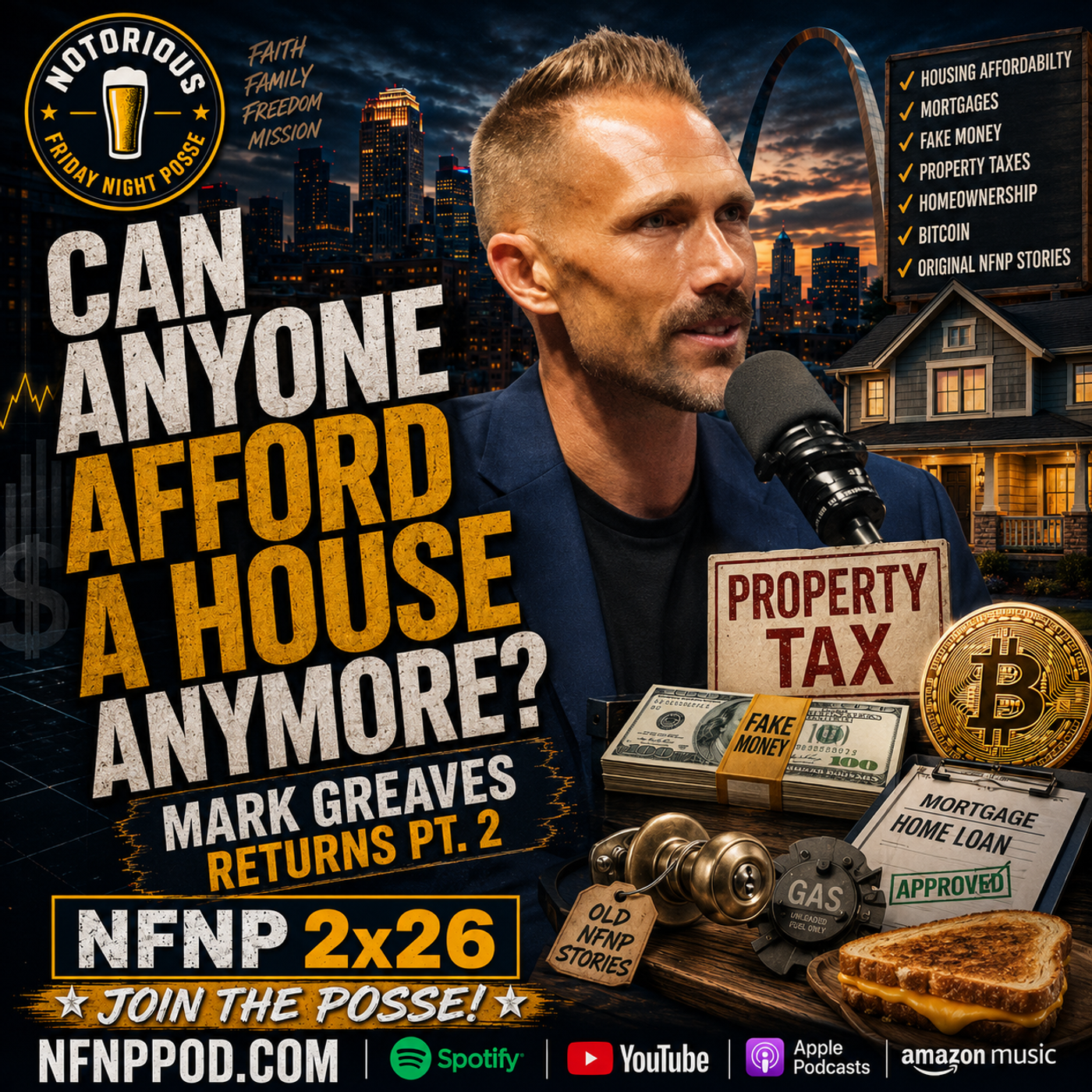
Original NFNP member Mark Greaves returns for Part 2, and this time the guys finally get into the housing conversation.
Bright, Duds and Mark break down one of the biggest questions facing regular people right now:
Can anyone actually afford a house anymore?
Mark brings his mortgage experience to the table as the guys compare the housing market of 2019 to today: home prices, mortgage rates, monthly payments, insurance, income, inflation, first-time buyer age, student loans and why so many younger buyers feel completely boxed out.
From there, the conversation goes full NFNP.
Mark explains why experience matters when choosing a loan officer, why first-time buyers should shop around instead of blindly using whoever their realtor recommends, and how local banks, mortgage brokers and bigger retail lenders can all offer very different paths depending on the buyer.
Then the guys get into the bigger money questions: M1, M2, the Federal Reserve, debt, bonds, fractional reserve banking, money creation, Bitcoin, goldbacks and why Mark’s kids apparently understand inflation better than most adults.
They also talk HELOCs, home equity, property taxes and the very uncomfortable question Mark’s ten-year-old asked him:
If the government can still take your house when you stop paying property taxes… do you really own it?
And because Mark is an original NFNP member, the episode closes with old Posse stories: kindergarten soccer, Catholic school basketball, the doorknob incident, Bright’s braces, broken fingers, poker nights, grilled cheese covered in potato chips, newspaper chaos, flaming porch mistakes and the legendary stolen gas cap that was returned two years later with a note signed “the thief.”
It’s mortgages, fake money, homeownership, Bitcoin, old friends and the kind of teenage stupidity that makes you realize the original NFNP was never a podcast. It was a warning label.
Listen, follow and join the Posse:
NFNPPOD.com
Find Mark: tithelending.com & markgreaves.com
First and Focused with Mark Greaves
Bright: Welcome back to the notorious Friday Night Posse. This is NFNP Season 2, Episode 26, and we're back with part two of our conversation with original posse member Mark Greaves. Last week, Mark came back to the NFMP to talk Bitcoin, business, burnout, faith, tithe lending, and the bread company betrayal. This week we finally get into the housing conversation. Can anyone actually afford a house anymore? Home prices are way up, mortgage rates are way up, insurance is up, property taxes Are up. First time buyers are older. Student loans are crushing people. Rent is brutal. And somehow everybody is still supposed to save for a down payment like it's 1998, and houses cost four nickels and a firm handshake. So we brought Mark back to talk through it. He gets into mortgage rates, first time buyers, creative lending, why you should shop around, why experienced loan officers matter, HELOCs, home equity, property taxes, and the very uncomfortable question his 10 year old asked him. If the government can still take Your house when you stop paying property taxes, do you really own it? And because Mark is an original NFNP member, we also finally get into those old stories the doorknob incident, the braces, the broken finger, the grilled cheese, the newspapers, the stolen gas cap, the kind of teenage stupidity that makes you realize the original NFNP was never a podcast. It was a warning label. Mortgages, fake money, bitcoin, goldbacks, and old podcasts. Posse crimes. Pop the top, kick back, and join the posse. What they're not doing though, transition is buying a house that's going to earn them equity. And so let all right, we've d we've digressed. my God.
Mark: Yeah. So give me your give me your house questions. Try to stump me.
Bright: well I'm not I'm not trying to stump you, but I w I want what your opinions.
Mark: I will tell you what, I I just I I most recently completed the most complex home purchase of my career in Missouri. It was
Bright: Okay.
Mark: a zoned agricultural. it was down near the Missouri-Arkansas border. All right. So this is not zoned residential. So zoned agricultural
Bright: Right.
Mark: automatically you take like a whole swath of lenders and they don't even mess with it.
Bright: Sure.
Mark: it was twenty three acres. There was two houses on one parcel. Okay. Two full houses on one parcel,
Bright: Mm-hmm.
Mark: which is usually a big no no. and the guy was relocating from Illinois using future income. So we were qualifying on an income that he hadn't even made yet. And so
Duds: Interesting.
Mark: we got it done, baby. and also the twenty three acres, it was part steer and part crop farm. So this
Bright: Right, sure.
Mark: had multiple outbuildings, actual like cattle. I mean, it was it was pretty very complicated.
Bright: Well so I wonder y and you you might
Duds: So was he buying it to farm? He was buying it to farm on it or what?
Mark: they're gonna farm just for their family and I he'll probably like lease out, you know, ten or fifteen acres to the farmer who's doing the crop.
Duds: Gotcha.
Bright: Yeah. And you might not be able
Mark: But yep.
Bright: to disclose this and you don't have to, but you say future income, like is it selling the cattle? Was that the future income, right? Was he putting coll the cows up for for collateral? The cattle up for collateral?
Mark: Mm-hmm. no, no. he was he's a doctor of physical therapy. So he basically
Duds: Yeah.
Mark: he was leaving the group that he was working with in Illinois and he had already signed, had a start date and everything, you know, set up in Missouri, but hadn't hadn't started yet. Yeah.
Bright: Yeah. So he had a contract. He w yeah. Yeah, sure. Yeah, yeah. Cool. Cool. Cool cool. All right. Well, I went and I
Mark: Kinda crazy, you know.
Bright: pulled some stats and I did a lot of it pre COVID. It's kinda a little bit of our theme, I think. So I went back and I said, Let's compare twenty nineteen to where we are today and just kinda want your your overall suggestions. I got a couple of questions. So I'm gonna run through some stats. You let me know if any of these seem off. Median home price, existing home price, so not new, in twenty nineteen was somewhere around twenty two excuse me, two hundred and seventy five thousand dollars, twenty nineteen. Today it's four hundred and forty thousand dollars. Thirty year mortgage rate in twenty nineteen was three point nine percent. It even got lower than that after COVID.
Mark: Mm-hmm.
Bright: Currently at about six and a half percent, six point six percent, if that sounds right. Yeah.
Mark: Yeah. National average, yeah. National basically th this morning I was working out and Good Morning America had it on that mortgage they they use mortgage news daily if you go to that website. they they had it at six point eight seven five was the
Duds: Yeah.
Bright: yeah. So even a little bit higher. Yeah.
Mark: national average as of today, yeah.
Bright: Yeesh. Okay. typical principal and interest payment, so not counting insurance and and taxes and all that. twenty nineteen, eleven hundred to thirteen hundred bucks. So let's call it even twelve hundred bucks. Today, twenty two hundred plus dollars. So double, double what it was at a minimum. Median household income was $68.7,000 in 2019 seems pretty low. today
Mark: No.
Bright: is 83.7 is the median household income. So it has gone up, but it's lagging behind cumulative inflation. So if you take 2019 as the baseline, cumulative inflation from 2019 to today is 31%. Think about that number. 31%.
Duds: In seven years.
Bright: Yes.
Mark: Well, there's a bo there's a bunch of information well well first off ask your question. Or else I'm gonna start ripping.
Bright: Well, I I'm not even to the question yet, but I mean
Mark: Keep going.
Bright: Okay, I'll I'll keep going, right? So first time homebuyers, median age, early 30s, we'll say, give or take. So now it is 40, 40 years old.
Duds: Cash.
Bright: So you gotta wait a decade longer to be able to afford your first house. Homeowners insurance.
Duds: Wait, forty forty is the the first time home buyers?
Bright: First time home buyer median age. So of course there's some early, some some later,
Mark: Right now. Right now it is.
Duds: That is crazy.
Bright: but that's the median is forty. And in twenty nineteen, you could say thirty-one, thirty-two, maybe, right? Homeowners insurance back in twenty nineteen cost you roughly thirteen hundred bucks. I'll round up. Today it costs twenty four hundred dollars for a couple of reasons. Obviously we've had major disasters and and of course also the the value of homes have have gone up, so I'm not necessarily getting in that.
Mark: Yeah, because they're unregulated.
Bright: Recommended.
Mark: They can raise it and there's no they're they're unregulated.
Bright: Right. So so yeah, okay, so I'll I'll go into
Mark: One of the only industries you can do that.
Bright: some of my some of my questions here. So the the real question is, can anybody actually afford a house anymore? What what is the state of the mortgage at the moment? Is it all b boomers, baby boomers?
Mark: All right, so people can. So here let me go let me go through a bunch of those data points and why.
Bright: Mm-hmm.
Mark: let's go with why is it forty? Like why is that why is it forty now? Part of the reason why it's forty now is for a lot of the things we've been talking about, it's very, very hard to keep up with inflation. And for a younger person who's coming out of school, you didn't touch on the student loan problem, but student loans have gone berserk over the last like ten
Bright: Sure.
Mark: to fifteen years.
Duds: Hundred thousand plus, yeah.
Mark: So they're already coming out with a mortgage. It's just for their education. So
Bright: Mm-hmm.
Mark: the vast majority of them are doing that. And if you look at incomes, like if so, for example, when we were growing up, a six figure income was what would people aspired to, like get to a hundred thousand dollars. You have to make three hundred thousand dollars now to have the same purchasing power from when we grew up in the nineties. But these guys aren't coming out making a hundred thousand. So you just went over the median income.
Duds: It hasn't gone up three times. Yeah.
Bright: Right, no.
Mark: The the median income numbers you just correct.
Bright: And that's the household that's the household income. So that's you and your s your spouse.
Mark: But here's why. Here's why it seems crazy. We all have houses. So that's not the median income for a home buyer. That's just the medium income for the country. And
Bright: Mm, sure. Mm-hmm.
Mark: if you look at how the country's doing, it's not doing so great. You know, so there's sixty, seventy percent of people, I think there was a stat that was like over eighty percent of people can't afford a four hundred dollar out of pocket expense. They have to leverage a credit card for that. So when you think about Yeah.
Bright: Yeah. Yep. Don't have a thousand dollars in their in their savings account and their emergency fund. Yeah.
Mark: When you think about eight out of ten households can't afford a four hundred dollar emergency, it's crazy.
Duds: That's not good.
Mark: So the median household income for a a home buyer is much higher than those numbers. But in general, that's why the majority of the population's boxed out. So for these young people, when they come out of school and they've got a boatload of debt, and then they've got their first job. And for the first 10 years of their career with inflation going up, and we'd already been talking about like what what does it cost to buy things now? Most of their income is going to just meet basic needs. There's just no opportunity to save. So if
Bright: So
Mark: they don't have a gift fund coming from a parent or a relative,
Bright: Mm-hmm.
Mark: if they don't have an opportunity like that to where, you know, a mom or dad or somebody that maybe has made some money and has had the benefit of inflation because their assets have gone up in value and they can take some of that and gift it to a kid to buy a house, if they don't have that relationship going on, they're boxed out of the housing market completely. It's brutal for them.
Duds: And if and if you're not buying a house, typically you're either living with the family or renting and
Bright: You're ranting.
Duds: renting has gone up tremendously too. I mean, that's another thing that's gone out of control. Yeah.
Mark: Yeah. Yeah. And it's nineteen percent a year on average, I think.
Bright: And you're not building any equity, yeah.
Mark: So the other the other problem is property taxes. So depending on what state you live in, I mean you guys are in Missouri, so yours are relatively low. like here where I'm at in Ohio, I pay fourteen thousand dollars a year a year in property taxes, over a thousand dollars
Duds: Holy crap.
Mark: a month. Ohio is high. Ohio is high.
Bright: That's almost triple what I pay. Yeah.
Duds: Yeah.
Mark: Right. And Brightman, I know what kind of house you live in. Our houses
Bright: Sure.
Mark: aren't that much different.
Bright: Right.
Mark: So like when I look at my parents' house, my parents have an awesome place. And I think their property taxes are like thirty eight hundred bucks or something.
Bright: Yeah.
Mark: but so I mean, depending on what state you live in, the property taxes have just exploded too. So when I when I built this house in twenty sixteen, I think ours were about nine. So today they're fourteen. So
Bright: Wow.
Mark: that just keeps ratcheting it up too. So when you're when you're thinking about all that, it's like, okay, home values have gone up, but have they really? Really what's happened is our money doesn't buy as much. Because we printed it. If you ever go look at I'd encourage any listener to do this, go to the just go to Google and type in the Federal Reserve M1 and M2 money supply chart. It'll come right from them. And just watch what happens at M1 and M2 money supply from 2020 up. It literally is a straight line parabolic. So if you go to the all time chart,
Bright: Mm-hmm.
Mark: it it it's crazy what's happened. So when money supply is growing like that, your money's just not gonna stretch.
Bright: Sure.
Mark: And because we can't save our money and money anymore, we can't save dollars and dollars. What you have is as people gain equity or if they're in the stock market and their assets are going up, they're buying more houses. So, like the other dirty secret is there's a lot of people out there that have multiple homes because they're like, what am I gonna do with all this money? Well, if they're not plugged into Bitcoin or if they're like a savvy investor, people know real estate is like a nice sturdy thing that
Bright: And it's gonna make money eventually.
Duds: There's there's a chart, Mark.
Mark: Yep, land is always yeah, look at look at twenty twenty. Look what happens. Boom. Straight line up. Straight line up.
Bright: Yeah, right there. Uh-huh.
Mark: That's insane, right? So that's M2 money supply.
Bright: If you stopped the chart in twenty twenty, it would it would literally be right there. It just it would just end with this straight line up. Right.
Mark: Well here, check this out, Brightman. Toggle it toggle it over nineteen seventy one.
Bright: This is Duds actually that's that took control here.
Mark: Yep, yeah. So that's gold standard. That's when Nixon takes us off the gold standard, right? If you would if you
Duds: Six thirty three. Yep.
Mark: could rewind it even back farther than that, that line is relatively stable all the way through. So the creation
Bright: Sure, yeah.
Mark: the creation of the Federal Reserve in nineteen thirteen kicked this whole thing off, but nineteen seventy one changes it. So that goes all the way up. And then if you look at two thousand ten, that little gray these gray areas are basically recessions.
Duds: Was there sessions or yeah?
Bright: Yeah, that's what I was gonna say. So the market crash, yeah.
Mark: Yep, they're recessions. So two thousand eight starts a recession. Then we start marching higher and higher and higher. So between 2010 and 2020, we had easy money in our country. Rates were low. Things were just free falling, man. And then boom, 2020 hits and we just go parabolic. So between 2008, it go look at where we were in 2008, man.
Duds: It's that covet recovery. Yeah.
Bright: Yeah.
Mark: 2008. Guys, we were working. We were out of college. We
Bright: Yeah.
Mark: were under 8 trillion. These are in billions. So you're when you're talking 8,000 billion, that's that's trillion. Now, so the and that only goes to 2025.
Duds: Yeah, what are up to forty right, and I think we're at like forty trillion now, aren't we? Something like that. in debt, that's right.
Mark: We're well in debt. In debt. This is this is two money supply. So we're at twenty four trillion. Twenty four trillion
Bright: Twenty four
Mark: is twenty four million million. It's twenty four thousand million, but it's twenty four million million. That's how much money we're talking.
Bright: So that's you're saying that's how much money That's how much money is in the market, essentially. That's how much US dollar Yeah.
Mark: yeah. And that that includes so M1 is a little bit different than M2. So here's the other
Bright: Okay.
Mark: crazy thing. And if you just want like your listeners' minds blown for a second on how like money is created, this is what is just bizarre. And until you until you understand it, this is what people will actually light bulb on Bitcoin on this. Okay. So when I make a loan, when we do a new mortgage, a lot of people assume that that money comes from somewhere else.
Duds: I love this.
Mark: They assume that when I make a loan to you and there's a a mortgage or an auto loan or something like that that comes from a bank, they assumed that if they were watching all those banks' screens and all the all the different ledgers, that the money would come from somewhere else to create that loan. It doesn't. So there was an actual empirical study
Duds: You just make it
Mark: done on this in 2014 by an economist named Richard Werner. He's in he still is an active economist today. He's one of the best in the world. they did it. It was aired on the BBC. They've since taken it down. But they did this where they had every single screen up because they wanted to see does new loans from banks create new money or does that money come from somewhere else? And they proved it. It just comes out of freaking thin air because of fractional reserve banking. So how let me rewind the clock on this. This is how fractional reserve banking really works. our government has a deficit every single year. So every year we have right now it's a little over two trillion. That we're going to spend more than what tax revenues and things like that come in. So where does that money come from? They issue bonds to float
Bright: Mm-hmm.
Mark: that deficit. So a bond is debt. It's a big IOU. So they issue a bond. Now, for a long time, when we had stable money, there was demand for a bond. There was natural demand for a bond. People would save their money in it and they would earn a yield year after year after year. And then when it came to maturity, they'd get the entire bond back. Well, we did. Savings bonds. Now, guess what?
Bright: We probably got some from our grandmas when we were younger, right? Yes.
Mark: Nobody wants them. There's no natural demand, so they have to create artificial demand for bonds. Well
Duds: So who buys them, Mark?
Bright: China China
Mark: who buys them?
Bright: I think just sold a whole bunch of their bonds like just just this week or something.
Mark: They did.
Duds: They've been selling them. Yep.
Bright: Yeah.
Mark: So think about this. Our government has to issue more supply at an ever increasing rate to fuel the deficits that we have because we have these massive deficits. Well, what happens when they're issuing more supply? And then our enemies around the world are hip to this like, hey, America's debt is a runaway train. We don't want to be sitting here holding that bag anymore. So they're flooding the market with more supply and there's no demand.
Duds: Mm-hmm.
Mark: You look at these treasury auctions, I mean the demand is pitiful. So guess who buys them? The Fed. So how does that work? The Fed creates new money, which buys
Bright: Mm-hmm. They print it. Yep.
Mark: the bonds. The bonds go on the Fed's balance sheet as an asset because it's a receivable. Okay. So think about this.
Duds: Mm-hmm.
Bright: Duds, we did an episode. This is one of our early episodes we talked about this.
Mark: So now the no, but here's here's the next part. It goes a step further. So then when the government, if the Fed creates the money out of nowhere, right? Because they have the luxury of doing that. It's a central bank, so they can create the money out of nowhere. They buy the bonds, it goes on their at on their balance sheet as a receivable. Now the government has their money. They've got their cash that they can go fuel that deficit with. So let's say I'm a government contractor and I've got a I'm a I don't know, I'm a painter. Don't I don't know, whatever. I'm painting some stupid government.
Bright: Let's say you're an asphalt asphalt paver. Let's say that. Yeah,
Mark: There you go.
Bright: yeah.
Mark: So I've got a government contract. Now the government has that money that was created by the Fed that was given to them for issuing a bond. They give it to me. Now what do I do with it? I'm gonna go down the street and I'm gonna put it in Chase or PNC or US bank or whatever. I put it into my account. So now this is money that I put into my account at that bank. Now because of fractional reserve banking, they usually only have to keep about a tenth. Some banks even keep less.
Bright: Ten percent. Yeah.
Mark: But many people think that what that means is let's say I deposit $10,000 there. They think, okay, well, they'll keep $1,000 there and they'll lend out nine. That's
Bright: Mm-hmm.
Mark: not what they freaking do.
Duds: Yeah.
Mark: They keep the whole $10,000 and they lend out 90. New money gets created because when I deposit my money there, they use that as the reserve and then they create all this new money in the form of debt to me and you. So everybody out there, it there's not enough money in the system. If if we all wanted,
Duds: Fueling the machine.
Mark: we know if we ran on the bank. America's whole thing is based on debt. It's not money.
Bright: Right. And then like that's what happened in in nineteen nineteen twenty nine, right? Everybody ran to the banks trying to get
Mark: Kind of.
Bright: their money out and they couldn't do it. Obviously it's a much bigger issue now. My question and the big question I think a lot of people always ask is like, Well what would happen if we just defaulted, right? Like it I
Duds: Well the whole system is it's
Mark: What happens
Duds: a house of cards. It'll all come collapsed and yeah.
Mark: if we default?
Bright: Yeah, it'll all come crashing down. Yeah, yeah, yeah. Hyperinflation, Germany post World War Two, yeah,
Mark: yeah, yeah, yeah. At that point, yes, money doesn't work anymore. Correct.
Bright: yeah.
Mark: Yeah, th they the basically there's three options. Either default on the debt, rein in spending to the point where we can get it under control, which would mean basically cutting a lot of things and going through a ton of pain. We go through a lot of pain
Bright: Cutting up going through a ton of painting.
Mark: as a country that way. Or
Duds: Depression. Yeah.
Mark: or inflate it away, print more money. meet all the obligations in real terms, but in like nominal terms or in nominal terms, but in real terms like the money's basically just being inflated away right from under us. It's kinda crazy.
Bright: Well then you gotta g you gotta find a way to replace it then at some point. So whether that's capturing an asteroid full of diamonds, which we've talked about on this pod, or
Duds: But that doesn't do it either, because all you do is flood the market with diamonds, then diamonds become useless and you know, they're not valued in anything either. Anything anything that you can anything
Bright: Yeah, I guess so. Well, I guess if you're in control of the diamonds though, I you yeah, I don't know.
Mark: Yeah. So the hold on, the whole moral of the story
Duds: you can flood the supply, you it's not gonna be valuable anymore. And that's what we've done with the dollars.
Bright: Yeah. Yeah.
Mark: Right. Right. So I mean, back to the real estate thing is houses, are they actually worth this? I mean, technically, yes. Can people afford them? Yes, people can still afford them. there's a lot of really good creative ways that we make loans happen every single day. You
Bright: Mm.
Mark: don't need a ton of money for down payment. depending on what your income is, there's a lot of programs that are really lenient for lower income borrowers where there's incentives. each state kind of has different grant programs available where they can help out with down payment and give specialized interest rates to people who are below something called the area median income. So if you're below eighty percent of the area median income, you there's a lot of perks for that. They want you to be able to come a homeowner.
Bright: Sure.
Mark: there's all kinds of cool ways where you know, you can tap into four one K to put down a down payment on a primary residence and it's not penalized or anything like that. So people do that all the time. there's a lot of unique stuff. But but I if you're trying to break into buying a home and you don't know if you can afford it, the best way is find a loan officer who's been doing it for a long time. Don't find somebody who's been doing this for like a year. just cause just from experience, I've employed tons of those people and they're good people, they're learning, but they don't really know how to help you because they know the simplest form of the box. And
Bright: Right.
Mark: what they're gonna do is they're gonna work with every customer that fits in that box.
Bright: Mm-hmm.
Mark: And the box is actually a really giant, freaking big box, but there's only one way to learn it is through experience. AI has not caught up yet with what everything is going on in mortgage because yes, we need credit, yes, we need income, yes, we need assets, yes, we look at properties, but the problem is every single unique customer story between all these different prongs and criteria is very, very different. So while the thing the boxes that we're putting information into are the same. The information's different every single time. And while we have guidelines and things like that and different criteria, there's workarounds and there's gray areas and there's all kinds of stuff that are like nuanced there. So you gotta find a loan officer who's been doing it long enough that they've seen a lot and they can help you. But it's it's still doable.
Bright: So that was gonna be one of my questions was gonna be what what's your number one piece of advice for first time homebuyers that are looking to get in the market? So it sounds like go get
Mark: Yeah.
Bright: an experienced loan officer with a decade of experience under his or her belts that that knows how to how to
Mark: That and I would do
Bright: work in your situation.
Mark: If I was first time home buyer, number one piece of advice I would say is don't just use whoever your realtor says. Get a quote from a local bank, like a small local bank, get a quote from a mortgage broker, and get a quote if you want to get a quote from like a regular like retail lender like Lower used to be, you can. Usually they're gonna have the worst pricing. Retail
Bright: Mm-hmm.
Mark: lenders are gonna have the worst rates for you, typically, but they're gonna have the highest marketing budgets. They're the ones that have stadium naming rights. If you look around, it's just true, like Rocket Mortgage, Loan Depot, like all these places. they market a lot, they spend a ton of money on advertising. So they're gonna go out there and just be collecting people top of the funnel. but they're gonna give you a crap rate, typically. Correct. Local
Bright: Yeah. Yeah.
Duds: Have to. Have to to support that marketing budget.
Mark: banks sometimes will have cool local incentives for people that maybe I wouldn't have access to. and from time to time. They can do a portfolio loan. So if you've been with them a long time or your family's been with them a long time and you don't quite fit in that home ownership box, but they know that you're good for it because they trust you, they can do a portfolio loan and put it on their books if you've had a long standing relationship with them. what we are is we're a lender and a broker. So I kind of prefer our style now because about two thirds of the time we lend our own money when that makes sense. We can get the lowest rate. But I'm also signed up with 12 different wholesalers right now. So depending on the niche, like for example, that agriculture loan.
Bright: Mm-hmm.
Mark: I I sent that through United Egg. United Egg is a fantastic wholesaler for things zoned agricultural and they'll work with you on the types of properties and if there's a weird scenario like that. and I've got a relationship with those guys. So if if you're working with somebody like up like me, I've got relationships with a lot of people from doing it for 20 years and I know where to take you. So if you don't quite fit in that normal conventional FHA VA box, we can do some unique things and and still make it happen. So just
Bright: So
Mark: and and we give you a great rate 'cause we're we don't have all the overhead.
Bright: So speaking speaking of that, we'll give you a little bit of a plug here. Where are you currently licensed to do business? I know you are licensed in Missouri now. I love doing business in Missouri. Yeah.
Mark: Yeah. Love doing business in Missouri, yeah, 'cause it's home to hometown. yeah, so Missouri and Ohio obviously we're on that, but then we're in Texas, both Carolinas, Florida, Wisconsin, Indiana, Virginia pending. is that it? That's it.
Bright: And where where can people find you? If they want to do business with you, where do they go?
Mark: Yeah, just tithe lending dot com. So T I T H E for tithe, that's the ten percent that we give to to charity, tithe lend tithelending
Bright: T I T H E. All right.
Mark: dot com. Or i they could just email me to mark at tithelending dot com. I'm always around.
Bright: man, putting your email out there, that's that's dangerous. Yeah. Woof Well, I will I will certainly make sure to add that in the show notes, that's for sure. So
Duds: boy. What's your phone number?
Mark: What's my social? You want my seed phrase, Dudley?
Duds: And here is another thing you didn't say, Mark, is if you're gonna save up for a down payment, save him Bitcoin. Don't save him dollars.
Mark: Yeah.
Bright: Yeah.
Mark: I exactly. By the way, real quick, I know you guys are probably trying to kick me off here, but have your kids heard of have have
Bright: No, no such thing.
Duds: Heck no. You're gonna be a regular on NFMP pod.
Bright: It's possible.
Mark: you guys have your kids heard of goldbacks yet? dude,
Bright: I don't think so.
Mark: Delhi, look up. You're gonna love them. So instead of dollars for like their like, you know, you're giving them money for chores or if if they earn something, or if like grandma and grandpa are giving them money on a birthday card, my kids ask for goldbacks now because they know all about inflation and I've taught them about Bitcoin. So instead of getting dollars, they're basically they look like they look like a like a dollar or like currency wood,
Bright: Yeah.
Duds: here we
Mark: but it's actual gold. It's 24 karat gold and it's just different percentages of an ounce. Yeah, there you go. So you can get like one one thousandth of an ounce, one two hundred and fiftieth of an ounce, whatever it is. So and it's just depending on what gold's price is, but it's real gold and it can be traded in. So gold dealers all around the the country do them now. And there's actually
Duds: No kidding, that's cool.
Mark: like There's tons of small businesses that accept them.
Duds: Really?
Mark: So
Bright: Really?
Mark: my kids won't take dollars anymore. So like when they when they ask for like a Danielle's
Duds: Get that crap out of here, Dad.
Mark: parents, all they want
Bright: Look at those Trump
Mark: is gold backs.
Bright: Trump presidential. Yeah.
Mark: Marine one. Yeah, but but like if you click on like that New Hampshire gold back, that's one one thousandth of a troy ounce of twenty four carat silver and they've got like a really cool like way that they like print and there's no Yeah. Yep.
Bright: So is the price always fluid dependent on the price of gold? So it you know, you go on today, the price might be different tomorrow.
Duds: So are these
Mark: Yep.
Duds: paper gold certificates or what are these?
Mark: You gotta get from a gold dealer. no, they just they're basically the same size as like a dollar would be.
Duds: Okay.
Mark: so it's but it's actual twenty four karat gold, only sold by gold dealers. And then so they're like they have money in their savings accounts from like grandma and grandpa giving them birthday
Bright: Yeah.
Mark: money and stuff. And Frankie, my son, was like, Dad, is there any reason why I shouldn't just pull all those dollars out and buy gold backs? And I'm like, Yeah, I I I probably would if I was you. It's like
Duds: Okay.
Bright: Now where d where do they keep that though? They gotta keep it under the mattress or something?
Mark: No, they all they both have a safe. Yeah.
Bright: Yeah, a safe. man.
Duds: You gotta keep your golden safe.
Bright: My kids my kids are younger than your kids. We still got piggy banks.
Mark: Yeah, so they they think those are awesome now. So
Duds: That is nice.
Bright: Hey. My kids they got more disposable funds than me though in those piggy banks, I tell ya. They got just hundreds of dollars sitting in there, they don't even know what they have. They just count the coins right now and they're like, Look how much money I have and I'm like, No, it doesn't work like that.
Mark: Well, Frankie was it was actually kind of fun watching their little brains because he he turns ten in a couple of weeks. So we went up to the gold store and in there they've got all their silver and stuff too, and they've got like the dimes, like I I think it's like the pre sixty-four quarters or silver. I can't remember what the year the dime was still silver. And he was trying to like figure out how to get the most silver for his buck. And so he was asking, like, what's the silver content in the dime? It's like ninety percent. He's Well, what's the
Bright: Yeah.
Mark: silver content in the quarter? And the guy was telling him, and he's like, Well, how much is a quarter? Then and then he's like, Well, how much is a dime then? The guy was telling him how
Duds: Yeah.
Mark: much dollars. So he's like looking at his dollars, trying to figure out how to maximize the amount of silver he can find. I was like,
Bright: Wow. I tell ya.
Mark: These guys are getting smart.
Duds: Yeah, you're teaching him well. You're teaching him well.
Bright: Teach young. That's right. That's right. All right.
Mark: it's so funny.
Bright: Well, we might have to have you back on in a future episode to talk about more home stuff and I'm sure the market will change and and there will be more news. Yeah.
Mark: Well, let me plug this real quick because just this this is actually important and one really good thing. If anybody does want to get home equity out, the home equity line market is very, very simple and easy now because there's not as many guidelines and and boxes that need to be checked to originate one. So that's one area where like AI and technology has actually been able to infuse itself into mortgage. So if anybody needs a an equity line, hit us up. We can usually have your money with you like eight days. And then
Bright: Nice.
Mark: you don't even have to deliver anything in. So it'll link your bank instead of doing income verification like W-2s
Bright: Mm.
Mark: and pay stubs, it'll just link through plaid to your checking account and verify deposits. Everything's done off
Bright: I use plaid yep. huh.
Mark: everything's an AVM so there's no appraisal. You'll have your approval in 15 minutes. And then usually you sign, you got your rescission window, you have your money with five to eight days. It's very easy.
Duds: What are those what are
Bright: Nice.
Duds: those rates at right now?
Mark: Depends on credit score and like what your loan to value is that you're going up to. But like start
Bright: Yeah.
Mark: around five nine nine, they go up to about maybe like nine percent, depending on if you're trying to max it out or if you have, you know, crappy credit.
Bright: Now do you lock that in? Is it variable?
Mark: Yep, those are thirty year fixed rates. So and it's
Bright: Thirty year fix
Mark: not an interest only. It's a it's an actual thirty year fixed second. Yep. So like the one that we just
Bright: Right. Yep. But so but but is it a is it a HELOC or you're talking about like a HE loan?
Mark: No, yeah, it's so it's a HELOC. And what that means
Bright: Yeah, okay.
Mark: is the way it would work is like you have a five year draw period. So
Bright: Five year. Okay.
Mark: you max it out, but then as you pay it down, like if you let's say that you paid it down twenty, thirty thousand,
Bright: Mm-hmm. You you can draw that money back out. Yeah.
Mark: yep, for five years, you could use it as either a credit card or you could use it, you know, to make another purchase or do a home renovation or whatever.
Bright: Yeah, revolving door. Well, and certainly interest rates on that, six percent, six and a half percent, whatever it may be, way better than you're getting with any credit card at twenty percent or
Duds: For sure. Or
Mark: Well,
Duds: a lot of loans too.
Mark: there was a lady in Texas this week, here's the example, is she has a free and clear home. She wants to pull two hundred thousand out to go buy a condo in Galveston. And she had a a quote from her savings and loan or local savings and loan. It was gonna be like eight grand in fees to do that. And I was like, just take out the equity line. They were offering her at six and a half percent. The equity line that she got was at six point seven four, so only
Bright: Mm.
Mark: a quarter point difference, but it's only one point nine percent of the line amount. So 200 grand, one point nine percent is thirty eight hundred bucks. I was like, the payment was like almost the exact same. I was like, instead
Bright: Right.
Mark: of paying eight grand in fees, pay thirty eight hundred in fees, have your money in five days, for almost the exact same interest rate. And I I did the math for I was like the break even on this minute difference in payment from the forty two hundred dollars you're saving right now up front is like many, many years down the road. So it was a win for her.
Bright: So that is one thing, and I will plug AI. I plug AI all the time. We've we talked about it a lot in in many different episodes. But if you're looking to figure out those break-even points and should I buy down points and all like
Mark: Mm-hmm.
Bright: AI will do the math for you, it'll do it quick. your amateurization schedules and all those things, it you know, it can figure out in a snap all of those this things that used to be a headache when you would try and figure out should I go this route, should I go that route, do I pay more, do I keep this, should I pay off? My house and all of those things, it you know, it can it can break that out for you pretty quickly. So I'm a I'm a big fan of that and and I got all my things connected through Jet Tube T now, through Plaid. it's got access to all of my accounts. So if if the robots take over, right. Yeah,
Mark: It's like this isn't even Brightman's voice right now. This is actually a
Duds: I know I don't even know if I'm talking to him anymore. Sometimes I just think I'm talking to AI.
Bright: I know. I tell ya.
Mark: I think it is. I think it's an AI bot and somehow he has like a
Duds: He's upstairs watching the watching the game.
Mark: I was gonna say I know how we're I don't know how we're looking at him right now. There's there's some sort of a
Bright: We're not quite there yet. Not quite there yet. I'm sure I'm sure it could be done, but it what's the what's the fun of that?
Duds: I would imagine though with the with how much home values have increased that those home equity lines are probably very popular
Bright: Yes.
Duds: right now. Am I right?
Mark: Well, they kind of are, but unfortunately like it's just the truth about anything in America. uneducated. I mean
Bright: Yeah.
Mark: we have like a you know, we have a lot of years in school but people still don't know how do anything. So it's like they people just don't know what's a what's out there. I mean there's a lot of people who could really use it, but what
Duds: Yeah, I mean if you got all of your like like our buddy Nate, you know, he he paid off his house and he only had a three percent mortgage, but he w he didn't
Bright: Mm-hmm.
Duds: want to have a mortgage payment anymore. So he what did he pay? Like a hundred grand off, you know, right away? And locked it up into his house. And it's
Bright: Yeah, a hundred grand, one fell swoop, got everything. Yeah.
Duds: like, Well, buddy, you know, and then he was out of work. It's like, you know, that's money you could have had in a interest bearing account, you know, and instead you locked it up in equity in your home for no reason. I mean Some people just aren't really thinking that through sometimes. Sure.
Mark: It gives them peace of mind. But yeah, it is it is an interesting choice where it's like equity's only real if it's if it's used. I mean what's w what good is a paper asset? I mean, granted,
Bright: Right. Right.
Mark: it's not, it's a utility, like you live in it, so it's like a real asset that you own, but Right.
Bright: It's only good until you sell it. That's that's true
Duds: Stop paying your property taxes though and see what happens.
Bright: for any investment. Well and and we've talked about
Mark: Yeah, they take it.
Bright: that a lot, right? He never really owns that house. Yeah, he paid it off. He's got peace of mind. Until he can't afford his property taxes, the government will still come take it away.
Duds: Right.
Mark: My my kid asked me that. It was kind of crazy. we were on the way to the barber shop the other day. This is a true story. And we were talking about taxes. 'Cause they all they had I mean, they gave these guys asked so many qu good questions. So I was telling all the different kinds of taxes. And told about property tax. And then Frankie was like
Bright: They probably were like, Dad, how do you have any money left?
Duds: Yeah.
Mark: Yeah, no, it's for real. And
Bright: Yeah.
Mark: I was like, Yeah, I was like, even if we pay our house off, we still have to pay the taxes or the government can take it. And he goes, So do you really own it then? And I was like, Dude, great question. Yeah. He's
Bright: No. You figured it out early, yeah.
Duds: You figured that out early, son.
Mark: like, If you if you still have somebody that can take it from you if you don't pay, then do you really own it? And I was
Duds: That's right. You don't.
Mark: like, Dude, you're only ten. You're f you're figuring this out young.
Duds: Mm-hmm.
Bright: I was talking to my driver
Mark: Although it's kind of depressing.
Bright: in Jamaica and we we had a long drive. I was driving like across the island and he said, Hey, do you know the deal of all of the unfinished houses in Jamaica? And I was like, Kinda, like I don't know what's going on. And so he's telling me, he was like, Well, in Jamaica, you get a little bit of money and you build the first room in your house. And then you get a little bit more money and you build the next room in your house. And I mean that
Mark: What?
Bright: and that's how it works. So you have all of these half finished houses, and then people run out of money, they don't finish the houses. It does not look great.
Duds: Mm-hmm.
Bright: But here's the deal. Nobody can come take your house away. You own it. There is no property tax on that house. There is no mortgage on that house. You have a half finished house, but it's yours. No government entity is coming to take it away.
Duds: No credit. Yeah. When you don't have
Mark: Yeah.
Duds: credit, you gotta save up and and pay for it right away.
Bright: Yeah. No. He was telling me they were just starting to get automobile loans in Jamaica. It was just starting to become a thing. Yep. Yep.
Mark: That's why we like Bitcoin, Dudley. Is because it's the one thing they can't take.
Duds: That's right. That's right. We'll try though. They will try.
Bright: All right, Mark.
Mark: Yeah.
Bright: Let's do we got eight minutes left before we hit the the hour and a half mark.
Mark: All right.
Bright: we don't necessarily have to use the full eight minutes, but I know you're an hour ahead of us and you're probably tired. I wanted to ask a couple of NFMP questions. Yeah, yeah, right. These this is where Well,
Mark: Go. Can I can I pass if they get too weird?
Duds: Ha ha
Bright: y th they're more about what, you know, like what you remember and
Duds: I plead the fifth.
Bright: Yeah, stuff stuff like that. But what is your earliest memory of both myself and Duds? Not necessarily together, but what's your earliest memory of us?
Mark: My earliest memory of you is kindergarten soccer because I was
Bright: man.
Mark: so nervous. And I remember I got there late and my mom like had to walk me up to the the team and it was your dad was the coach. So
Bright: Yeah, yeah.
Mark: I remember I remember her asking your dad like if it was the right team and it was. And then I remember like I was horrible at soccer and you were the coach's kid and you were good at soccer.
Bright: Ha ha ha.
Mark: So like in in our grade school, like the kids that were good at soccer were like the kings of the earth for like, you know, the first few years. So I just remember thinking that like
Bright: Yeah, only in
Mark: Matt Brightman was like the coolest kid and like
Duds: Yeah.
Bright: Eventually that ran out, right?
Mark: And then I I I remember I seriously remember thinking that. And I remember thinking like how good your dad was at soccer and like
Bright: Yeah, yeah.
Mark: being really intimidated to like be on the team and stuff. It was weird.
Bright: Yeah. And this is it's so funny because it's a soccer game.
Duds: We had a couple of good soccer teams at our grade school too. They were pretty good.
Bright: Yeah. We did. We did. And it's funny because it it's changed so much, you know, back then the being work y playing for a good Catholic school like we did, that was the cream of the crop when it when it came to soccer. And you know, now you you it's pay to play Scott Gallagher's and Lou Fuse's and, you know, all of that. So it the times
Duds: Changed a lot.
Bright: have have changed. Yeah. What about
Mark: Dudley, where did you get did you get there sixth grade? Because I I do I rem I remember you you got there in fifth too. So same year as Divine.
Duds: Fifth fifth grade. Yep. Mm. Yep.
Mark: I remember you standing there and like you were one of the only kids that was like kind of close to as tall as me. So
Duds: That's right.
Mark: I remember like when you got there, because I had I was towering over everybody. I just
Duds: Hey, I'm the tall one. Who's this guy?
Bright: Yeah.
Mark: I just remember getting there and be like, we got another tall guy now.
Duds: Yeah.
Mark: And then I'll never forget
Bright: That's that's funny.
Mark: your Y we obviously you are on our basketball team. Man, that's some funny stories right there when Brightman couldn't play in eighth grade 'cause I knocked his teeth out at that that trivia night.
Bright: I figured we would get there at some point.
Mark: But I just remembered that your your dad would always keep the stats and be on the bench and then it was my dad and Mr. Divine and it was always just so funny because typically Joe would do something really stupid and Mr. Divine would be yelling at him and like my dad would be making something your dad would have the stat book. I just it was kind of funny, like thinking back about how bad we were.
Bright: Youth sports. man. Well yeah, you were bad because I couldn't play eighth grade year. I was the I was
Duds: That's what it was. That's what it was.
Bright: the three point shooter, you know? I was the one that
Mark: Yeah, but do you remember what happened now? Okay, so the whole the knob and say who actually farted? Did we ever figure that out?
Duds: Is that a nabbing incident?
Bright: Alright, we yeah, so this this is a story where you know, we we were at some trivia night, one of our friends' parents came to pick us all up, and I don't know how many of our listeners remember this game, but yes, when you're younger,
Mark: Doorknob.
Duds: Mm-hmm. yeah.
Bright: doorknob, right, you remember it, Duds, right? You farted and if you didn't call safety, right? You had to call safety first, or s if somebody called knobs before you yelled safety, then they could hit you legally, punch you. Yes.
Duds: Legally. Yes, there's laws.
Bright: P until you touched the doorknob. Well, we were in a car and we were in Mrs. Dolan's face. Yeah, yeah.
Mark: We were in Mrs. Dolan's van and it was Roberts, Devine, and I think it was Johnson in the back. Dan was up in the shotgun, and me and you were in the middle seat,
Bright: Johnson, yeah. Me and you and the captain and yeah. Yeah.
Mark: but I was holding your soda and my soda. And this was what the stupid part. Like I went and filled up these two fountain sodas right before we left with no lids. And I get in
Bright: I don't even remember this.
Mark: and I'm sitting in the seat and somebody farted, and it wasn't me, and somebody yelled doorknob.
Bright: It was not me either.
Mark: Somebody goes doorknob, and you go, who wasn't? They go, Greaves. So everybody in the backseat starts punching me. And I don't even think Brightman was punching me. Starts punching me in the back.
Bright: That's the whole thing, the back seat.
Mark: And I'm sitting there and this these sodas are spilling all over me. And I'm getting punched from behind. And I don't know what got into me, man, but I just freaking snapped and I let go of the sodas. And Brightman was just happened to be sitting right here. And I just punched him as hard as I could right in the face.
Bright: Right in the face.
Duds: Oops. That's the end of doorknob.
Mark: Yeah. And then I remember his his it it would definitely
Bright: And you know what is crazy what is crazy though is it did not hurt. Like b I think because you got me in the teeth, like it my my nose wasn't broken. It I like I was kinda just like, what the hell was that? You
Mark: Well, we were all so embarrassed.
Bright: know, you're not expected to get punched in the face by your best friend.
Mark: We were so embarrassed and that everybody I remember you were like it's pretty messed up and we kept going that's how it always looks, that's how it always looks. And well, I got home and my two knuckles my two
Bright: It it was not how it always looks. Even Mrs. Dolan, even Mrs. Dolan was like, looks normal to me.
Mark: knuckles were like just completely torn up from Brightman's braces. And so I hid my hand from my mom when I got home, and then I went to bed. And then the next morning, all of a sudden I get a call from My mom downstairs, you know when you get that mark? And I was like,
Duds: Yeah.
Bright: Yeah.
Mark: Yeah. And she's like, get down here. And I'm like, crap. So Mr. Brightman had called over. Well tell
Bright: You knew it was gonna happen.
Duds: I know what this is about.
Mark: what happened. So for your end, you had to find some like emergency orthodontist in the middle of the night?
Bright: We went to my orthodontist, yes. We had to wake him up and late at night it's we get there. It's like at this point it's one in the morning or something like that. And the only reason that it was Okay is because the Olympics were on and team USA was playing hockey and they were over in like Italy or Russia or Japan, I don't remember. And so they were playing all these late night games. So the the Orthodontist was like, I was still awake watching hockey. You know, he came in, it didn't take but five minutes. He was just like popped it back into place, straightened my braces out or whatever, and he's like, You're good. Let me know, let me know if you have any issues. I don't even think he charged us. I don't know. I think it was.
Duds: Hey, was that was that Shanker? Yeah, that's who he's still
Mark: Shanker. Dude,
Bright: Yeah, yeah. We all went to the same guy. Yeah.
Mark: I never had braces. My brother
Duds: Jameson had
Mark: had Shanker and hated it.
Duds: he he got his vi invisaline there. He's still doing it.
Bright: Yeah. Crazy.
Mark: Dude, so the funniest part about that was then it was like two weeks later that you were at my house. Of course, farting is gonna come up again, but we were
Bright: Yeah.
Mark: playing two on two basketballs, me, you, Dolan, and Divine. And yeah, your finger is still probably jacked up. You were like posting up on Dolan and you farted on him. And then so Dolan started pushing you and you guys started fighting in my driveway. So I took the basketball and I just I chest passed it right at you guys as hard as I could. I was trying to get you guys to stop fighting and you saw it out of the corner of your eye and you like turn and where it hit your pinky, it like broke your wrist or something.
Bright: It it's they call it a boxer's break. It's when you you go and you punch and you hit w somebody with your outer two knuckles, which are floaters. You can you can test it right now, you know, go f move You can move your outer two, but you can't move your index or your middle. And so when you punch somebody, you want to hit with those two knuckles. If you don't, it's called a boxer's break. So yes, that's what happened. It broke my pinky finger, and they put a cast all the way up to my elbow right before I was going to Mexico for the first time. And I went back
Mark: On a beach.
Bright: on the yeah, I went back to the doctor and I made him take the cast off before we left. And it was supposed to be like a four to six week cast. So I did two weeks and then I was like, just tape up, man. And so we had to do it AMA against medical advice, taped up my fingers. They're fine. I'm good. Pink pinky fingers all all straight.
Mark: I'll never forget it was like the next night we were having a poker game at your house and I came over and your dad called me over and was like, Listen, Mark, I know you guys are friends, but if you keep if this stuff keeps happening, we're not gonna be able to let you hang out with Matthew anymore. I was like this last one I swear was like I was trying to like keep the peace.
Bright: Yeah. You know, and you were always bigger. You were always a foot taller, you know, you were
Mark: Yeah.
Bright: you were always just a bigger guy. So this was probably like freshman year of high school, probably, right? Yeah. And
Mark: It just looked bad. Yeah. yeah.
Bright: and yeah, so you you probably looked like a sixteen year old and we still look like thirteen year olds. And you know, there's a big big difference there in body mass and and muscle mass and All right, last one. All right.
Mark: Last memory, and I I know you guys probably have it. Mr. Burkhardt's grilled cheese.
Bright: yeah.
Mark: I just love every time we were over there, all of a sudden he would just come out, all right, I made some grilled cheese for you guys. And it would always be grilled cheese with like a whole bag of potato chips just like loaded on top of it. I loved going over
Bright: smothered in potato lay's potato chips. Just smothered. Yeah. Yeah. yeah.
Duds: those poker nights were awesome.
Mark: there for that reason. I was like, let's play poker over at Nate's house.
Bright: Yeah, those those were good times. A lot of halo, a lot of yeah, just stupid stuff over there. Do you remember when we tipped over all of his patio furniture? All of Nate it wasn't even like that cool of a prank. We just went over there and tipped over all of his patio furniture, and Mrs. Burkhart was pissed. Like pissed. You would think it will you would think we lit it on fire.
Mark: Do you remember do you remember what we did with the newspapers? Do you remember the newspapers?
Bright: Well yeah, so that's classic NFNP.
Mark: Well, we won't name names but on what what
Bright: Yeah.
Mark: we did with it, but we went around to every one of those stupid newspaper things where you put in fifty cents and you can get one, but there's like a stack of ten, and we took every paper and then we shredded them up into little strips to the point where they were like up to our waists in your course account.
Bright: No, it was the full Corsica. It was like I had this much of the windshield to look out of, the rest of the car was newspaper.
Duds: All right,
Mark: And then
Duds: dump
Mark: we went over to this guy's lawn that we didn't like and we pushed it all out on his lawn.
Bright: Okay.
Mark: And then we kept driving by it over and over again that day. my gosh, it was great.
Bright: We would drive by to watch them clean it up. Yeah. That that those are
Duds: Such a holes.
Bright: those are three good stories and other than me getting hurt, we didn't really hurt anybody out of those three stories. I'm sure there are others that we're not at those ones. Yeah. We'll have to
Mark: None of those ones, yeah. the one that you didn't get involved in that we got pissed at you about. I th I think you were there, Dudley. Divine, I think, was driving. But we went over and we got a bunch of dog crap out of Marath's backyard,
Duds: yeah.
Mark: and then we lit it on fire on your porch and we kept ringing your doorbell, but you were too lazy we knew you were home, but you were too lazy to come get it. And then it
Bright: I think I knew what was happening. Somebody either somebody gave me a warning or I
Mark: Yeah.
Bright: like I knew what it was. So I wasn't
Duds: Didn't the neighbor call the cops on us or something?
Bright: I wasn't gonna entertain it. No, the cops never got called.
Mark: Yeah, because the flame got so big 'cause Brightman wouldn't come out and put it out. So then we went and then Mrs. Brightman was pissed 'cause it stained their porch. I think it
Bright: That's one of those things you see it in the movies and you think it'll be a good idea, then you realize like, what like no, that wasn't funny.
Mark: Well, yeah, we were thinking like Billy Madison, like this is gonna be funny. And then
Bright: Right, right.
Duds: Don't put it out with your boot!
Mark: Well, we ended up having to put it out ourselves and had the same porch. So we got in so much trouble for that. I mean there these are the tame stories because there was a lot of really bad ones.
Bright: Yeah, and there were there were ones where we got in trouble with the law. There were ones where we definitely could have gotten in trouble with the law if we would have gotten caught. And and s and stuff that you look back on now and you're like, That's stupid. Like we could have killed people, you know. Like, not great. Yeah.
Duds: I always thought I always thought that the gas cap the gas cap was funny.
Mark: Like the smoke bomb the mammoth smoke bombs.
Bright: the gas cap was one of the best, actually.
Duds: That was pretty h pretty harmless too. I think that was
Bright: That was that was pretty harmless. And I can't even remember the whole story. Like, we lost the gas cap to my car somehow and it back then it wasn't attached. You know, like
Mark: Right.
Bright: it it w it was just gone. And so I we we stole it from another person, I think on your street, Mark, that that had a Corsica and I I used it for like two
Duds: It was it was on Mark Street. Yeah, wasn't it another Corsica? Yeah.
Bright: years until I got rid of that car. And then I sold the car and we took the gas cap from it. And we returned it. And Mark,
Duds: Pinned a little note on it.
Bright: you wrote the note to the guy with the Corsica who still had the Corsica. We returned the the gas cap two years later with that note of why we stole it and and then you signed it the thief.
Duds: Thank you.
Bright: That's that that's what I always remember signing it the
Mark: Remember that now.
Bright: thief. Yeah, that was pretty harmless, but I'd be pissed today
Mark: my god.
Bright: if somebody stole my gas cap. I would laugh though.
Duds: I would laugh though if they returned it two years later.
Bright: Yeah, yeah, you're right you're right about that. You're right about that. All right, man. Well that that
Mark: You knew it had to be some kids. my God.
Bright: is a good one to end on, Mark. I know it's late. It we do have a local and the loo story. I'll leave it to you. We're having fun. If you wanna do local in the loo, you can hang out for another fifteen minutes. But if you gotta go to bed, we totally understand and you know Yes.
Mark: I'm going to bed 'cause I'm I got a I got a six thirty meeting in the morning, so
Bright: Yeah, so there you go. Well, we appreciate the time. It was fun having you on. You're always welcome. I think there's there's always more stuff to talk about. You obviously bring a lot of knowledge. go ahead and just before you do head out, plug your business one more time, plug your websites. I think you have a couple of and plug
Mark: Yeah.
Bright: your podcast.
Mark: Yeah. So tithe lending. So T I T H E Lending dot com. That's where you can get all the mortgage stuff. first and focused is actually the name of our podcast. But if you just go to markgreaves.com, I've written a couple of books. One's on leadership, one's on tithing, you know, actually. we do a podcast there where it's links to Spotify, YouTube and and Apple. And then there's also a newsletter that we put out.
Bright: All the places you can find all the places you can find NFN Pea Pod and and City Posse, you can also find Mark's podcast. So what what is the name of the podcast?
Mark: Yeah. There you go. First and focused.
Bright: One more time?
Mark: First and focused with Mark Reeves. Yeah.
Bright: First and focused. All right. I checked it out the other day. Some great, great content on there, great episodes. And I was surprised actually how many episodes you've done. You're right up there with NFNP Pod. I think you
Mark: Yeah.
Bright: launched it at the beginning of this year, and you're consistent every week. new episode pretty much. yeah.
Mark: Every Friday, yeah.
Bright: Every Friday, right along. So th there it is. We release ours every Friday, notorious Friday Night Posse. You can knock out two podcasts and throw in C D S C posse, not knock out three podcasts. On Fridays alone. So well through the I d yes.
Duds: Beautiful.
Mark: Look at that. Just so much content.
Bright: Well thank you, Mark. Go to bed. We'll chat soon. Let us know the next time you're in St. Louis. Maybe we'll record a a live episode and we'll be a Thanksgiving episode of
Mark: Thanksgiving episode. I'm in.
Bright: it. All right, perfect.
Duds: Ooh, that'd be good. I like that.
Bright: Perfect. Sounds good. Thanks, Mark. Have a good one.
Mark: All right. Yep. See
Duds: Say Mark.
Mark: you guys.
Bright: All right, Duds. I figure we got we got twenty twenty minutes here max. I'm actually surprised. But you know, once you you start hanging out with old buddies and and y I I see Mark not all that often, maybe w once every couple of years. but when was the last time you've really hung out and talked on this probably?
Duds: I think it was probably your wedding. Yeah.
Bright: Yeah, there you go. So that that was a decade ago or longer actually at this point. So been a while,
Duds: Yeah. It's been a little while. I hardly recognize them.
Bright: so yeah, I know, right? That mustache and everything. But always good to catch up. It's fun to to talk old NFNP stories And my local and the l
Duds: I love the nostalgia.
Bright: That that's right. Nostalgia sells, no doubt. That wraps this episode of the NFNP Pod. Huge thanks again to Mark Greaves for coming back to the posse for not one but two episodes. If you need mortgage help or want to learn more about what Mark is building, check out Tithelending at tithelending.com. You can also find Mark at markgreaves.com and listen to his podcast, First and Focused. Part one was Bitcoin, Business, Faith, and the Breadco Betrayal. Part two was housing mortgages, fake money, property taxes, gold bags. Into old NFNP stories that probably should have stayed buried. And honestly, that feels about right. Follow NFNP, follow City SC Posse, and join the posse at NFNPpod.com.