
 Spotify
 Youtube Music
 Apple Podcasts
 Amazon Music
 iHeartRadio
 Deezer
 Mark Greaves Returns: Bitcoin, Business, Faith & the Bread Co Betrayal - Pt. 1 | NFNP 2x25
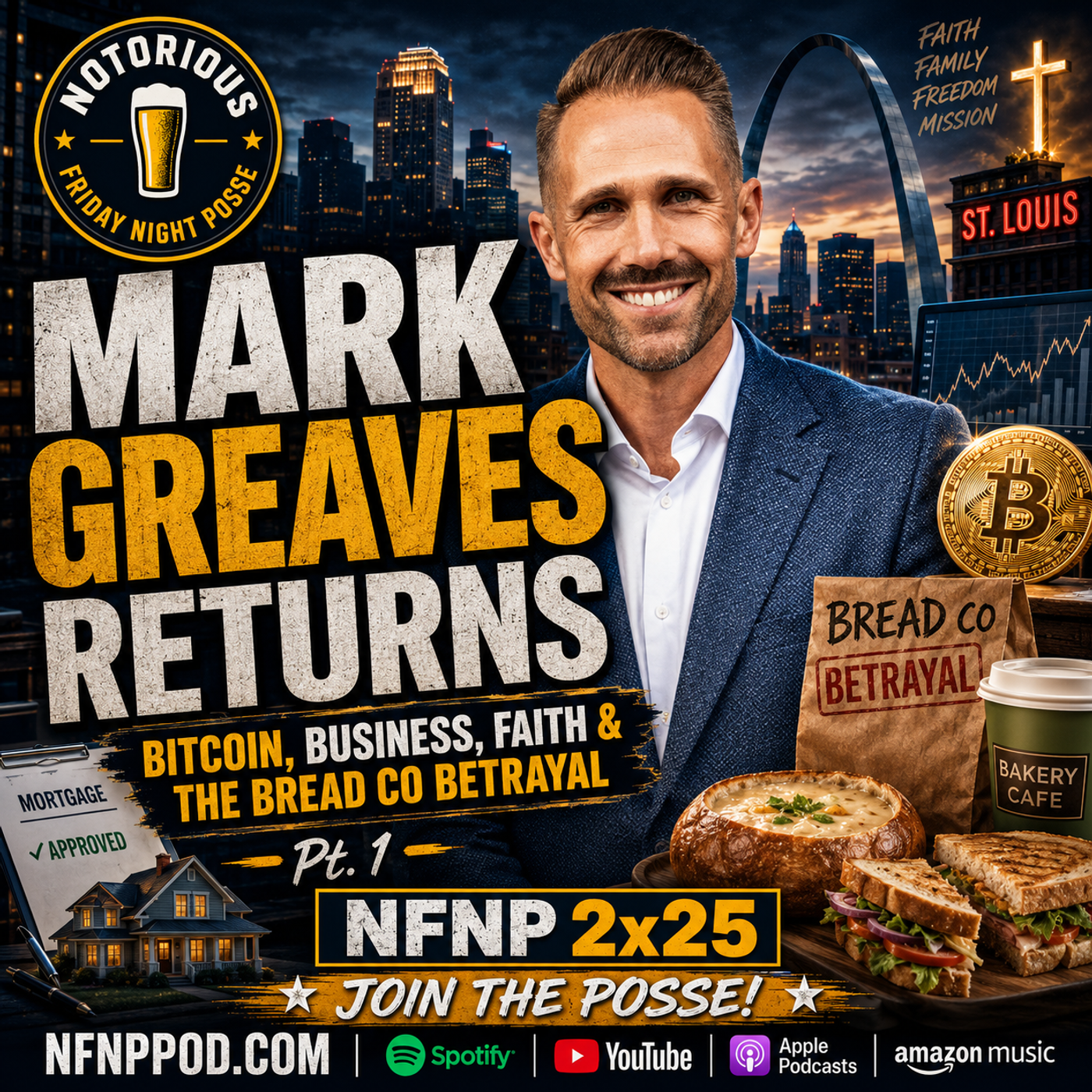
Original NFNP member Mark Greaves is back with the Posse.
Bright and Duds welcome Mark Greaves, a childhood friend, Ohio State volleyball alum, mortgage expert, business owner, podcaster and founder of Tithe Lending, for Part 1 of a two-part conversation.
The guys start with old NFNP energy, Rush concert talk, growing up in St. Louis, moving away to Ohio and never really coming back. From there, the conversation turns into Bitcoin, crony capitalism, inflation, big tech, faith, business burnout, mission-driven work and why Mark walked away from the giant mortgage machine to build something smaller, more intentional and rooted in giving.
Mark explains the story behind Tithe Lending, how the business gives back through Christian ministries and charities, and why more people seem to be searching for something sturdier in a chaotic world.
Then, after Mark jumps off, Bright and Duds hit the big St. Louis story of the week: Panera, or Bread Co if you were raised correctly, moving its headquarters out of St. Louis. The guys talk local pride, corporate decisions, cost of living, Boston vs. St. Louis, AI, quiet layoffs, and why another St. Louis company leaving town feels personal.
Plus, a quick City SC Posse tease before a huge match against Real Salt Lake.
Part 2 with Mark drops next week, featuring the full housing and mortgage conversation, home prices, interest rates, first-time buyers, HELOCs, property taxes, money being created out of thin air, and old NFNP stories involving broken braces, broken fingers, poker nights, stolen gas caps and teenage stupidity that probably should have stayed buried.
Listen, follow and join the Posse:
NFNPPOD.com
Bright: Of course, Duds, as soon as I do the countdown, he's like, I gotta gotta grab a beer and walks away. But it doesn't matter because we're joined today by Mr Mark Greaves, and I think we're in for quite an episode for a couple of reasons. one, Mark, you're you're a smart, successful dude, and we're gonna get into some stuff here. great topics on the economy, home prices, mortgages, all that fun stuff. but also you're an original NFNP member. OG is right.
Mark: I I am. And when I when I heard about this
Duds: gee.
Mark: well, I actually got a little bit nervous when I heard about this because I didn't know what stories you guys were telling on here. And
Bright: Yeah.
Mark: there's a lot of things that have happened in in the NFN P realm that I have not told my wife about at all. So I'm hoping that it stays that way.
Bright: Really? wow. All right. We we don't tell any stories that could get us in trouble, with the law, e even or with our jobs or any of that stuff. So investigations do it. There there could
Mark: There might still be a few open investigations from that period of time that
Bright: be. We you know, we may have had the cops called on us once or twice and yeah.
Duds: Couple deep dark secrets we like to keep hidden.
Mark: Yeah, these they need to be remain unsolved for sure.
Bright: For sure. Yeah, definitely. Maybe we'll get into some of that towards the end of the episode. I got some questions for you, Mark. But but certainly, you
Mark: no.
Bright: know, just for our listeners, we've we've pretty much all known each other since grade school. we all went to the same high school and then and then you bailed. You w you went to the Ohio State University, played some volleyball
Mark: Yeah.
Bright: up there, and then and then met a girl and and never left or never came home. Just
Mark: stayed here forever. I actually I I I've come to the realization it it's finally happened where I like it better here than St. Louis because my whole adult life is here. I don't know I don't know anything. So when I go
Bright: Sure. You don't even remember.
Mark: back to St. Louis, Danielle always makes fun of me because I still have to use Apple Maps or whatever to get around. And she's like, You're from here. And I'm like, I only drove here for two years. And I only I only
Duds: Yeah.
Bright: That is
Mark: drove around where my house was to my high school and anywhere else that we played sports. So it was like I don't really know how to get around.
Duds: Yeah, what's it been like twenty two years
Bright: That that is funny.
Mark: It's kinda it's kinda crazy.
Duds: now or something for you out there?
Mark: Yeah, it's twenty four. Twenty four years here. Isn't that crazy? Yeah, so
Duds: Twenty four. That is crazy.
Bright: That is crazy. And Ohio, you know, Ohio's a good state. You're you're based out of Columbus, which is a big city and a growing city, and and probably works works well with your business. Like I said, we're gonna get into to all of that. but but before we get into some of the deep dives, I I did have to call out our shirts. I I specifically wore my rush shirt today. You also and I wore mine for you, so
Mark: I wore mine for you, just for you.
Bright: but you you'll have to fill in Duds 'cause Duds was a little late, but you just went and saw
Mark: Yeah, I mean, dude, unbelievable show. I and each I think that was my eighth time seeing them because I've seen now on four different tours. And mo some of those tours I went to different places. I would go up here in Ohio and then I would go with my family down in St. Louis.
Bright: Right, right. And then back in Saint Louis, yeah, yeah.
Mark: And each tour they just add to the show. So
Bright: Mm-hmm.
Mark: I mean, obviously the ridiculous musicians and like the song, I mean everything is great. And if you've Never met a Rush fan before. Like everybody's basically in the Rush family. So like anybody that likes Rush, as soon as you meet somebody else that likes Rush, it's like you know each other, you understand each other. So it was kind of cool. We went in Chicago, me and my sons, and it was their first time, and I never
Bright: Yeah.
Mark: thought I'd be able to take them. So it was like a bucketless checkoff for me. And
Bright: Sure.
Mark: they were going nuts. And we're walking in and it's
Bright: And I'm sure they know all the songs because you've played it for You even gave me a C D when my kids were born that was instrumental
Mark: Every song. Every song. Yeah.
Bright: rush songs with like xylophones and stuff like that. I still have it. Lullabies, that's right. Yeah, yeah, yeah. I still got it. I don't know that I have a C D player anymore, but that's awesome.
Mark: Lullabies. Rush lullabies. Yes. I I told you, I was like, I played this for my kids. But no, man. I mean, my oldest boy just turned twelve and he's been drumming since he was five. so he he came out of the womb like loving music and and knowing he had rhythm and stuff. So he's been drumming since he was five. So he can play most rush songs now. He gets them probably like eighty, ninety percent of the way there. I mean, obviously there's there's parts and pieces of it that are too complex that he can't master yet. But like he the other day he learned La Villa Strangiato all the way through. And
Bright: Crazy.
Mark: so he was just like geeking out at the concert. It was so fun to watch. So really cool.
Bright: Nice, nice. And
Duds: Are you are you playing anything, Mark? I know you wanted to play guitar for a long time. Do you play at all?
Mark: You know, I like cowboy chords. Like I could play some chords and I can play some piano, but like I can't I'm not good, you know? Nothing. Steve is good. Steve can really
Duds: You're not playing any rush.
Bright: Now your brother though not like Rush, Steve can play. Yeah, Steve can play.
Mark: play. Yeah, and it's it's next level. Steve can really play. But man, what
Bright: Not
Mark: so the cool part about the show this time around was they had the South Park thing back in. They had
Bright: Yeah.
Mark: Paul Rudd and what's his face? Yeah, from they they were back in there.
Bright: Jason Jason Siegel. Yeah, they're bringing all so okay, so all of the old things. So they have the washer dryers. Washer dryers worn out. No. The chicken roasters. I remember the chicken roasters from one one tour.
Mark: Uh-huh. Washer dryers weren't out, but they had some other stuff that was out. I mean, it was it was just Yeah. They did the whole opening video was you know how like Getty was making sausages and stuff like that. They had all that all that stuff was back. Yeah. It was really cool.
Bright: Yeah, yeah yeah yeah. I remember that one. Yeah yeah. Yeah yeah yeah. So this is this is the last tour with twenty fifteen. So Neil's last tour. And
Mark: And you bought that on tour?
Bright: I bought this on well in Saint Louis. but I've I saw a lot with you when we were younger, when whenever they would come through Saint Louis. And you know, they were always three hour shows. I'm sure it's probably the same now.
Mark: yeah.
Bright: what about Getty's vocals? That's the only thing that that I was kinda hearing, you know, but Yeah.
Mark: We're all right. you know how it is. Like trying to hit notes that high when you're seventy or whatever he is, like very difficult.
Bright: Yeah, I I got his book right here actually.
Mark: See, I don't have that book yet, but
Bright: this was good. My F and Life. It's it's it was a really, really good read. Starts off with
Mark: I bet it is.
Bright: starts off with Hitler and Nazis and ends ends with brain cancer. Yep,
Mark: huh. Yeah, he was a his parents were Auschwitz survivors, yeah.
Duds: Is that right? I don't know that.
Bright: yep, yep, yep.
Mark: Yeah. Grayson's reading Ghost Rider right now, one of one of Neil's books. So
Bright: Nice. Yeah. But that that's how we ended up in Canada. You know, it's 'cause his his grandparents, I assume, they had to flee or his parents, I don't know. Somebody had to flee Hitler.
Mark: Whoever flees to Canada though? That's isn't that just weird like
Bright: That's what I that's what I was thinking. Why didn't we come to the the US? You know, Canada, really? Yeah,
Mark: I don't know. I don't get it.
Duds: Now you gotta flee Canada to come to the US.
Bright: really.
Mark: Yeah, you do.
Bright: Yes, you do. You're right about that. All right. Well, should we get into the reason, Mark, that we have you on and why don't why don't you run us through Well
Mark: Only if you want to make the show boring. If you wanna make it boring.
Bright: It I think it's actually quite interesting. I think our listeners think that it's interesting and and honestly we don't care whether people like it or not. This is more for us, it's fun.
Mark: Well you guys you guys have you covered a lot of ground, like financial stuff. I you know you guys have talked bitcoin, you've talked are you guys Bitcoin fans?
Duds: I am. Yeah.
Bright: Dutch is a big Bitcoin fan. I know you are as well. I hold a a yeah. Last time you were in town,
Duds: Are you Mark? nice. A fellow Bitcoiner. Love it.
Mark: Yeah. yeah, for sure.
Bright: I I took Mark out and his wife and we went and had dinner and drinks and played mini golf and he wouldn't shut up about it. That's all he talked about was Bitcoin.
Mark: Dude.
Duds: That's usually how it goes.
Mark: It's the Yeah, you meet a Bitcoiner and it's like we mean it's it's almost like one of those things where once you see it you can't unsee it and then it's like you just wanna tell everybody.
Duds: You see it everywhere. Yeah. You can relate anything to it.
Bright: Yeah, now mean relate anything to it. The only problem now
Mark: Mm-hmm.
Bright: is of course we're in a big down swing and everybody
Mark: Yeah.
Bright: everybody's probably lost money on it at this point unless you were in on it early. But
Mark: Not gonna not unless you're dollar cost averaging, you just keep buying. That's
Bright: Well, and that's that's that's Dud's argument. He always just says that he's buying buying low now and you know, of course he expects it to be four, ten times higher
Mark: You just gotta watch who's buying.
Bright: at some point, you know, so
Duds: The way I
Mark: Watch who's buying around the world and what's happening because it's it's the same thing that every that always happens. You know, institutions always front run retail and they gobble it up when it's like this and then they wait for euphoria to hit and then when everyone and the price gets bit up and then they they sell it to the rest of us. That's how it goes. So I'm buying now
Duds: Yep, that's exactly what happens.
Bright: Ain't that the truth?
Mark: when they're buying. I'm watching who's buying and I'm like, I'm buying while they're buying. That's that's that's my strategy.
Bright: Good.
Duds: Yeah, you know the funny thing
Bright: Duds, you buy
Duds: is I think I started buying when it was like at a hundred and something thousand.
Bright: I was in before
Mark: Yeah.
Bright: that.
Duds: Yeah, and I mean I I
Mark: Yeah.
Duds: had seen it over the years, you know, back even, you know, ten years ago was three I was just telling our our text group about that, about you know, if if I would have bought if I would have taken our down payment of our house when we moved back here in twenty sixteen, I think I could have bought a hundred and twenty Bitcoin with it. And that would be worth like twelve million dollars today.
Mark: Yeah. Well, there was a guy that
Bright: C coulda wulda shulda.
Mark: I knew. This is a real story. I don't know where this guy is right now. there was a dude named Scott. I won't say his last name just because I don't know.
Bright: Yeah, I I I know who you're talking about, but yeah.
Mark: No, there was a dude, so when I was working long time ago at American Bank, like second job I had out of college, Bitcoin's like two years old, and this guy wouldn't shut up about it. And the time, I probably would have listened to him, but I thought he was nuts because he was he had a drug addiction and he was always late for work and it was he was a messed up guy. But he knew his he was really smart though, but he was telling everybody like, you just gotta buy this. It's the future of money. And because it was him telling me, I thought he was crazy, so I didn't buy it. And I mean this guy had loads of it. So I'm like, he's either probably dead in a ditch from a drug overdose or he's bought his own island and he's a billionaire. I I don't know which one it is 'cause he he kinda nobody ever heard from Emmer again. But I mean it was he
Duds: So Mark, when did you
Bright: Well
Duds: actually get into buying it?
Bright: could be either one then.
Mark: what year did I start buying it? Probably like twenty eighteen, twenty nineteen.
Duds: So quite a while ago, yeah.
Mark: yeah, but just little by little. I wasn't buying a ton. I didn't like just go crazy and, you know, into it 'cause I didn't really know what it was.
Duds: Well yeah, every year that passes too it gets a little more stable, a little more stable. You get a little more comfortable with it. So that's what took me for it took me forever to get comfortable, you know.
Mark: yeah. Yep. Yep. Really twenty twenty to twenty twenty two is
Bright: I wanna say I was
Mark: sh it does, for sure.
Bright: That's when I bought my first big chunk, or I I'll say big chunk for me, was probably twenty twenty one, twenty twenty two. And then I bought a second, then I was buying a little bit here and there. I think you kinda talked me into it like just by, you know, twenty five bucks a week or a hundred bucks a week. So I I was buying a hundred bucks a week and then I bought another big chunk at what it was like a dip at like one seven, I was like, it's never gonna come back
Duds: Yeah.
Bright: down this low That was after it hit its high and I'm like, All right, I'm buying another big chunk at one seven and now I've lost, you know, half of that money, but just don't sell. Right. That's
Mark: yeah. Just don't sell it. Just never sell it. Just consider
Duds: Yeah.
Mark: just consider that it's just that's there for ten years from now.
Duds: Yeah, the way I look at it is it's
Bright: Well that's what I figure. I'm I'm
Duds: something you can actually save your money in. If you just if you dollar cost average in, you're actually putting it into a savings. And ten years from now, fifteen years from now, it's gonna be much, much higher than it is today. So
Bright: Yeah, and that's my thought
Mark: Yeah.
Bright: process pretty much for all my investments is sixty two. I'm that gives me twenty years until I'll probably even consider retirement and wanna start looking at, you know, making any changes to my portfolio to a larger scale. So I'll I'll just I'm just gonna hold twenty years. What are you gonna
Mark: What would you do what are you gonna do when you retire, Brighton?
Duds: Pod podcasting. He's already doing it.
Bright: do when you retire, right? I'm gonna podcast. I don't know. I mean Who would have thought you that first off, Mark, we'll and we'll get to this, you're a podcaster.
Mark: Yeah.
Bright: w never thought that we we would be podcasting. Duds brought it up one day and I was like, that that does sound fun. And then I was just like, let's do it. And we started doing it. And then now I have City S C posse as well with my brother that has eclipsed NFNP. believe it or not, we have more listeners on that that pod now. And maybe maybe when we're off air, you can tell us how many listeners you have on your pod. Cause you know, it's interesting. It's interesting to see, you know, where you start and you start seeing people coming in and you're like, who are these people that are actually listening to us? And do I
Mark: Yeah. You don't know.
Bright: do good? Are we just making Yeah, yeah.
Mark: No, I I that is viral though. Ours ours goes big on YouTube for some reason. We got like eleven thousand subscribers there and people
Duds: wow.
Bright: That's insane. I mean, we're nowhere near those numbers.
Mark: People watch it on YouTube a lot and it hits like a real target niche audience. I mean, it's for people who are trying to
Bright: Yeah, you're right about that.
Mark: live their faith through their work, and there's there's a vein for that right now where people are craving that kind of content. So the shorts do great, and then like the actual shows do great, and it's all over the place. Like there's no rhyme or reason like which one does really well. There's two specific ones that have been like super suppressed on YouTube because of some of the content in there. I can tell.
Bright: Because of the topic. yeah. Yeah.
Mark: yeah. It's like less than a hundred views. It's like the one before it had like eight thousand views and then this one has like forty. If
Bright: Right. Yeah.
Mark: it's like you can tell which ones they try to bury in the in the algorithm.
Bright: Sure. I I find that interesting too, even stuff that I post on TikTok and stuff like that and you know, we'll have one that that has thousands of views and then the next one will like two hundred and I'm like, All right, like what's going on? What
Duds: What was it, Mark? What was
Mark: Mm-hmm.
Duds: it you think that they were trying to suppress?
Mark: the one guy is basically there's like the main political lobby group that lobbies on the on behalf of like Christian ideals or values, right? It's called Center for Christian Virtue. He works for them and runs something called the Church Ambassador Network around the country. And because we're coming up on midterm elections, they were basically talking about all of that. So anytime you try to blend Christian values with the government,
Bright: Mm-hmm.
Mark: it just like they just suppress the crap.
Duds: No kidding. Wow. Yeah, we'd hate to we'd hate to have
Mark: It's like it's they don't let everybody see it. It's crazy.
Bright: Yeah.
Duds: that. We'd hate to have any Christian values in our government. That'd be
Bright: Really. And the but that's that's
Mark: Okay.
Bright: big tech and you know, Duds, we've we've covered this in in some of our episodes about the stuff that that they just weed out and and don't let anybody see. And of course we we saw that and there's proof of it going all the way back to COVID and, you know, the the last election that Trump
Mark: yeah.
Bright: lost, you know, how how much that was suppressed. We know it for a fact. So it doesn't surprise me. Yeah.
Duds: Algorithm.
Mark: Well, either e things are either suppressed or enhanced based on the agenda. I mean, look at what Fauci just did. Pleading the They peddled that guy
Duds: Mm-hmm.
Bright: That well that was gonna be my
Mark: out there like we're all supposed to just listen and trust this dude for years, and now all of a sudden it comes out that basically everybody
Duds: What color is your tie?
Mark: got screwed.
Bright: Yeah. Holly did a great job and I I think I think most of the the Republicans did. And actually this was gonna be my backup story, Mark, if you were a no-show for whatever reason. I was like, otherwise, what are we gonna talk about? And it it's just so relevant. and we haven't done a big COVID episode, even though I would love to go back and and really expose a lot of the craziness that went down. But what I find
Mark: Yeah.
Bright: funny, since we're talking about it, is how partisan it still is. If you watched it, all of the conservatives are hammered. him asking the questions, even though they knew he was pleading the fifth. And then as soon as you got a a Democrat, he they immediately were just like, Thank you for your service. You've done more than any other American in the history of this country. I love you. You're the best, you know. And I'm like, why is it
Duds: It's really sick.
Bright: still so split when we know, we know for a fact that half if not more of what he recommended was wrong and made up. And it's even in his own diary. It he c it's completely
Mark: And made up. Yeah.
Bright: Not for its i he dreamt it somehow and he knew he ended up just following the crowd of of liberalism and and fascism and that's what it turned out to. Don't get me worked up
Mark: It's really pretty insane. I mean our I I I almost I'm to the point now where I've just got like almost no hope in any politician or government person. Like it's just it's all just such a it's such a crock, man.
Bright: Sure.
Duds: I'm right there with you, man. I agree. I think they're I think they're all just corrupt and they're all in on it together, you know?
Mark: Yeah.
Bright: Well, we had a great episode
Mark: Yeah.
Bright: last week about crony capitalism and s gotten some really good feedback and and good views on so social media on on that topic. And we we were talking about that because of the poll that came out that said that like fifty well, I forget the exact number, fifty two or fifty eight percent of Democrats prefer socialism over over capitalism. And so the
Mark: 'cause that's 'cause we don't have capitalism so they don't know what they're comparing it to. Yeah.
Duds: Exactly. That's
Bright: Well and that and that was kind of Duds'
Duds: what we were saying, yeah.
Bright: point, you know, is is we have crony capitalism. And and I think that resonated. I think it resonated with some of our listeners. So it's true though. Yeah.
Mark: It's true though. Yeah. I mean, if if they knew true capitalism, obviously it would be much more pure and merit based than this. It's not. I mean, our system's set up basically the the rich will only pull away more and more and more. We and this gets into the real estate topic that I know you want to get into. They're only gonna keep pulling away more and more and more in the coming decades. And at some point there will be a revolution, which some people think Bitcoin is a peaceful revolution to the
Bright: Mm-hmm, mm-hmm.
Mark: the economic catastrophe that's coming. But we're gonna enter a a currency collapse. There's going to be big issues. And there's only a matter of time when the vast majority of the country won't be able to keep up with inflation. The system isn't working for them. So that's why people are voting for this other crap is because the system we have today is already stacked against them. It's already rigged against them. It just won't work. So they're trying to vote for any possible alternative. That's usually what happens before there's some sort of a big revolt.
Bright: Yeah, and hopefully through elections
Mark: Is like they tried to do it peacefully through elections, but then when that doesn't work, then it's like all right, now we have to overturn the whole thing. So it's it's common.
Bright: Right. And hopefully we we do see some of those minor corrections that can help bring us down the right path. We can't go too far to the left, can't go too far to the right, but then everybody in the middle just keeps doing the same thing and increasing debt and inflation's out
Mark: Mm-hmm.
Bright: of control and so there's there's no real solution. And that's kind of what I brought up last week is is this is not post World War Two capitalism anymore. Right? W coming out of the out of the the World War and and in the fifties, it was great, you know, corporations were just getting started, everybody had money, you were spending every it was the golden age of America. And to your point, the gap
Duds: Then nineteen seventy one happened.
Bright: Well yeah.
Mark: Because you're no his that's what you just said was exactly right. The golden age came because we were still pegged to the gold standard, money still mattered, it and it it actually bought what it was worth, you know, and it it held true to its value. And after Bretton Woods, after after World War Two, when we became world reserve currency, then all of a sudden we can print energy. Like think about it, like when when every oil trade is done in dollars,
Bright: Mm-hmm.
Mark: we can literally print energy.
Duds: Mm-hmm.
Bright: Sure.
Mark: Because we have the world reserve currency and the and then that's that's basically what's been happening. Everything was so cheap for so long.
Bright: And of course that's what that's what China's trying to change and w I think we've we haven't done a deep dive on that, but we've certainly talked about it in prior episodes that you know, China, c several other comtr countries.
Mark: Well, we got a buddy that we went to school with that a long time ago told me the thing I asked him, I was like, What are you most afraid of for like a coming world war? Like what would what would trigger it? And he literally said, If we ever lose the petrodollar, just wait, 'cause like we will fight. Because that once that thing turns over, it's not good. So we will we'll literally do whatever we gotta do to maintain that. Mm-hmm.
Duds: That's where all the power is. Yeah.
Bright: So where all the power is. Was was Venezuela the the first kind of a look at that? And now Iran? I mean, could could both of those things really be a result of, as you say, the petrodollar making sure
Mark: Yeah.
Bright: that e I think there was just a story today that China was was gonna start supplying Iran and they ended up denying it and the US came out and said, Don't even think about it So I don't know if it's a true story or not, but could you imagine if you know if China got into it any more than they already were, i i it could turn into a whole big bad thing. And and you're right, it's all over, you know, oil and and distribution of oil around the world and like you say, the petrodollar.
Mark: It's it's getting kinda crazy, dude. I mean w all I know is the kind of oil I don't know a bunch on this, I'm not an expert on this, but the kind of oil that gets produced out of Venezuela, the main refineries for that type of oil are Iran and China.
Bright: Right.
Mark: So like you don't you don't have to follow the breadcrumbs very long to figure out why we did that.
Duds: Yeah, from what I've heard, it's not it's not the it's not the good oil. Like the the Venezuelan oil is really hard to refine. It's not nearly as good as what you get. Right. Yeah. But I think it'll take
Mark: But it's got the most quantity of it. It's like the most mass quantity of it, yeah.
Bright: Right.
Duds: it would take like I think they're predicting ten years to get the infrastructure down there to actually start refining it to use. So they don't they just don't have it set up to do it.
Bright: We're playing the long game.
Mark: Next year is when all this is gonna hit, man, because like w when it comes to like the fertilizers and all that kind of stuff, like this year was already baked in the cake. Like those supply lines were r were cooking, but like I feel like next year is where a lot of this is really gonna start coming to a big head. It's gonna be very weird. Like
Duds: It is.
Bright: We we
Mark: I
Bright: will see. It's it's been it's been weird for a while now, right? Pretty much
Mark: It has.
Bright: since COVID, there's always been some it hasn't been again the golden age, twenty nineteen, you look back to twenty nineteen and everything seemed perfect, right? Other than maybe who was president according to fifty percent of the country. But other than that, the money was good, stock market was good, economy was good, inflation was low, gas was down, people had
Duds: No wars.
Bright: jobs. Like you would you would look back and you're like, it was great. And so of course something comes around like COVID and then you know, this crazy political stuff and And and wars and all kinds of things. We could go down that. So I got I got two things that'll transition us. One, I'll
Mark: Yes, go.
Bright: say I purposefully bought the house that I live in now in twenty nineteen because I said at the time, I said the the presidential election's coming up and If Trump wins, the Democrats are gonna go crazy and and it ain't gonna be good to have you know, because the Democrats just can't stand it. If Trump loses, the Democrats will screw up the economy. So I said now's the time to to get in and and buy a house.
Mark: You had great timing, my friend.
Bright: I di I did have good timing and you just said that you're not an expert at oil markets and and the petrodollar, but you are an expert at something and and that's why we have you on. You are an expert at All things mortgages and refines and all all of that stuff. Give us so we've made it already what, like we're probably half an hour into this twenty twenty-three minutes into recording, and we haven't even really introduced you other than an OG NFN peer. But but give us a little bit of a background of what you do now, how you got to to where you are, the company that you run, and and then I wanna get in and I got some statistics and I wanted to get into to what What you think is going on with the the housing market?
Mark: I'll give you the the the two minute resume. So graduated Ohio State, like you already poked fun at me about. Played men's volleyball. Yeah, yeah. And I
Duds: The the Ohio State. Come on.
Bright: The Ohio State. Yes.
Mark: played on the volleyball team, which was great because it's so it's such a manly sport. They gotta keep a net between us because who knows what would happen if we would, you know, get it the other team.
Bright: Hey, to to be fair though, you were you were like an all American or something, weren't ya? So no one cares about Hey, you got a full ride, I think, so y you take what take what you can get.
Mark: Yeah, all an all American at a sport no one cares about. That's that that's my claim to fame for sure. That's true.
Duds: Hey, my boy's gonna be playing that this this
Mark: But yeah, so
Duds: fall for the first time. He's getting into it. Yeah. He gave up soccer, so
Mark: really? dude. Yeah. Well, get ready.
Duds: he wants to wants to get into volleyball. Yeah.
Mark: That's good, man. I got I got my kids playing. There's not as many teams up here. It's not as it's not as popular with like youth sports up here, but we've we've got a team going, so it's it's pretty cool. But
Duds: Good. I've always liked it. I think it's a fun sport
Bright: Nice. I've always
Duds: to play.
Bright: liked sports. Yeah, it is a fun sport.
Mark: So mortgage got into it by mistake, not really mistake, but by accident, I guess. I was waiting for Danielle to graduate. She was two years behind me, so I had to get a job. And I knew some guys that were working at Wells Fargo. This is pre great recession two thousand eight days when
Bright: Mm.
Mark: you could do whatever you wanted in mortgage and they were making a bunch of money. And I liked them and I said, okay, cool, I'll get into that. So that I rode that way for about a year or two, and then she graduated. And by the time she graduated, I was managing 14 stores. And I was like, what this is a really good job. So we're just gonna stay here and we're gonna see what what happens with this. So stayed at Wells for about four years, left there to run sales for a smaller bank called American Federal Savings Bank. And we grew that to about 150 employees. we were doing maybe three, four billion a year in in mortgages. It was really profitable for the bank. but they had a really old guy who was their chairman. And when we presented a this was in twenty thirteen, we presented a business plan to go expand. And he shot it down, said we're already in due diligence with two other banks that are, you know, we're gonna basically be selling. We're not gonna increase any more risk that we've got going on right now in mortgage. So at that point, my boss, who is head of the division, said, We gotta get out of banks. I'd met him at Wells Fargo. We had been at a smaller bank now for a while. So in 2014, seven of us that left that company started something called homeside financial. And that was an experience because that was the first time I'd ever done this where we had a dingy nasty temp space with stained up carpeting and the first thing we did was Allen wrench together IKEA tables and chairs
Bright: Yeah.
Mark: to sit on and then literally went to world a beer right after because we had no computers,
Bright: Yeah.
Mark: we had no operating system, no CRM, no leads, we weren't even licensed. Like we had literally nothing. Like we started just putting together our table. well if you fast forward that business seven years to twenty twenty one, so in the middle of the pandemic, lower dot com was the the parent company that ended up I was the president at lower
Bright: Mm-hmm.
Mark: and Homeside was now a D BA under that along with like forty other national brands that were strategically located in different cities.
Bright: I think you sold my mortgage that I did with Home Side to lower
Mark: Yeah, we probably do.
Duds: Ha ha ha.
Bright: and then a couple of other places. Who knows where it is now? Even I don't know who owns my mortgage anymore. Yeah, they're all composed.
Mark: Yeah, they're all consolidating now, but that was a cool journey because we ended up we had about three thousand employees at the peak of it. we named the soccer stadium, so the Columbus crew here, it became lower dot com field.
Bright: I I teased that a couple of weeks ago 'cause at the time we didn't have it's not. okay. All
Mark: It's not that anymore though. It's Scott's Miracle Grow Field now. Yeah. Yeah.
Bright: right.
Mark: So that's a funny story. in those negotiations, I had never done this before. So they would throw me out to just like throw stuff out. So we were negotiating with a a company called Legends. So it's actually a a group that's under Jimmy Jimmy Johnson owns it. It's like Cowboys owner.
Bright: Yeah.
Mark: So Legends basically does like the big stadium deals around the country. so we would you know, be talking to these guys and I'd be Hey, what do you think about this? Hey, what do think about this? And we asked for a five year out. So it was a ten year deal with a five year out. And they said there's not a stadium in the country that has like a a main naming rights to it with a five year out clause. Like none. And we were trying to get it to where if our revenue dropped by a certain percentage, we could automatically initiate the the the out. they didn't go for that, but they did give the five year out, which was
Bright: Right.
Mark: crazy. At the time, I won't I won't say how much it is, but it was it was multi millions a year to have our name on that thing. And at the time it was about eight percent of our marketing budget. So we thought to ourselves like this is
Bright: Sure. That's that's nothing. You would think you could go Yeah, yeah.
Mark: Correct. Yeah. And and for what we got out of it and for the amount of publicity and especially
Bright: For sure.
Mark: here, it's like in our local, you know, headquarters it was a good it was a good investment at the time.
Bright: Well, a good a good way to get your n your name out there, 'cause at the time I I if I remember correctly, you y you guys were just starting to expand nationally and and really get that that lower dot com name out there. And I remember when you negotiated the deal, Saint Louis didn't have a team yet, but MLS was was really growing and and they're still growing. So you probably got in at a good time and you look at Saint Louis now, we had our first naming rights deal fall through. I don't know how or
Mark: Mm-hmm.
Bright: why. So We had to open up our first year as a team as City Park because whoever it was that they were negotiating with didn't didn't work out. twenty twenty twenty two? Yeah.
Mark: What year was it? I mean, there was there was there's a couple years
Duds: Twenty two. Yeah, twenty two, I think.
Mark: there where things were pretty squirrely on a lot of people just financially it was like, All right, this is not the time to be naming stadiums.
Bright: Right, right.
Mark: coming out of COVID, there was I mean, most businesses were struggling.
Bright: Well, inflation was at its peak, probably at twenty percent, whatever it was. I think yeah, I think it was actually what was it nine percent or I don't know. Sure.
Mark: Yeah. Well, and you gotta remember that was like the work from home era and there was a lot of layoffs going on and there was a lot of you know, a lot of industries were struggling in general and like trying to figure out I mean, really the only ones that were doing great were, you know, stuff like ours, mortgage, healthcare.
Bright: Mm.
Mark: There were certain things. Some tech stuff that was enabling people to work from home was just up into the right. But a lot of industries were struggling. So when all of a sudden it's like, hey, should we name this stadium this year? It was like you automatically already had a ton of places
Bright: Right.
Mark: that probably would have been interested, not interested. So
Bright: Yeah, yeah. And maybe it worked out for for St. Louis City because they they delayed, they went with City Park, and then they were eventually able to announce Energizer. And maybe by delaying they were able to secure a better deal. Obviously I'm not I'm
Mark: Probably.
Bright: not privy to that, but it it's a bummer 'cause you're counting on this this revenue for your first year or two and you don't have it and and you're no one as City Park. And then the concern becomes, is anybody gonna recognize it as Energizer Park, or is everybody just gonna call it City Park from now on? Right. You look at you look at you mentioned everybody called
Mark: Probably. That was our problem. Is everybody called it Cruise Stadium no matter what we did.
Duds: I didn't even realize it was in her I didn't even realize it was in her Jazer Park.
Bright: it personally. Yeah, so it's ener it's energizer now. Look at Miller Park. you were just up in Milwaukee. You mentioned this before we
Mark: Yeah.
Bright: started recording, and I think it's called American Family Insurance Field now. Nobody calls it that. They call it Miller Park. And it'll forever imagine if they tried to rename Bush Stadium. Come on. It would never work.
Mark: Will be that forever. And that's that's how Cruise
Duds: It would never work.
Mark: Stadium will be forever because when the crew launched here it was Crew Stadium. So everybody just still calls it that. So, I mean for us it went okay, but
Bright: Yeah. So everybody can still call. Sure. Yeah. But on a on a national level, you got the recognition, you got the the big whenever it was on national television, stuff like that. And I think you had some pretty sweet perks, did you not? And I say sweet perks, like you got some come on. Well that's what I said. I said
Mark: It was. I didn't go I didn't use them though. I never used them.
Bright: as soon as St. Louis gets a team, I'm gonna come and we're gonna sit on the on the field level in your owner's box
Mark: We had that.
Bright: or whatever that yeah, that you guys had. And then we get a team and you leave and you s you start your own you start
Mark: I quit.
Duds: Yeah.
Bright: your own company. So tell us a little bit about where you are now and what you're doing.
Mark: So this company is very different. tithe lending. So first off, it's not three thousand people. we're we're a couple you know, about a dozen people by design. I don't really have an appetite to do that again. I mean, that was some of the most stressful years of my life. It was really, really yeah.
Bright: Sure. To scale a business with that many people, manage that many people, even though you hire managers and all of that, you have to fire people, you gotta hire new people, you have to lay people off.
Mark: It was crazy.
Bright: I mean that's that's a lot of a lot of stress.
Mark: And you never you're never home. You never see your kids. it's put strain on your marriage. You're constantly stressed out. I mean, one story I always tell people is twenty twenty one, Christmas party. We're going down we had it down in the field, and I'm supposed to give a toast to our team, right? And I'm so stressed out because heading into twenty twenty two, rates were starting to take a turn. When you're trying to feed a machine that gets that big, like the the marketing engine has to be humming. And we're already seeing like, okay, there's there's cracks in this thing. We're scraping the bottom of the barrel now. And we're having to loosen guy qualifications and criteria for leads. We're having to go lower into the credit score tiers. We're having to go lower into the loan amount tiers. We're having to go wider in geography, do crazier kinds of loans, different types of properties, just to feed the machine that we had going.
Bright: Mm-hmm.
Mark: We also had venture capital come to the table where we got a hundred million dollar investment from a VC out of San Francisco. So now all of a sudden the pressure's on and
Bright: Yeah. You gotta have the reports ready to go for them. Yeah.
Duds: Ha ha.
Mark: So to get down to that stadium for our Christmas party, I had to take two Percocet and two shots of bourbon just to be able to like stand up straight because my neck was so wrenched for like a month that like when I stood in the mirror, my neck now is all in alignment, my neck was like over here. It was like an inch off on my shoulder blades because I was I was just so stressed out, man. I mean it's in that that that's scratching the surface with You know how a lot of executives get when they get to certain certain ways, but you can do it if you're willing to sacrifice everything
Bright: Yeah.
Mark: else on the altar of business. But like if you are still trying to be a good husband and trying to be involved with your kids and trying to do other things that it maybe interests you, like it's really hard to hold it all together. Almost impossible. So we're s we're a small business now. We've we've pivoted. So we're in nine states. Yeah.
Bright: Good for you for being able to take that leap. And I mean, that that's a big life change. And I'm sure you're gonna say it is gonna work out for the better, right? but it it's not easy
Mark: Yeah, it is.
Bright: to to sometimes give all that up, not only the power, but the money and and to start fresh. And you don't know. Are you gonna have the money rolling in? Are you gonna be able to support the same lifestyle? And and I know you we've talked about some of the things that you did have to give up. You don't have to talk about all that on air, but of course you you had to do something. of that and and where you are today, I mean, take take it off, yeah.
Mark: I'm happy to talk about it. I mean, we we did I mean, so th to start the business heading into twenty twenty three, my my business partner and I left our company. He was our COO. So we both quit on the same day. It was a little bit of a blow when you have two leaders. Yeah. But
Bright: Mm-hmm. You kinda have to though, that's how you gotta do it. Right.
Duds: Yeah.
Mark: starting in twenty twenty three, it was a it was a tough slog because rates had already risen. so the refi world is just closed off. And it largely has been for the last three years. It hasn't been a ton of refinance action. People pulling out home equity lines and stuff, yes, because obviously their home values have gone up. It makes sense. It can fuel their life and do some different things for them. But so you're just fighting tooth and nail for the purchase business that exists. But there's so many mortgage companies. So what when you take normal market, refinance would be about thirty percent of what you would do. Lately
Bright: Mm-hmm.
Mark: it's been probably for most places less than ten. You know, in in some
Bright: I would think so. Just the rate yeah, s of course. I mean, if if you got
Mark: And some zero. Yeah. So
Bright: in like when I did it in twenty nineteen at a rate under three, it doesn't really make sense to refinance now when you got rates at seven percent or higher a couple of years ago.
Mark: No, no, it doesn't. But yeah, so we knew it was gonna be tough. So we just sold stuff. I mean, it was like, hey, all the all the earthly stuff we'd accumulated, second homes and investment properties and stuff like that. We just ditched all that stuff and sold
Bright: Mm-hmm.
Mark: that stuff, took took the gains, invested them into the business. we had an awesome guy who had known my business partner who was a mentor to him years prior. I won't say how much he gave us, but he literally gave us hundreds of thousands of dollars with no strings attached to start the business.
Bright: Nice. He believed in the mission, right. Correct. Yeah.
Mark: Because he knew what the business stood for. Yeah. So we we Correct. Yeah. So we give the first ten we were we seen what finance and big business does. It's there's just full agreed. So we're like, well, how do we start a mortgage company that's the opposite of that? So we give the first ten percent of our revenues to Christian ministries and charities and anything from helping trafficked kids, homelessness, education funding, the list goes on and on. But actually we've just hit seven hundred thousand dollars that we've given away in the first three years. So it's like, hey, we everybody that does a mortgage with us, they're gonna get a great rate. They're gonna get experts who are working on their deal, but then they know choosing tithe lending is actually gonna help somebody in need in their own community. So it's
Duds: That's awesome.
Mark: kind of a cool twist on it.
Duds: Yeah, that's great.
Bright: It's it's very cool. Yeah. Now how how does that resonate with with your clients? How do you source business? Do they are they coming to you? Is it word of mouth? How y how does that work?
Mark: Little bit of everything. So we we we we know where to be. So we're on about thirty to forty different rate board sites and places that people go to, you know, do mortgage calculators and and search for things like that in the states and the cities that we want to be in. And then a lot of it is word of mouth. So some of it is realtor driven, just like a normal market would be. Like a
Bright: Mm-hmm.
Mark: you know a realtor, they're a lot of times the the person who makes first contact with a prospective home buyer, they're referring out for a pre approval. That happens a lot. Now that we've actually got traction and people know that this mission isn't just an idea. In the beginning, when you go out with a mission like that, people want to test it a little bit.
Bright: Sure.
Mark: it's not just people don't always just believe what you say. They want to see what you're gonna do. Now that we've got the track record and it's been happening for a while, it's attracting a lot of folks who either a like that thing or part of a nonprofit that we've supported or a place that, you know, maybe we've volunteered alongside. there's a lot of other businesses now who have hopped on the bandwagon with us up here. So that's the cool part that I didn't know what happened, but there's
Bright: Non competing businesses, I'm I'm assuming, right? So other segments
Mark: Yeah, yeah.
Bright: of the okay.
Mark: dude, everything from barber shops to construction companies to we got a guy who's pioneering a nanotechnology that's basically gonna be on every plane's wing here in a couple of years. I y you name it. But they've they've said, Hey, we want to do this thing too. So they've signed a pledge saying my business is dedicated to God and at least ten percent of my profits is gonna go to charitable works to help people in need. So we we didn't know that would happen when we started ours, but we've had a bunch of people kind of come on and And want to do it with us, which has been fun.
Duds: You know, I think it's kind of the the
Bright: That's how things get started.
Duds: perfect time for that too. I think you're seeing a resurgence in people going back to church and, you know, finding their faith because everybody, like we were talking earlier, you look at social media and look at what's going on in politics and you're like, I I think the
Mark: Yeah.
Duds: a big reason why the country and the world is in the state that it's in is because people kind of turned away from God for so long. And I think that's why you you're seeing this. And that's probably what's helping, you know, companies like yours become successful, you know.
Mark: I I I can use my own example. It was like they want something sturdier that's gonna hold up, that can actually withstand the weight of life. And when it's you're constantly looking for what's the next thing that I want or that I wanna do or that I'm trying to get for myself, and it's all so focused on me, it all just ends up feeling so empty and it all falls apart at some point. So it's like, all right, what is something that is tried and true that I can actually base my life on that I don't have to constantly be s guessing one way or the other? And a lot of people are finding that it's obviously it's God is
Duds: Mm-hmm.
Mark: like the one thing that's the constant and you know it's it's transcended time. So it's yeah, you're starting to see I think the the level of confusion is only going up. And since we've been talking about since COVID. I mean, these last six years have been crazy and the amount of chaos and confusion has just been up, up, up, up, up. So people are looking for something to like settle in. So it's happening.
Duds: Right. Yeah, get some like solid
Bright: Mm.
Duds: foundation for Right.
Mark: Yeah.
Bright: Well, I th I think the numbers back up your statement, Duds. W I mean, we saw certainly with COVID, you weren't even allowed to go to church. You weren't
Mark: Yeah.
Bright: allowed to go to funerals. You couldn't have a wedding. You couldn't be with family. And we saw suicide numbers go up, d depression, drug use, all of those things went up because people didn't know
Mark: Yeah.
Bright: how or who or where to connect with other people. And so once that opened back up and and people were I know this this is a little bit of a cliche lost, it was
Mark: Mm-hmm.
Bright: where can I go to find community? In a community that's going to accept me,
Duds: Mm-hmm.
Bright: right?
Mark: Yeah.
Bright: And and I I think that's ev coming even from a person that's not religious, at least not anymore, I understand
Mark: Yeah.
Bright: the benefits and and appreciate the the benefits of all of that.
Mark: It's crazy though to think like how like liquor stores and strip clubs were open, but churches were cl had to be closed. It's like how how do you not see what's going on here?
Bright: Right. yeah. And and it it just goes to show again
Duds: yeah.
Bright: the machine and the reprogramming that was that they were trying to do at the time. That's exactly
Mark: yeah.
Bright: what it was. The test. What can we get away with? it is crazy. And I think that's why you did see a little bit of a reset. That's that is why Trump won. I don't think anybody would would argue that fact. but okay.
Mark: the second time?
Bright: The second time. Yes. Or the third time, depending on how you look at it, but I digress. I d I
Mark: Yeah, probably one of the reasons. Yeah, there you go. That's probably true.
Bright: don't want to get suppressed on YouTube for election interference conversations or el election fraud.
Duds: He was he was running against somebody that was dumber than a rock, I mean
Bright: Well or or a vegetable, right?
Duds: That was the first person that dropped out.
Mark: Has anybody seen anything from Biden? Has has Biden even emerged? Like it's
Bright: He did
Mark: he basically his presidency ended and then like he's not been heard from since.
Bright: He did a couple of things. I know his wife wrote a book. He may have wrote a book. I he's been I
Mark: No he didn't.
Bright: think he may have I mean obviously he didn't, a ghostwriter or AI or something, you know, but Exactly.
Duds: Doctor Jill wrote it for him.
Bright: Yeah. So I've seen a couple of things, but for the most part he's been out.
Mark: Every every picture you see of Biden is just him like licking an ice cream coat. It's
Duds: Ha ha ha.
Mark: just so funny. It's like, my god.
Duds: fallen off his bike.
Bright: Falling off his bike. man.
Duds: Remember that?
Bright: Yeah. Well and that's what's kinda crazy when you look back at it and I think people will look back at it. It's already starting, but even ten, fifteen years from now, b what were we thinking? Like, this guy couldn't run the country? Why like and I think they'll do the opposite. Honestly, I think they will with Trump. I think they'll look back and they'll say like, you know, he actually did a pretty good job and we might not have liked his theatrics, but his policy
Mark: This time around I think I'm kinda I'm getting kind of sick of him this time around.
Bright: Well, I I think I think several people are and we've definitely talked about it and I I think that's primarily
Mark: no.
Bright: around Iran and and the like. I know Bob Capman, who we talk a lot about on the podcast, has yet to join us, but is is pissed off at gas prices and diesel prices. And he his main thing is certainly inflation and and whatnot. And
Mark: Yeah.
Bright: yes, inflation has gotten better, but it's not great. Yeah, it it's back up to what, three and a half percent or something.
Duds: I don't I don't think that's even true. Like I think that's all just propag that's propaganda.
Bright: And we
Mark: If you believe their measurements,
Duds: Yeah.
Bright: We talked about it. Yeah.
Mark: just look at what you actually spend. Do you do you track your spending? Like if you actually just look at like what am I s what did this used
Bright: Yes. huh, we all do.
Mark: to cost me? And then you look at what they're telling you inflation is and you're like, that's not
Bright: Dud specifically in the group chat sends his electrical bills from the year before and now along with all of his usage. And it'll be like here's my loose usage last year. Here's the exact same usage this year, and my price is forty percent higher,
Duds: Twenty percent.
Bright: right? Like ridiculo like numbers to numbers. Like you can't and we talk we talked about it last week. Unless you're buying televisions. Televisions have gone down in price. Great. And I and I said this in our most recent blog post. You can't feed your family with televisions, right? You can't you can't enter
Mark: Dude, but it's the entertainment zone, right? It's that is that is what they want. When we're entering this type of a I mean, you guys love sports, but I mean I've been to Turkey and visited the seven churches of in that were in Revelation and they're all ancient Roman cities, like massive Roman cities like Ephesus.
Bright: Dudge was just in in Greece.
Duds: Mm-hmm.
Bright: I just did Bath England, Bath and and Stonehenge and
Mark: Look at the stadiums.
Bright: all that stuff and yeah, sure.
Mark: In all these ancient civilizations, it's like you hit this peak where like the only thing left is like, well, just entertain The bread and circus era, we're in it. We're so in it that it's like give every streaming service, give cheap TVs, give stadiums, give them gambling. I mean, that that's the most dangerous thing right now. It's like you can gamble on your own life. You gamble everything. It's like there's there's
Duds: On the weather, right?
Mark: so much hopelessness.
Bright: Did you listen to our episode last week? 'Cause that we specifically talked about that, gambling sure.
Mark: That people are just gambling. No. It's bad, man.
Bright: And when you do win, you don't really 'cause they'll just they'll just say, sorry, it was it was fraud or sorry it was the machine malfunctioned or y yeah, yeah, yeah. So the house the house always wins.
Mark: It's ridiculous, man.
Duds: It's funny that you mentioned the sports, Mark, because the during COVID, you know, when they shut actually all the sports got shut down too. I was big into watching Cardinals baseball and watching football and doing fantasy sports. And when that happened,
Bright: Mm-hmm, mm-hmm.
Duds: I was kinda like, Hey, I have all this free time. I never have gotten back into it. I'll go to a game every once in a while and if it's on, I'll I'll watch, you know, watch it. But I am not following it like I used to. It to me it's like
Mark: Dude, same. I don't even golf anymore. I don't do anything. 'Cause
Duds: It's just kind of a yeah, it's a waste to me anymore.
Mark: I'm like I I have so much life to live. I would rather do something than watch other people do something. So I'm like I
Bright: Something that's gonna better yourself, right? You spend more time reading books with your family, exercising.
Duds: I'd rather watch my kids play sports than go watch an a a professional do it, you know.
Bright: Sure. Yeah, yeah. I I think that and it might be the stage of life that we're in, but I I think there's something to that where it's like what what can I do to to better myself, be a better dad, be a better husband, and it's not necessarily spending three hours on the sofa drinking beer watching a Cardinals game, right? It's it's getting out with your son and teaching him how to throw a ball, right? Yeah. Yeah.
Mark: Hundred percent. You'll have plenty of time to sit on the couch later in life.
Duds: Yeah.
Bright: Right. When when your kids have left you and they're all vr yeah, your
Mark: It's like don't don't miss these years. Yeah.
Bright: knees don't work anymore. That that's the time to watch Cardinals baseball.
Mark: Hundred percent.
Bright: Yeah. Not when you're in your prime, that's for sure. So all right.
Duds: But I think it does open your eyes up to how much of that is really just pushed on society and how, this is so important.
Bright: I think you're right.
Duds: There's so much money in it. And it's everybody's gotta watch these events, you know, and everybody come and do this and distract you from what's going on. And some people like that as a distraction of, you know, the everyday, all the politics and stuff like that. But at the same time, I just can't see past it anymore. I can't it it doesn't distract me like it used to.
Bright: Well see that's thing. I do l I still like like going to the city games and doing that stuff. Of course I like it, it's fun. I
Duds: Sure.
Bright: go with my wife a lot. You're actually coming with me, to the next game Saturday night, right? Which will which will be fun. Yes.
Duds: Well I was actually gonna ask you about that. I listened to the last city posse and you were talking about taking your wife, so I thought I got booted from this.
Bright: Well, y we recorded that last week. We couldn't we couldn't find a babysitter, so she's gotta stay home with the kids. So you are my date for Saturday night at the game. There you go, you're all caught up.
Duds: All right, well I know what we're doing. I I listened to the episode, so I'm I'm ready to be wind and dined.
Bright: we're gonna release another episode before the next game against Real Salt Lake too, so yes. We'll go have some fun.
Mark: my God. You're a hot date, Dudley. He's a hot date.
Duds: Thank you. I'm the bear. I'm the bear.
Bright: We'll get we'll we'll have a Saturday night distraction. We'll drink some beers. I I think there's something to be said about that. You know, certainly getting out, spending some time with a buddy or by yourself or a date night with your wife. You can't always be around the kids, but
Mark: Sure.
Bright: But it is it is interesting when you're talking about following the money, right? There's just too much money in it. And they have to make sure these stadiums are full, the like you said, Mark feeding the machine. The advertising spots have to be filled,
Mark: Dude, we get hit up all the time.
Bright: the jerseys have to sell. All of those things. Otherwise people are losing their
Mark: So
Bright: jobs.
Mark: got like a brag on my wife. She's actually this this September, she's getting inducted into Ohio State's Hall of Fame. Cause Danielle
Bright: Very cool.
Mark: was she was ridiculous. I mean, she's she's the third all time career points leader in history for OSU women's volleyball. Yeah.
Bright: Congratulations to her. Yeah. Wow.
Duds: Wow. It's impressive.
Mark: She ridiculous. but yeah, we Yeah. Yeah,
Duds: She better than you, Mark?
Mark: she was good. But we we get hit up all the time to like contribute to all these NIL funds and stuff. I'm like, that's what people are spending their money on? Like
Bright: Yeah.
Mark: there there's so man there's literally kids fifteen minute from each one of our houses who are like have no food. And then but we're
Bright: Yeah.
Mark: like, No, these athletes need to make millions when they're teenagers. That's what we're spending
Duds: Well, and that's probably some one of the worst things
Bright: Yeah.
Duds: you can do is give a teenager millions of dollars too. I mean, that is just setting them up to fail from the very beginning.
Mark: It's insane to me. I tell them no every time. I'm like, I'm not giving any of this my money to NIL stuff. Like, I'm not doing that.
Bright: People will give it to them because these kids make money and then they just immediately go out and spend it. I mean, you can look at all these NFL
Mark: Mm-hmm.
Bright: players, they make their first ten million dollars and nine point five of it's gone before they make it to their second contract. And most of the time they don't even get a second contract, they get booted and their money's gone, and they're like, Well, what am I gonna do now? You know,
Mark: It's crazy.
Duds: So I'll be flipping burgers.
Bright: because they go to strip clubs, they buy jewelry, they buy cars, you know, they it is nuts. It is nuts. Second half of that conversation deserves its own episode. So we're going to hold the rest of that conversation with Mark Greaves for next week. In part two, we get into the real housing crisis, the mortgage conversation, home prices, interest rates, first-time buyers, student loans, property taxes, HELOCs, and whether anyone can actually afford to buy a house anymore. Not to mention how money basically gets created out of thin air. And Because Mark is an original NFNP member, we also get into some of those old stories from our early posse days. Grade school soccer, broken braces, broken fingers, poker nights, stolen gas caps, and all kinds of things that could get us in trouble with the law. So that drops next week. Make sure you come back to check that out. But before we wrap up this week, Duds and I really wanted to get into the big St. Louis story right now, and that of course is Panera or Bredco. If you were raised correctly, they are moving their headquarters out of St. Louis. And after talking with Mark about business, money, cost of living, faith, mission, and why regular people feel squeezed, the story fits a little too perfectly. it's the big story in St. Louis right now, and that's Panera. St.
Duds: yeah.
Bright: Louis St. Louis Bredco. Breadco. All kinds of different names that we have for it, moving their headquarters out of St. Louis.
Duds: Boston.
Bright: To Boston of all places. Boston. Boston. Why?
Duds: You know, I've always had s a little bit of angst against St. Louis Bread Company because of their whole embracing of this Panera name outside of St. Louis. I'm never like that. Why can't you sell the St. Louis Bread Co?
Bright: So I don't know the real official story, but I do have a some history on it. So it was founded in 1987 by Ken and Linda Rosenthal. They opened up the first St. Louis bread co in Kirkwood, and Ken invested $150,000 of his own money plus a small business loan. And he was inspired by a San Francisco sourdough bakery. So that's kind of how it started. And then he eventually grew to twenty to twenty-four bakeries. Around St. Louis and in the the metro area, give or take. And he sold it in nineteen ninety-three. So he scaled up pretty quickly.
Duds: Mm-hmm.
Bright: Sold it to however you pronounce this company, Aubon Pond or something like that. I don't know. How how done yeah, Aubon Pan, however you pronounce it. Yeah, yeah.
Duds: yeah. Albontown. Like some French some French bliss.
Bright: Exactly. Sold it for $24 million, give or take. And the story that I had always told, so they re
Duds: Boy, that's cheap.
Bright: well, by today's standards, wait wait until I told you how much they sold it for in twenty seventeen. But
Duds: Gotta be billions.
Bright: Ken, you know, Ken who invested one fifty sells it for twenty four million. th that's a good return on your investment, no doubt. And he's a multimillionaire living in St. Louis. He's probably set up for life, and he probably still h held on to some stock in the company.
Duds: I'm sure. Yeah.
Bright: yeah, yeah, I'm sure. So in nineteen ninety seven, the company rebranded to Panera Bread. in markets outside of St. Louis. And what I had always had heard is that they tested St. Louis Bread Company in other markets and people hated it 'cause they they thought St.
Duds: Right. 'Cause they hate Saint Louis.
Bright: Louis was crap. They hate Saint Louis, which we talk about on this podcast often. And and one of our other guests talked about it.
Duds: Yeah. Seems like if you're not from Saint Louis you hate it for some reason. I don't I don't I don't get that.
Bright: Yeah, Adam Swart, when we had Adam Swart on, he talked about how St. Louis is one of the worst-run cities in in America. And he even talked about how many Fortune 500 companies we've lost. And I don't necessarily think Panera is Fortune 500, but maybe they are. I don't know. But to
Duds: bien.
Bright: lose them is is a big blow to to St. Louis. And for us locally, we've always had a little bit of pride. in them being a St. Louis company and it remaining St. Louis Bread Company in St. Louis. Now a couple of years ago in other like St. Charles, Wentzville, Edwardsville, they already started rebranding those stores Panera, which is kind of crazy. But in my industry, we do a lot of meetings and stuff like that at Paneras. And so whenever we do one outside the St. Louis market, I always make sure to tell people, you know, this is a St. Louis Bread Company and in St. Louis we always call it breadco. And now
Duds: Right.
Bright: it it it now I'm kinda like F that noise.
Duds: Mm-hmm.
Bright: I just w I won't even go at all.
Duds: I know. We actually just ate it last week and it was pretty good.
Bright: Well, it is good, you know. And they had supposedly they've struggled a little bit. so but they they did sell the company.
Duds: Probably struggle because of the low carb diet push, you know. Right.
Bright: Well, like what I'm doing, right? So absolutely. Like no bread for me. and we you know
Duds: Although sourdough bread is supposed to be good for ya. I believe so.
Bright: Is it better for you? Yeah. And Nila, if he ever if he ever comes back on the podcast, he's got some NFMP stories. Do we used to go to Nilla, who worked and
Duds: yeah, get the free Saint Louis bread. Yeah.
Bright: he would just g hand out sandwiches all day long, you know? Yeah, right.
Duds: Bacon turkey bravo, come on.
Bright: And he would he would just make it while he was making the other sandwiches and and he'd slowly call us up and we'd go get our sandwiches one by one. And for years we didn't pay. At least two years, I would think, sixteen to eighteen or fifteen to eighteen. eighteen, we never paid for breadcoat if Nila was working. Yeah,
Duds: It was awesome. Loved it.
Bright: it was great. It was great. and it is a good company I'm sure to work for. I've always heard good things. But then they sold so they they got up to around twenty two hundred locations across the US and Canada. And they sold to a German private equity firm, J A B Holding Company, for seven and a half billion dollars. That's a lot
Duds: That's a lot more than twenty four million.
Bright: more than that. Yes it is. Yes it is. That is a lot of
Duds: Lot
Bright: money. So now the news broke earlier this week and of course their their actual headquarters moved during COVID. They're now in Fenton, which is where we grew up, in
Duds: Mm-hmm. Right.
Bright: Fenton, j you know, just outside of St. Louis. so they're gonna move their headquarters over the next couple of years to to a a city w within the Boston metro area. but but essentially it'd be like saying St. Louis, they're moving it to Boston and
Duds: Are they down in the old Chrysler plant area? Is that where they're
Bright: No, well c I mean, close. I mean Merritt, do you know where Merritt's is? th
Duds: Yeah. So right down the street.
Bright: yeah, they're on the other side of the street now. So they're in the old Merritt's building, I
Duds: Okay.
Bright: think, that's on the other side of the highway. So and and I think they do a hybrid model for a lot of the employees, right? So you got to work from home, go into the office, that kind of a thing. But I I
Duds: So how many jobs is that that they're moving or displacing?
Bright: I don't know that I have the exact numbers and and originally they said it's not going to include certain, you know, c customer care and and things like that. But I also read another article that said eventually all of them are gonna move. And so th there'll be nothing left. So even if they keep a call center here for now, eventually it sounds like that might that might move on too. And so they're moving to Weston, Massachusetts is actually what what it is. And I guess the CEO maybe has some kind of connection to Boston. Boston, but as a whole, this German equity firm doesn't. The the company has no real stake in Boston. So I'm like, why why Boston? And to me. It is not. That
Duds: You wouldn't think that Boston would be a cheaper place to move your headquarters. Yeah.
Bright: is what I want to talk about primarily. It is not. And it doesn't make sense to me on a on a business. you know, trying to grow your business. It doesn't make sense. St. Louis, we are we have a lot of smart people here, college educated people. You can find good people and generally you can afford them for less than you would on on the east
Duds: Sure, I would imagine.
Bright: coast. I guess there's some benefits. You might attract some higher talent c you know, Ivy college educated people, Ivy League people, I don't know. But is it really worth it in the long run when you're looking for the the best bang for your buck? I I don't think so, right? And especially when you've been doing it for this long in St. Louis to just up and move. So here's what I kind of think is happening. I think they're just looking to lay off a huge chunk of their workforce. Move over to AI and and you know work with a much smaller downsize
Duds: Downsize their headquarters.
Bright: your significantly, but they don't want the bad press. So
Duds: So they say relocating.
Bright: so they're relocating, and what they're doing is they're offering people that are affected a 10% raise. Not good enough. Not gonna do it. And A fifty thousand dollar relocation bonus, if you if you want to call it that, right? So we'll
Duds: That might cover your might cover your relo relocation. Yeah.
Bright: you're move your moving expenses at best. But wait until you hear some of these numbers. So overall cost of living is roughly we'll I'll I'll put it in the middle, sixty percent higher than St. Louis. home land prices, which is the bulk of that, it's still twenty percent higher. Grocery bills, gas bills, energy bills.
Duds: So your ten percent bump ain't gonna cut it then.
Bright: It it ain't gonna cover. It ain't gonna cover it. No way. That so the housing market definitely is the biggest gap in that. home prices, rents are drastically higher.
Duds: Yeah.
Bright: listen to some of these stats. So the St. Louis Metro median household income is a little bit below the national average that we were just talking about. $82,000. But Boston Metro, where they're moving, is right around a hundred and fifteen thousand dollars. So much higher.
Duds: That's a big jump. Yeah.
Bright: So you're gonna have to pay people more if you're recruiting after the fact, right? Like th they're just gonna cost more in in Boston. There there's no doubt, no doubt about that.
Duds: So like you said, they're probably discouraging people from actually moving there.
Bright: I think that's what it is, you know. So yeah, they give you fifty thousand dollars, which sounds nice, but Even if you took all of that money to put it on a down payment on a new house or something like that, your house is gonna cost more. You're gonna have to pay moving expenses. You probably have a spouse that has a job here in St. Louis that's not gonna allow them to relocate. Of course, you you probably have kids that go to school here. You're gonna have to uproot their whole life. And you're only gonna get a ten percent bump when the cost of living at a minimum when you take housing out of it costs twenty percent more. So financially you're gonna have a lot.
Duds: Well, and you're gonna have to you're gonna have to buy a house or have a place to live too, so you can't just discount that.
Bright: Of course, or rent and all of that's gonna cost more, exactly. And it takes time and a lot of work and you're gonna have to call up our buddy Mark. you know, it it's it's not always fun to do that. So d it that it doesn't make sense. So that's what I really think is happening, is they're quietly laying people off, but it it it's better press to say they're relocating and that those people decided voluntarily to take the severance package and and not relocate for personal reasons.
Duds: That is a very astute observation. I think you might have hit the nail on the head there.
Bright: Thank you, Duds. so the average house in Weston, Massachusetts. Any idea of what it costs? I know you know Weston well.
Duds: boy. I'd have to say seven or no, let's go eight fifty.
Bright: Not even close. Two point three million dollars. Two
Duds: No, come on, no.
Bright: point three million. That's the average home price in Weston.
Duds: Man, I was off by a factor of three.
Bright: Yeah. Now that's not to say that if you move there you have to live in Weston, so you probably can't afford a house in Weston, so you gotta live further away. And a commute in Boston is a lot more challenging than a commute in St. Louis. Am I right about that? Yes. Yeah.
Duds: Gosh, that is insane. yeah, it's gotta be worse.
Bright: Right. Gotta be the traffic's worse, the gas prices are higher, everything. So so you're also giving up more of your free time. And who knows if th they might require you to work an office five days a week up in Boston. They haven't said if it's gonna be a hybrid model or you know what it
Duds: So you're gonna you're gonna move from a a place that has a median household value of around what four hundred thousand maybe here in St. Louis? Yeah. Up to two
Bright: We're probably right there with the national average, I would think, maybe a little bit less. So yeah.
Duds: two point four? Is that what he said? Two point three? So I mean, that's just never going to happen. Nobody can afford that.
Bright: Two point three, yeah. Two point three, yeah. That's just never going to happen. No. No. Exactly. That's why I I really think that this is they're moving to AI or they're gonna outsource their jobs and and they're they're just looking for the better press and the CEO wants to live in Boston, because I guess he like I said, Paul Carbone, he has Boston area ties. So whatever that means. So
Duds: Yeah. Sounds like a son of a bitch.
Bright: Yep, I don't know. I know if it was me, I would I would say no, I take the severance package and now you're looking for a job, so
Duds: I also saw that FedEx is laying off or closing a couple couple places too. Did you see that? It was
Bright: I'm we're gonna we're gonna start seeing it. We're gonna see it because of the economy. We're gonna see it because of AI.
Duds: Two two regional facilities closing Hanley Road in Maplewood and Lakefront Drive in Earth City, cutting one hundred and forty three jobs.
Bright: Yeah. Yeah. The logistics, AI is just gonna get better at working logistics. So you're not gonna need as many warehouses. You're gonna you're gonna be able to to manage all of that better. So people are gonna lose their jobs, they're not gonna need as many facilities, and that's just gonna be one of the consequences. Now hopefully we'll replace those jobs with something else, but that's just the way that it is.
Duds: It's unfortunate really. It's it's really
Bright: Yeah.
Duds: upsetting to see a a company like that too, especially with the name, you know, Saint Louis Bread to actually to leave.
Bright: Sure. Yep. Yep. And it it just again it it just further further lands on, you know, what's the long term hit for Saint Louis, you know? jobs, tack tax base, all of that not good. But but also when you look at Panera, you know, where are they gonna be ten years from now? Right? Like I don't know.
Duds: I mean their food is good, but it's not spectacular, you know. I could
Bright: No. I think honestly I think one of the reasons we go there is is just because it's it's a St. Louis company and I like I'd like to support it. Yeah. Yeah. Well,
Duds: Right. Yeah. I mean, decent sandwiches. They got soups, you know. Always liked their bread bowl, but
Bright: it's like look look at the beer that I drink now, right? I have less ties to Anheuser Bush. You're you're still drinking A B, but we have less ties. Like growing up it was A B or nothing. yeah. Right? But once they sold
Duds: yeah. I mean everybody everybody knew somebody who worked at the brewery too. So I mean everybody was tied to that.
Bright: Sure. Yeah. Yeah. Even my even my dad, indirectly, he he worked for another company, but he worked down at the brewery, which was great, 'cause anytime he did, he got to bring home a couple of cases of beer. Every week
Duds: Mm-hmm.
Bright: he got two two free cases of beer.
Duds: Yeah, it's just one of those things. It's it's sad to see, you know, the the history and the ties, you know, like the legacy to kind of just dry up and disappear. It's like you don't have it anymore.
Bright: Yeah. Well that's the thing, and and everybody knows somebody that works worked or works at Panera. We still know somebody and somebody, you know, big within our group that works at the headquarters, you know, with a corporate job. So at the moment Yeah.
Duds: That's why like representing another Saint Louis company.
Bright: Well, for now you know, so I was on a I was on a work No,
Duds: I don't see them ever selling.
Bright: no, I don't think so. I was on a work trip the other day and somebody brought it up. From outside of Saint Louis. They have no connection to Saint Louis. And they brought up First Form and the Frisellas and everything like that. And I'm like, I know them
Duds: Yeah.
Bright: You know. And I was like, Holy cow And then we started talking podcasts and and all kinds of different things. And so it was just kinda cool because th you know, they've grown their brand nationally and and the podcast too. So
Duds: And he represents Saint Louis really well too, I think.
Bright: Yeah, he does. Yeah, no, absolutely. So, you know, for for us, you know, we have a lot of pride in Saint Louis, even though we we do like to bash on it. I think it all comes from a place of love. We all want, you know, the city to be successful and and to be seen in in a great light nationally.
Duds: There's a lot of nice places to live, but honestly I couldn't see myself living anywhere else.
Bright: No, me, there are families here, of course, but you know, the the cost of living here is affordable. It's a good place to live. I always say it's a small, big city. You everybody kinda knows somebody that
Duds: yeah.
Bright: knows somebody at least, right? You know, it's that classic where did you go to high school question, which is the the big thing here in Saint Louis. And you know, we we talk about it but
Duds: I I don't know if that is definitely not something that is in other cities. I can guarantee you that.
Bright: No,
Duds: If but you meet anybody in Saint Louis and you start get to talk to and you probably know somebody. You know somebody
Bright: It's the first question they ask you. Yes.
Duds: who knows somebody that knows them. You know, it's like
Bright: And you also ev even though y you s you stereotype them a little bit, you know, you say and whether it's fair or not fair is that's another debate. But they say where they went to high school and you immediately can start making assumptions about yes.
Duds: I've profiled you. I know exactly everything about you.
Bright: You know, yeah, the type of person they were in high school, the type of person they are today, what kind of family life that they had, you know, what how
Duds: yeah.
Bright: they partied, who they partied with, what sports they probably played, all kinds of things like that, right? It's
Duds: It is funny.
Bright: it is it is kind of funny for sure, for sure. All right. you and I, we got we
Duds: Two more things. Two more things.
Bright: got the the well, this is the real last thing. We got the soccer game on Saturday night. So maybe we'll have you on the next City S C posse episode, and you can talk about your experience down at the game, what you thought. We're riding a big winning streak here. We're unbeaten
Duds: I've heard
Bright: in eight games. we've worked our way from fourteenth in the table to seventh, and we're playing rail Salt Lake this week. They're ahead of us in the standing. So we've got a chance to to continue moving up the moving up the table.
Duds: Can we jump or are they too much higher than us?
Bright: gotta double check that. If you're interested in can we jump rail salt lake, you might have to come back and listen to C D S C posse, which is gonna which is gonna launch tomorrow too. And actually I I think I do have it here if we if we wanna see.
Duds: So you're inviting me to the postgame? You're doing the pregame with Kev?
Bright: W yeah, we're we're gonna I'm gonna invite ya, I'm gonna do the pregame with Kev and then yes, with the postgame. So we're at twenty five points right now. Real State Salt Lake sits at fourth place at twenty six points. So this is a a situation where if we win that bumps us up to twenty eight points, and if a couple of other teams lose, we could be firmly in fourth place.
Duds: Wow, that's quite a jump.
Bright: So fourteenth fourteenth to fourth in a matter of a couple of weeks. So this is this is
Duds: That's pretty crazy.
Bright: a big game. That's a big game. It'll be fun. Weather looks a little iffy, so we might have to be prepared for that.
Duds: Maybe we get a little liquored up and then we come back after the game and do the postgame at your place live.
Bright: that could be fun.
Duds: Ha ha
Bright: That could be fun. We'll have to see. We'll have to see how that goes. Or w you know, the app that I use, we can go live from our phones or record
Duds: Perfect.
Bright: from our phones. So yeah, maybe we take some segments there.
Duds: Do it in the stadium too, yeah.
Bright: Y we could do it from the stadium. We'll you know, we'll have to see how it how it plays out. So
Duds: Stay tuned.
Bright: Stay tuned for that. All right. Well, lots of fun as always. We definitely went late. My wife is gonna be upset. but but it was good having Mark on and stay tuned. Well
Duds: Yeah, I might have to check out the the HELOC too, man. I mean, getting a rate like that and using that money for improvements around the house, who knows?
Bright: Absolutely. House improvements improvements refinancing an existing loan that you might have, that you took out a couple of years ago. This is a great way to lower rates and all that stuff. And five
Duds: Take it, buy some Bitcoin.
Bright: Bitcoin. And I and I think our buddy Mark can help you out, that's for sure. So that
Duds: Take your home equity and buy Bitcoin with it.
Bright: that's a little bit iffier. But you know what, with a with rates at six percent, i it's it's possible you could crush it. Yeah, well.
Duds: It's not the dumbest thing to do. There's dumber things. You could take it all and bet it on a you know, gamble it away.
Bright: Yeah, they're excited on black. Right, sure. Yeah, yeah, a hundred percent. So I talked about that on on the last city. Did you yeah.
Duds: I know. I I heard ya.
Bright: That's funny. Well, thanks for supporting it anyway. Outside of the Rexum episode, last week was our most viewed episode and it was about double the amount of listeners that you and I get, so I know.
Duds: man. I'm feeling kinda slighted now.
Bright: I know. City S C maybe maybe eclipsed us. We'll just have to do more cross promotion, Duds. More cross promotion. Absolutely. All right. Well take care. We'll see we'll see ya next time.
Duds: Alright, buddy. Later.
Bright: Thanks to Mark Grease for coming back to the posse. We barely scratched the surface this week, so we're saving the rest of that conversation for part two next Friday. Next week, Mark gets into the housing market, mortgage rates, first-time buyers, property taxes, home equity, how money gets created out of thin air, and whether anyone can actually afford to buy a house anymore. Plus, we finally get into those old NFNP stories: the doorknob incident, broken braces, broken fingers. Grilled cheese, stolen gas caps, and the kind of teenage stupidity that makes you thankful podcasting did not exist back then. This week we had to hit the Bred Co story leaving St. Louis because that one really hurts. Another local name, another corporate move, another reminder that St. Louis Pride and corporate spreadsheets do not always live in the same house. And if you're listening before Saturday night, City has a big one against Rail Salt Lake. Check out City SC Posse for the full review. And Duds is coming with me to the game on Saturday night. Maybe he'll be a guest in next week's City SC Posse. So make sure you follow the NFNP, follow City SC Posse, and join the posse at nfnppod.com.