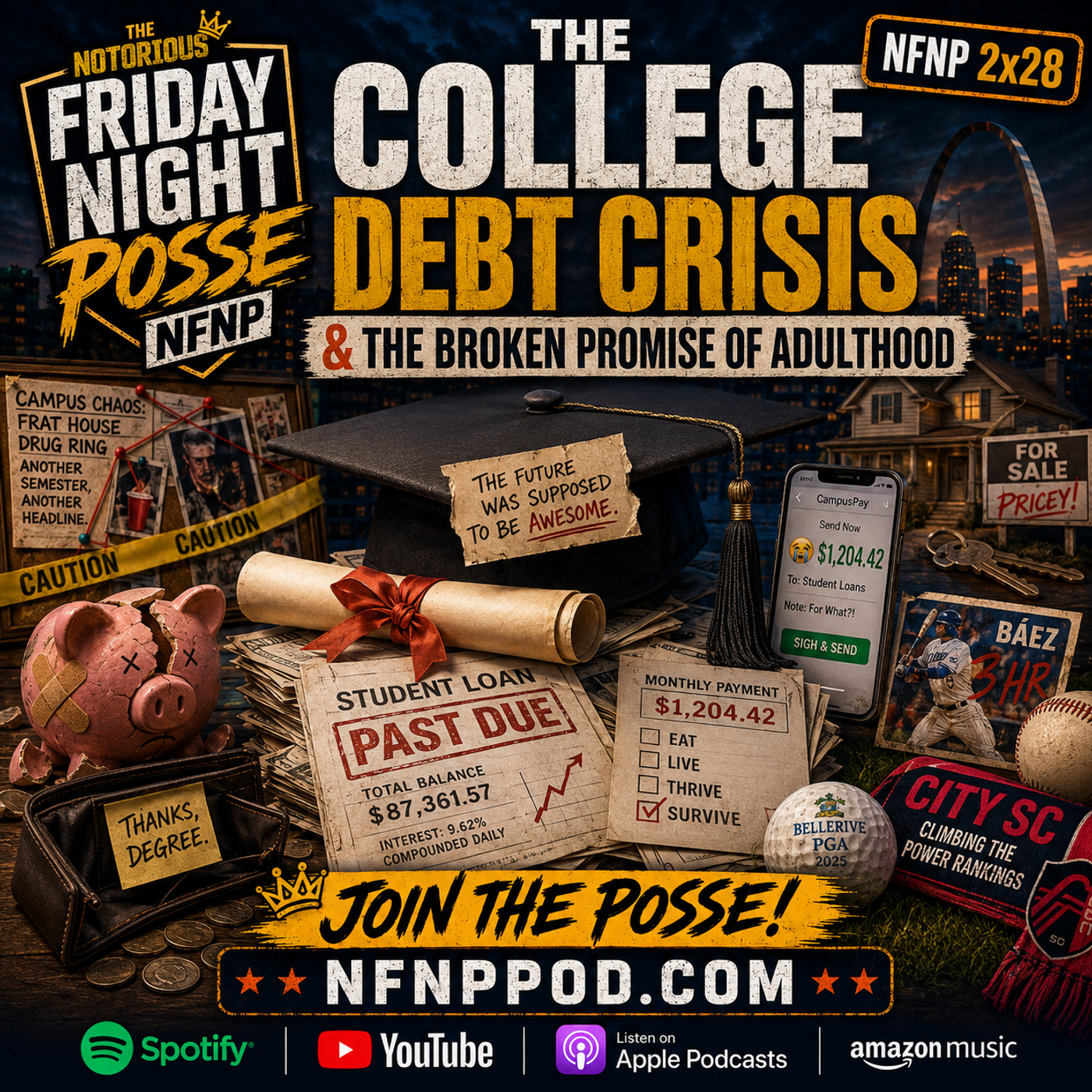
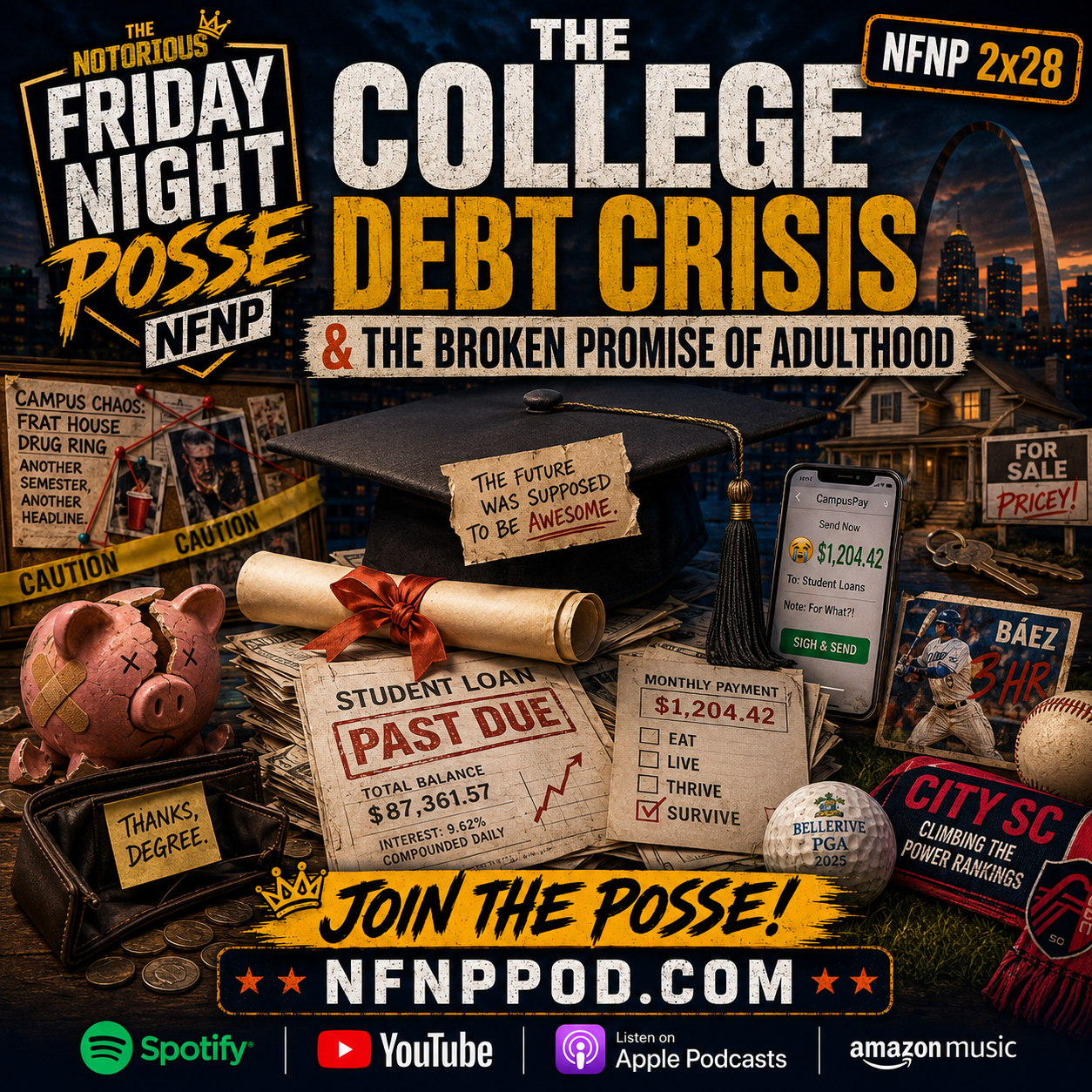
The College Debt Crisis & the Broken Promise of Adulthood
College was sold as the ticket to the middle class.
Get the degree. Get the job. Buy the house. Start the family. Build the life. Retire someday before your knees file for divorce.
That was the pitch.
And to be fair, for a lot of people, college still works. A degree still tends to increase earnings. It still opens doors. It still matters for a lot of careers. Nobody is saying your surgeon should have learned anatomy from YouTube Shorts and a motivational podcast.
But the old deal has changed.
Now the ticket to the middle class comes with interest, fees, repayment chaos, confusing portals, financial aid forms, parent co-signers, parking passes, meal plans, freshman laptops, and a student loan servicer that follows you around like a ghost with a calculator.
On NFNP 2x28, Bright and Duds continued what has accidentally become a three-part series on why adulthood feels financially booby-trapped: housing affordability, the scam economy, and now college debt. The episode moves from old college fake ID stories into the Penn State frat cocaine-ring story, then lands right where it belongs: the college debt crisis and the broken promise of adulthood.
The Debt Is Not Small! Let’s start with the number that makes everyone want to close the laptop and move to a cabin with no Wi-Fi.
Outstanding student loan debt stood at about $1.65 trillion in Q2 2026. At the same time, credit card balances stood around $1.26 trillion, which we will round to $1.3 trillion because this is NFNP and we are not testifying before Congress. Total household debt was about $18.8 trillion.
Meanwhile, the federal student loan portfolio included 42.6 million recipients. And if you are wondering whether people are handling that just fine, please enjoy this financial piano falling out of the sky:
About 9 million borrowers, owing roughly $220 billion, were in default as of March 2026. That represented more than 13% of the federally managed portfolio. Another 3.5 million active-repayment recipients were more than 30 days delinquent, including about 1.4 million in late-stage delinquency and at risk of default within six months.
So yes, the system is working beautifully, assuming the system was designed by a raccoon in a bank lobby.
The NFNP Budget Solution: Just Add It to the National Debt. Here is where the episode went full NFNP.
- Student loan debt: about $1.651 trillion.
- Credit card debt: about $1.263 trillion.
- National debt: recently over $40 trillion.
So naturally, the solution is obvious: Just add the student loans and credit cards to the national debt.
Boom. Done. Fixed. America’s newest bipartisan program: The “What’s Another Three Trillion?” Act of 2026.
Using the rough numbers, that gets you to about $42.964 trillion. Is that how federal accounting works? Absolutely not. Is it good policy? Probably not. Would it be very American to solve a debt crisis by creating a slightly larger debt crisis and then acting like we saved the economy?
Buddy, now we’re cooking.
Because at some point, when the national debt already crossed $40 trillion, adding a few more trillion starts to feel like ordering mozzarella sticks after you already put the entire restaurant bill on a credit card. Is it responsible? No. Does the waiter still bring the ranch? Yes.
That is the modern American financial system. “And it’s gone,” but with better branding.
College Is Still Expensive, Even Before the Surprise Fees Attack. The College Board reported average published tuition and fees for 2025–26 at:
-
$11,950 for public four-year in-state students
-
$31,880 for public four-year out-of-state students
-
$4,150 for public two-year in-district students
-
$45,000 for private nonprofit four-year students
That is just tuition and fees. That does not include room, board, books, transportation, parking, computers, hidden fees, meal plans, dorm essentials, laundry, lab fees, Greek life dues, or the emotional damage of paying $19 for a campus sandwich wrapped in moral judgment.
College Board also notes that average net tuition and fees for first-time full-time in-state students at public four-year schools peaked at $4,450 in 2012–13, adjusted to 2025 dollars, and declined to an estimated $2,300 in 2025–26.
That is important nuance. Financial aid exists. Net tuition can be lower than the sticker price. Not every student pays the headline number.
But that nuance does not erase the lived experience. Families do not budget for “net tuition” in a vacuum. They budget for the whole machine. The dorm. The meal plan. The books. The parking. The gas. The laptop. The lost income. The “required” online homework platform that somehow costs $137 and looks like it was designed during the Clinton administration.
Tuition may be one line item, but college is a full-body financial experience.
More Young Adults Are Carrying the Debt Longer. Pew found that young adults today are more likely to have student loans than young adults in the early 1990s. Among people ages 25 to 29, the share with student loans rose from 28% in 1992 to 43% in 2022. Among people ages 30 to 34, it rose from 18% to 39%.
The amount owed has grown too. In 1992, the median amount owed on student loans, adjusted for inflation, was about $6,000 to $7,000 across young-adult age groups. By 2022, it had climbed to $16,000 for ages 25 to 29 and $20,000 for ages 30 to 34.
That matters because this debt lands right when people are supposed to start building adulthood. You graduate. You get the entry-level job. You start paying rent. You need a car. You need insurance. Groceries cost more. Dating costs money. Weddings cost money. Kids cost money. Houses cost money. The refrigerator breaks. The A/C dies. The medical bill shows up from four different companies you have never heard of.
Then the student loan payment taps you on the shoulder like: “Hey, remember me? I’m your past making sure your future stays weird.”
No wonder adulthood is delayed.
Pew also found that young adults are marrying later and less often than 30 years ago. Among ages 25 to 29, 29% were married in 2023, compared with 50% in 1993. Among ages 30 to 34, the share married dropped from 63% to 51%.
Student debt is not the only reason for that. Housing, wages, culture, dating apps, cost of living, and general modern chaos all play a role. But student loans are definitely in the room.
They are sitting in the corner with a clipboard, asking whether your bachelor’s degree has considered refinancing its trauma.
Parents Are Still on the Hook Too. The broken promise does not only hit borrowers. The Fed’s 2025 household report found that 47% of adults ages 18 to 29 received help from someone outside their household to pay an expense in the prior 12 months. Common areas included cell phone bills, general expenses, and housing costs like rent, mortgage, or utilities.
That means parents are not just helping with college. They are helping after college. The kid graduates, and the economy looks at the parents like: “Congratulations. You thought you were done? That’s adorable.”
Parents help with bills. Parents co-sign. Parents contribute to rent. Parents set up 529 plans if they can. Parents worry about whether their kids should go to college, trade school, community college, military, straight to work, or just become a YouTube channel reviewing energy drinks from a garage.
And this is where the whole “college is the ticket” message gets complicated. For decades, the default advice was simple: go to college. But maybe the better advice should have been:
Go to college if the math makes sense.
- What does the degree cost?
- What career does it lead to?
- What is the expected salary?
- What happens if you do not finish?
- Is community college a better start?
- Is trade school a better fit?
- Is the expensive private school worth it, or is it just a four-year luxury resort with finals?
The answer will not be the same for everyone. That is the point.
The Degree Still Pays, But the Receipt Is Ugly. Here is the part that keeps this conversation from becoming too simple.
College still pays on average.BLS data for 2024 showed that workers age 25 and older with a bachelor’s degree had median usual weekly earnings of $1,543 and a 2.5% unemployment rate. Workers with only a high school diploma had median weekly earnings of $930 and a 4.2% unemployment rate.
So the degree still has value. But the question is no longer simply, “Does college pay?”
The question is: Does this college, at this price, for this student, in this major, with this debt, at this interest rate, in this job market, still make sense?
That is a much harder question. And it is a ridiculous question to ask an 18-year-old who still thinks the campus meal plan is a good deal. Eighteen-year-olds are not known for long-term financial planning. They are known for eating cereal out of a mixing bowl, buying posters from the quad, and believing they can survive on four hours of sleep and a gas station burrito.
Yet somehow we ask them to make six-figure financial decisions that can follow them for decades. That is not a financial aid process. That is a boss fight.
The Worst Outcome: Debt Without the Degree. The absolute worst version of this is borrowing money and not finishing. The Fed has noted that people who enroll and borrow for postsecondary programs but do not complete may still be responsible for the debt without having the certificate or degree.
That is the nightmare scenario.
- You do not get the credential.
- You do not get the wage bump.
- You do not get the clean résumé line.
- You do not get the “college graduate” checkbox.
- But you still get the bill.
That is like ordering a steak, the waiter bringing you one asparagus spear, and the restaurant charging you for the cow.
And because student loan debt is notoriously difficult to discharge in bankruptcy, it can feel permanent. The Fed has also discussed how non-completion plus student debt can damage financial well-being and restrict access to credit for big purchases like homes and cars.
So when people say college debt delays adulthood, this is what they mean. It is not just a monthly payment. It is a shadow on every next step.
Then There’s Penn State, Because Apparently College Needed a Crime DLC. Right before the main college debt segment, NFNP 2x28 took a side road through one of the most absurd college stories of the year: the alleged Penn State fraternity cocaine ring.
According to Fox News, court complaints alleged that suspects connected to Penn State fraternities used apps like Cash App and Snapchat to arrange cocaine transactions. The suspected ringleader, Agostino Abbatiello, 24, was dubbed online as “Pablo Pledgescobar.” Fox reported he was among those charged in connection with the alleged trafficking operation.
Pablo Pledgescobar.
That is not a nickname. That is a rejected Netflix limited series. The article says grand jury documents detailed 14 defendants in a multi-state cocaine operation involving Delta Upsilon and Sigma Chi, while the story text also refers to Abbatiello being among 13 others charged. So, for comedy and legal safety, let’s say a dozen-plus people were charged, because apparently even the defendant count needed a group project.
The allegations include drugs imported from New York and Philadelphia, pledges allegedly cutting and packaging cocaine, and one alleged associate sending about $30,000 via Cash App. One alleged transaction involved around 100 grams of cocaine for $4,000.
Again: allegedly. Allegedly, allegedly, allegedly. Put an “allegedly” counter in the corner like it is a telethon.
But the story is a perfect bridge into the college debt conversation because it shows the absurd double image of modern college life. On one side, families are paying tuition, room, board, books, fees, and parking.
On the other side, you have an alleged frat-house supply chain operation running through Snapchat and Cash App like Scarface got remade by kids who think disappearing messages also disappear from court documents.
Parents think they are paying for business school. Meanwhile, prosecutors are describing what sounds like narcotics logistics with a minor in app-based payment processing.
And yes, the obvious joke is that they were just trying to pay tuition. That does not make it legal. That does not make it wise. That does not make it an acceptable alternative to work-study.
But in the NFNP universe, you can absolutely imagine the defense: “Your honor, my client was not trafficking cocaine. He was pursuing an entrepreneurial solution to rising higher education costs.”
Denied.
The Broken Promise! The college story is not one story. It is several stories stacked on top of each other. It is the borrower with $100,000 in debt and a good job who still feels like the first decade of adulthood was spent digging out.
It is the teacher who needs a degree and maybe a master’s degree to earn a salary that starts too low. It is the kid who does everything “right” but graduates into rent, car payments, insurance, groceries, and student loan bills.
It is the person who borrowed, did not finish, and still carries the debt. It is the parent helping a 27-year-old with expenses because the cost of getting started is now insane. It is the taxpayer asking why someone else’s loan should be forgiven. It is the borrower asking why an 18-year-old was allowed to sign up for decades of debt before anyone taught them how interest works. It is the trade worker asking why college got treated as the only respectable path. It is the college asking for $45,000 a year while still charging separately for parking. And it is the federal government standing next to a $40 trillion national debt saying, “Have you considered another loan?”
That is the broken promise.
- College can still be valuable.
- College can still change lives.
- College can still open doors.
But it is no longer enough to say “go to college” like that solves everything.
The better question is:
What is the path, what does it cost, what does it return, and who gets stuck holding the bag if it does not work out?
Because right now, too many people are starting adulthood already behind. And when adulthood starts with a bill, a login, a payment portal, a servicer, a co-signer, and a balance that barely moves, the middle-class ticket starts to look less like a ticket and more like a cover charge.
A very expensive cover charge. With interest.
Listen to The College Debt Crisis & the Broken Promise of Adulthood | NFNP 2x28 at:
NFNPPOD.com

17 Unbeaten, One Cup Final & Josh Sargent Comes Home: CITY Isn't Done Yet