THE GREAT AMERICAN DEBT RESET - Act 1
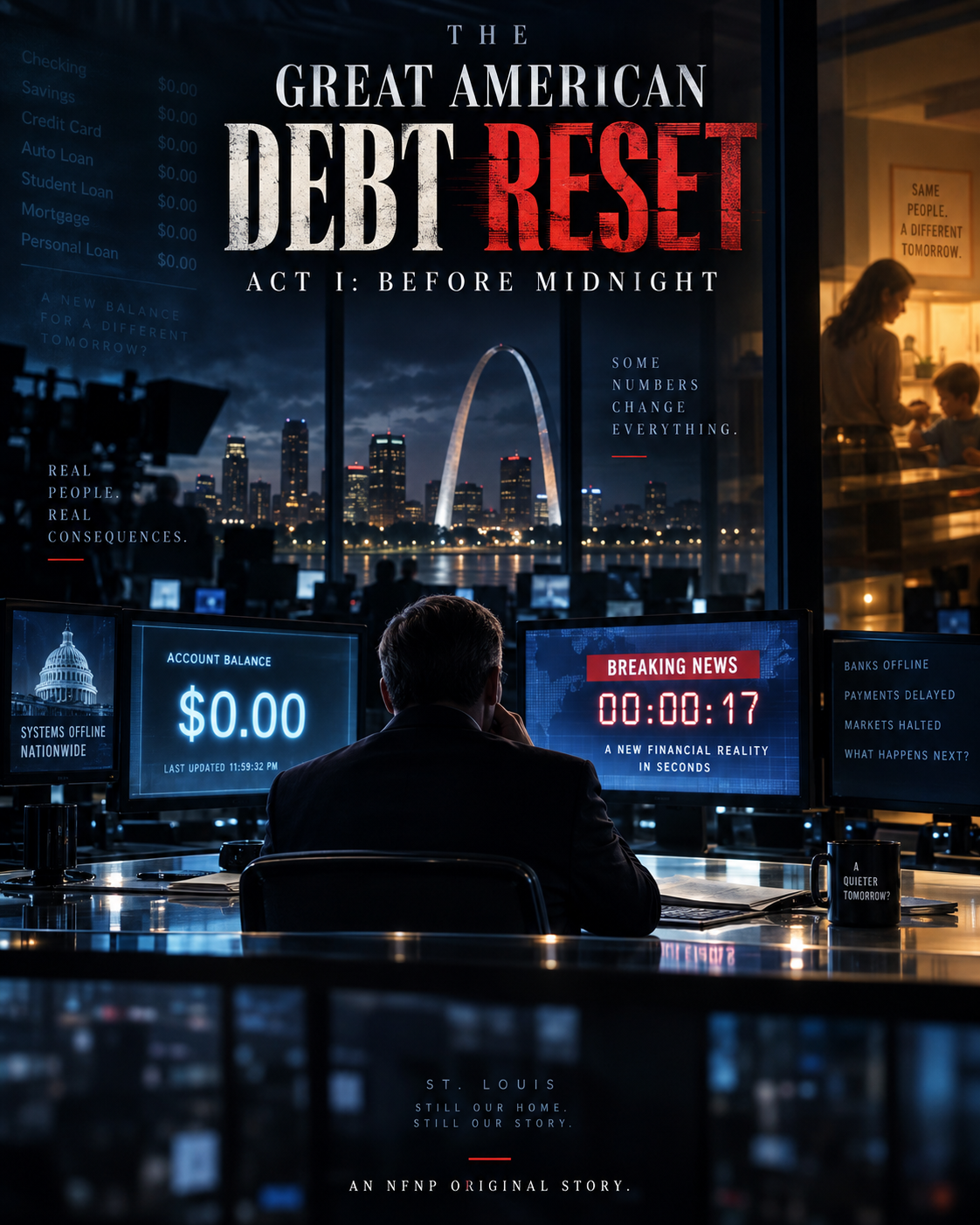
Before Midnight
At 6:14 on Tuesday morning, Evan Mercer learned that he had $147 in checking. This was not technically a crisis. A crisis was a tornado. A crisis was a chemical spill. A crisis was the mayor accidentally saying something racist while a microphone was still live.
Evan knew this because he had spent nineteen years telling people what counted as a crisis. One hundred forty-seven dollars in checking was merely Tuesday.
He stared at the number while standing barefoot in his kitchen, waiting for the Keurig to make a noise that suggested life was still worth participating in.
AVAILABLE BALANCE: $147.62
He refreshed the screen. Still $147.62.
“Well,” he whispered. “Good hustle.”
The mortgage had cleared yesterday. Daycare had cleared overnight. So had the $286 automatic payment to Visa, which was impressive considering that Visa's contribution to his household consisted mainly of sending emails congratulating him for having enough available credit to continue owing Visa money.
His phone buzzed.
CAPITAL ONE PAYMENT DUE FRIDAY
“Fantastic.”
Another buzz.
FEDERAL STUDENT LOAN PAYMENT SCHEDULED
“Even better.”
Behind him, Rachel walked into the kitchen wearing one slipper, pajama pants and the facial expression of a woman who had already heard one child yell Mom before sunrise.
“Are you talking to the bank again?”
“No.”
“You're holding your phone and swearing.”
“I didn't swear.”
“You said ‘fantastic’ in your bank voice.”
Evan put the phone facedown.
Rachel opened the refrigerator.
“We need milk.”
“We have milk.”
“We have enough milk for either cereal or coffee.”
He considered this, “coffee.”
“Correct.”
They had been married fourteen years. Some couples finished each other's sentences. Evan and Rachel triaged dairy products.
From the hallway came the sound of something hitting a wall.
Then their four-year-old son yelled, “I'm OK!”
Neither parent moved.
“Do we need to check?” Evan asked.
“No.”
“Good.”
Rachel poured the remaining milk into his coffee. Their daughter Maddie wandered in next, already dressed for school, carrying a piece of paper.
“I need forty dollars.”
Evan closed his eyes.
Rachel laughed.
“What?”
“Nothing,” Evan said. “I just enjoy how children always lead with the amount.”
“It’s for the field trip.”
“When?”
“Friday.”
“Of course it is.”
Rachel took the form.
“We'll do it tonight.”
Maddie shrugged and walked away.
Evan looked at Rachel.
“Credit card?”
Rachel looked at him.
“Credit card.”
That was how it happened. Not one catastrophic decision. Not a speedboat. Not cocaine. Not a secret second family in Tampa. Forty dollars here. An oil change there. Two root canals. Daycare. A furnace repair the same week their property-tax bill arrived. Christmas. A family vacation they probably should have postponed but didn't because the kids were getting older and Rachel had said, correctly, that there was always going to be some reason not to go.
And, yes, some stupid stuff. DoorDash. Amazon. A television Evan had absolutely convinced himself was necessary because the old television technically still worked but was “starting to look dark in the corners.” That phrase had cost them $1,299.
They weren't broke. That was almost what made it worse. Evan was the evening anchor at Gateway 8 News in St. Louis. Rachel was a speech-language pathologist. They made good money. People assumed they made really good money because Evan wore makeup on television and occasionally sat next to people who owned helicopters.
They had a nice house. Two cars. Two kids. A retirement account. A Costco membership. Three streaming services they remembered subscribing to and approximately six they did not.
They also had $21,418 in revolving credit-card debt. Rachel still owed $38,600 on graduate-school loans. Evan had $17,900 left from journalism school, a degree that had allowed him to spend the previous night standing in front of a touchscreen explaining why Americans were carrying record consumer debt. The irony had not escaped him.
Their household debt payments, excluding the house and cars, totaled a little over $1,100 every month. Enough that they weren't drowning. Enough that they were never quite standing on dry land either. Every month began the same way. Money came in. Money went out. Then they waited for money to come in again.
It was financial whack-a-mole, except every mole charged 24.99 percent APR.
By 4:45 that afternoon, Evan was sitting beneath fluorescent lights while a twenty-six-year-old producer named Tyler explained the American economy to him.
“Consumer debt is your B-block,” Tyler said.
“Again?”
“It's trending.”
“So is divorce. We don't do it every Tuesday.”
Tyler ignored him. “There’s been more chatter about the five-thousand-dollar rebate proposal.”
Evan spun toward him. “That thing would cost what?”
“About one-point-three-five trillion if everybody actually gets it.”
Evan whistled.
Tyler nodded toward the rundown.
“And this is the crazy comparison. Total credit-card balances are about one-point-two-six trillion.”
Evan stopped. “Wait.”
“Yep.”
“You’re telling me sending every adult five grand would cost more than wiping out every credit-card balance in America?”
“Nominally? Pretty much.”
Evan leaned back. “That feels like information somebody should not tell Americans.”
“Why?”
“Because somewhere a guy named Gary just heard that and screamed, ‘THEN PAY OFF MY DISCOVER CARD.’”
Tyler laughed. “That's basically our tease.”
At 6:17, Evan looked directly into Camera Two and became the version of himself that strangers trusted. Calm. Measured. Concerned, but not alarmed. He had perfected the face.
It worked for tornado watches, election nights and stories about lettuce being recalled.
“American households are currently carrying more than $1.2 trillion in credit-card balances,” he said, while the graphic appeared over his shoulder. A giant red number filled the screen.
$1.263 TRILLION
“Combine that with more than $1.6 trillion in student-loan debt, and Americans owe nearly $2.9 trillion across those two categories alone.”
Another number appeared: $2.914 TRILLION
Evan glanced at the teleprompter. Forty-three million federal student-loan borrowers. Average revolving interest rates. Minimum payments. Household cash flow. Numbers. Always numbers.
He wondered whether anybody watching realized the person delivering them had checked his bank balance before sunrise to see whether he could afford forty dollars for a field trip without moving money from savings. Probably not. That was television.
The meteorologist didn't have to personally enjoy weather. Evan didn't have to be debt-free to report on debt. Still, as he read the next line, something stuck with him.
“Economists say household debt can affect everything from consumer spending to home purchases, job mobility and decisions about starting families.”
That one felt less theoretical. Rachel had wanted a third child. So had Evan. They had decided against it. They never explicitly said, We cannot afford another child. Instead they had discussed bedrooms. Daycare. College. Cars. Schedules. Vacations. Retirement.
All of which was adult code for: We cannot afford another child.
“Coming up,” Evan said to Camera Two, “what a proposed five-thousand-dollar payment could mean for inflation, consumer spending and the federal deficit.”
The light went dark. Commercial break. Evan removed his earpiece.
“Cheerful show tonight.”
Tyler's voice came through the studio.
“Wait until the homicide at six forty.”
“Excellent.”
At 7:03, everything changed. The show was eleven minutes from ending when Tyler's voice suddenly cut into Evan's earpiece.
“Hold.”
Evan kept smiling while his co-anchor finished introducing a Cardinals story. Then Tyler said something Evan had never heard him say before.
“White House is requesting network pool coverage. National address at eight Central.”
Evan looked toward the control room. “About what?”
“No idea.”
“Military?”
“Doesn't sound like it.”
“Natural disaster?”
“No.”
“President resigning?”
“Please don't manifest that at seven-oh-three.”
Evan looked down at his script. “What do we know?”
“Almost nothing. Treasury secretary will be there. House speaker. Senate leadership.”
“That sounds economic.”
“That's what I thought.”
Another producer hurried into the studio holding a phone. “They're calling it the Household Financial Reset Act.”
Evan blinked. “The what?”
“The Household Financial Reset Act.”
“That sounds fake.”
“It is apparently not fake.”
Tyler came back into his ear. “Forget sports tease. We're staying on.”
Evan looked at Camera One. The red light came on.
“Breaking tonight, the White House has announced an unexpected national address scheduled for eight o'clock Central Time concerning what administration officials are calling a major household financial initiative.”
He kept going. Professional. Controlled. But the phrase kept bouncing around inside his head.
Household Financial Reset.
At 7:26, the first details leaked. At 7:31, Treasury confirmed them. At 7:33, someone in the newsroom yelled something that was not FCC-compliant. At 7:35, Evan read the bulletin twice because the first time he assumed he had misunderstood it. He had not. At 7:42, Gateway 8 interrupted regular programming. Evan sat behind the desk. A graphic beside him read:
THE GREAT AMERICAN DEBT RESET
“Tonight,” he began, “the federal government is preparing to erase nearly three trillion dollars in American household debt.”
For the first time in his career, Evan felt his heartbeat while reading a teleprompter.
“The program would eliminate all outstanding federally held student-loan balances and pay off existing revolving credit-card balances held by American consumers.”
His co-anchor turned slightly toward him. Not enough for viewers to notice. Enough for Evan to see the expression. Are you hearing this?
He continued. “Officials stress that mortgages and auto loans would not be affected.”
Another line rolled onto the prompter. “Credit-card companies would be compensated for outstanding principal rather than being forced to absorb the losses.”
Good, Evan thought. Because otherwise tomorrow's story would be BANKS ON FIRE.
“Future borrowing would remain legal. Credit cards would continue to exist. Colleges would continue operating under existing financing rules.”
Then came the sentence. “According to Treasury officials, at midnight Eastern Time, qualifying balances will be reduced to zero.”
Evan stopped for half a beat. Midnight Eastern. Eleven o'clock in St. Louis. Less than three hours away.
Camera Two tightened. “Officials estimate approximately $2.914 trillion in liabilities would be affected.”
There it was again. The number he'd reported an hour earlier as an abstraction. Now it was a countdown.
At 8:02, the President walked to a podium. Evan watched from the newsroom. There was no cheering. No partisan crowd. No campaign signs. Treasury officials stood behind him. Congressional leaders from both parties had apparently spent the previous forty-eight hours negotiating something that almost nobody outside Washington knew existed.
The President explained it simply. Americans had become trapped by revolving debt and educational debt. Washington had spent decades rescuing financial institutions, industries and markets. Tonight, he said, the rescue would go directly to households.
Rachel texted him.
WHAT THE HELL IS HAPPENING
Evan looked at the message. Typed. Deleted. Typed again.
I think our debt is about to disappear.
Three dots appeared immediately.
What debt?
Evan stared at the screen. Then another message arrived.
ALL OF IT????
He smiled.
Cards + federal student loans. Not house/car.
The phone rang before he could put it down. Rachel.
He stepped into the hallway. “Hi.”
“Do not ‘hi’ me. What is happening?”
“I am literally at work trying to determine that.”
“You just told St. Louis our debt is disappearing.”
“I did.”
“Is ours?”
“I think so.”
“How much?”
“All the cards.”
Silence.
“And student loans?”
“Federal ones.”
More silence.
Evan leaned against the wall.
“Rachel?”
“My student loans?”
“That's what they're saying.”
“All thirty-eight thousand?”
“Yes.”
“And your seventeen?”
“Yes.”
“And the cards?”
“Yes.”
Another pause.
Then: “Are we rich?”
Evan laughed.
“No.”
“We sound rich.”
“We're exactly as rich as we were this morning.”
“We owe seventy-eight thousand dollars less than we did this morning.”
“That is an extremely strong counterargument.”
“Oh my God.”
Evan closed his eyes. He could hear their dishwasher running in the background. One of the kids yelled something incomprehensible.
Rachel lowered her voice. “Evan.”
“Yeah?”
“Our payments.”
He knew exactly what she meant. Not the balances. The payments. $286. $194. $412. $227. Month after month after month. Gone.
They had spent years talking about debt as one enormous number. But their life was actually governed by the smaller numbers. The monthly ones. The ones that told them whether they could take a trip. Replace the couch. Fix the deck. Save more. Let Maddie play club volleyball. Stop checking the checking account before buying groceries.
Evan did the math. “It's around eleven hundred a month.”
Rachel didn't say anything.
“Maybe a little more.”
“That's thirteen thousand dollars a year.”
“I know.”
“That's...”
“I know.”
Another silence.
Then Rachel began laughing. Not hysterically. Not even loudly.
It was the laugh people make when something has been heavy for so long that their body doesn't know what to do when somebody suddenly lifts it.
“We can fix the bathroom.”
Evan laughed. “That's your first thought?”
“I've hated that bathroom for nine years.”
“We are not taking out another credit card twelve minutes after the government pays them off.”
“I didn't say credit card.”
“You were thinking credit card.”
“I was thinking Home Depot.”
“That is credit card adjacent.”
“Fine.”
She paused.
“We could actually save it.”
“That's probably what we should do.”
“We could max the Roths.”
“Listen to you.”
“We could take the kids somewhere.”
“Also possible.”
“We could replace your car.”
“My car is fine.”
“Your check-engine light has become a permanent interior feature.”
“It's atmospheric.”
Another pause.
Then her voice changed. Softer. “We could breathe.”
That one landed. Evan looked through the glass wall into the newsroom. Monitors showed Washington. New York. Chicago. Los Angeles. Financial reporters were talking so quickly that nobody appeared to be inhaling. The Dow futures had moved. Bank stocks were bouncing all over after-hours trading. Economists were already fighting on cable news. Some called it the largest household rescue in American history. Others called it reckless. One analyst predicted an economic boom. Another predicted inflation. A third appeared to be predicting the collapse of Western civilization before breakfast. Normal television.
“Yeah,” Evan said. “We could breathe.”
At 10:43 p.m., Evan pulled into the driveway. The house was dark except for the kitchen. Rachel was sitting at the table with two laptops.
“That's ominous.”
“I have everything open.”
“Of course you do.”
Visa. Capital One. Federal Student Aid. Their checking account. A spreadsheet.
“You made a spreadsheet?”
“I married a news anchor. Somebody in this family has to understand money.”
“Unnecessarily hurtful.”
The kids were asleep upstairs. The television was muted. Across the bottom of the screen, a countdown graphic read: DEBT RESET: 00:14:32
Rachel had opened a bottle of wine.
Evan looked at it. “Celebrating?”
“I don't know.”
“That seems healthy.”
“What are we supposed to do?”
“I've been asking economists that for three hours.”
“And?”
“They don't know either.”
“Great.”
He sat beside her.
Their Visa balance read: $12,884.16
Capital One: $8,534.71
Rachel's federal loans: $38,602.09
His: $17,914.22
Total: $77,935.18.
Rachel stared at it. “That's disgusting.”
“It wasn't all dumb spending.”
“I know.”
“Some of it was.”
“I know.”
“The television was maybe dumb.”
“The television was absolutely dumb.”
“It looks fantastic.”
“It does.”
They watched the countdown. Five minutes. Evan refreshed Visa. Nothing. Three minutes. Nothing. Rachel refreshed StudentAid.gov. Nothing.
“One minute.”
“This feels like New Year's Eve.”
“Except instead of kissing me you owe Mastercard twelve thousand dollars.”
“Romantic.”
Ten seconds. Rachel started counting.
Evan joined her. “Ten.”
“Nine.”
“Eight.”
He suddenly felt ridiculous. “Seven.”
This was accounting. Numbers in databases. No fireworks. No parade. No armored truck delivering bags of cash.
“Six.”
“Five.”
“Four.”
And yet his stomach tightened. “Three.”
“Two.”
“One.”
Midnight Eastern. Eleven p.m. in St. Louis. Nothing happened. Rachel stared at him.
“That was anticlimactic.”
“Give it a second.”
She refreshed. The page spun. Stopped.
Her student loan balance changed. $0.00
Rachel covered her mouth.
“Oh my God.”
Evan refreshed his. $0.00
Then Visa. The page loaded. CURRENT BALANCE: $0.00
Capital One. $0.00
For several seconds neither of them spoke. Seventy-seven thousand nine hundred thirty-five dollars and eighteen cents had vanished from their household balance sheet. Their checking account was still exactly the same. Their house was the same. Their jobs were the same. Their salaries were the same. There was still a field-trip permission slip on the counter. Milk still needed to be purchased in the morning. But something invisible that had followed them through every grocery store, every vacation discussion, every daycare bill, every Christmas and every argument about money... was gone.
Rachel started crying. Evan hadn't expected that. Then he realized he was crying too.
She laughed through it. “We're such losers.”
“Speak for yourself.”
“You're crying over a Visa statement.”
“It has been a difficult relationship.”
She leaned into him. For the first time in years, neither of them owed a credit-card company anything. For the first time since their twenties, neither of them owed the federal government a student-loan payment. Tomorrow, $1,100 that had already been spoken for every month would belong to them again.
Rachel whispered: “What do we do now?”
Evan looked at the four zeroes glowing on the screens. He thought about the economists shouting on television. The banks. The markets. The forty-three million borrowers waking up to the same number. The nearly three trillion dollars that had just moved, disappeared or changed owners depending on which economist you believed.
He put an arm around his wife. “I have absolutely no idea.”
Upstairs, one of the kids coughed. The refrigerator clicked on. Outside, nothing looked different. America had just erased $2.914 trillion in household debt. And for one quiet minute in a kitchen in St. Louis...
it felt like the greatest idea anyone had ever had.
The College Debt Crisis & the Broken Promise of Adulthood