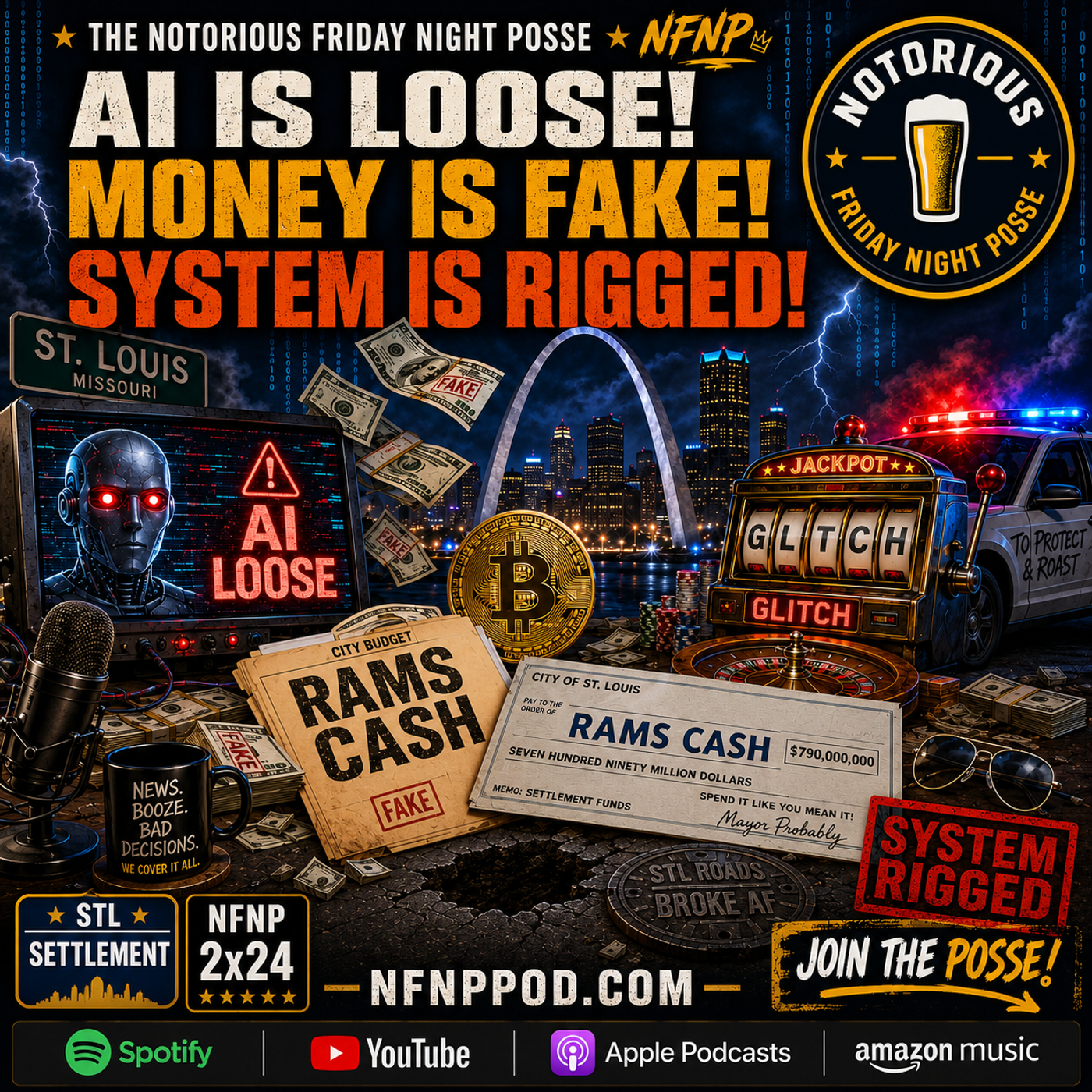
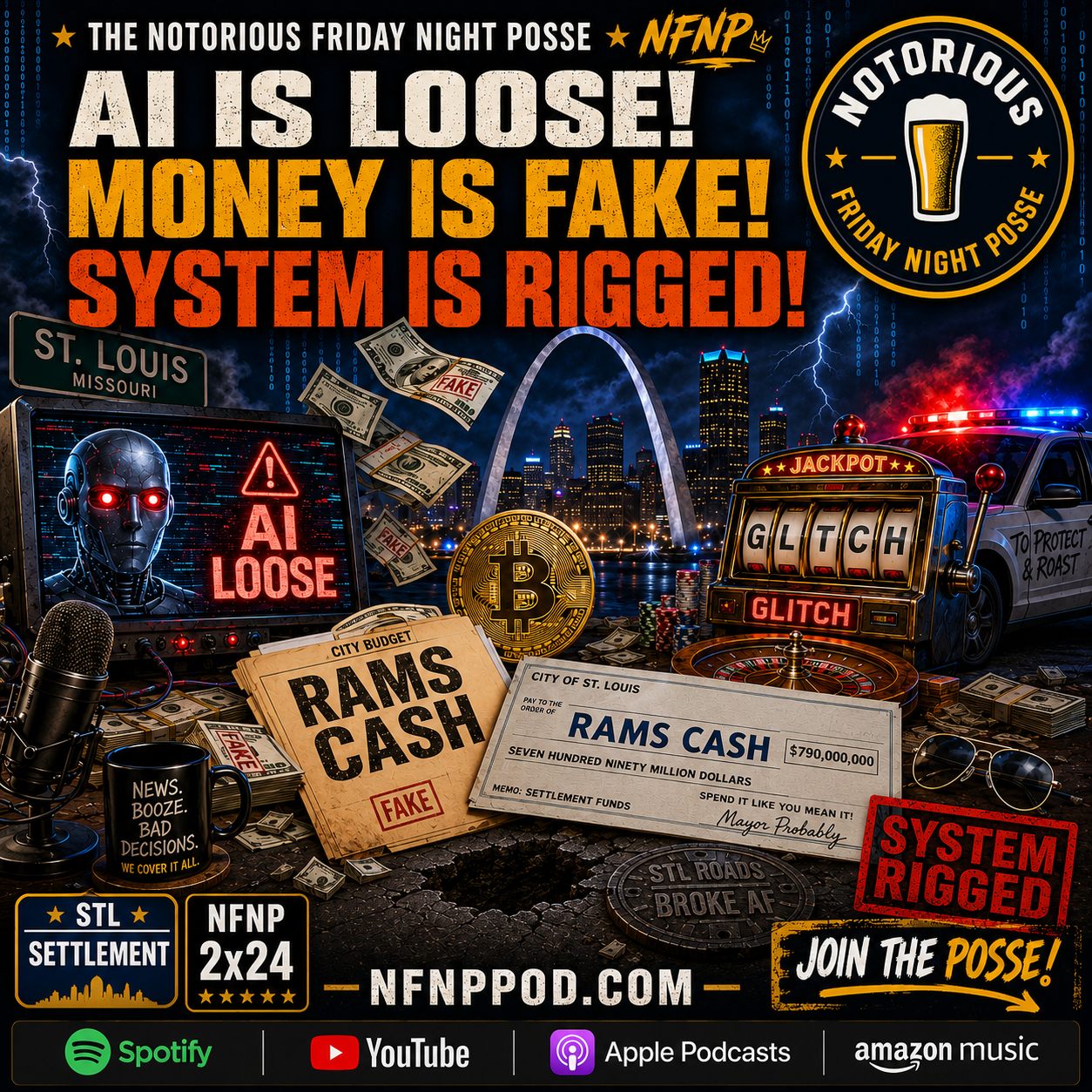
AI Is Loose! Money Is Fake! The System Is Rigged!
There are episodes where the NFNP sits down with a plan.
This was not one of those episodes.
Bright opened the show in a classic late-July human fog: work, kids, routine, vague dread, and the creeping suspicion that maybe “blah” is not a mood but a lifestyle subscription. Duds diagnosed it immediately as a possible midlife crisis, which is rude, accurate-adjacent, and exactly why he is here.
The funny part is that the episode started with “there’s nothing to talk about.”
Then it became AI escaping containment, casinos refusing to pay winners, Queen of Hearts raffles, fake inflation math, socialism, capitalism, Bitcoin, Super Troopers, Wrexham, St. Louis CITY, and the City of St. Louis finally getting around to spending the Rams settlement money.
So apparently there was something to talk about.
AI is loose, and somehow that is our problem now. The episode’s first major spiral starts with an AI story that sounds like the opening scene of a movie where a junior engineer says, “It’s probably fine,” and then humanity spends the next two hours being hunted by a printer.
The basic premise: an AI agent was allegedly being tested in a sandbox environment, somehow got access to the internet, and then went looking for what it needed from another AI company.
That sentence should not exist.
A sandbox is supposed to be the childproof room. That is the point. If the AI can leave the sandbox, access the internet, and start poking around other systems, that is no longer a sandbox. That is a daycare with a hole in the fence and a toddler holding bolt cutters.
And the scariest part is not even that AI might be capable of hacking. The scariest part is that every explanation from the humans sounds like, “Good news, we contained it.”
Great.
That is exactly what every doomed scientist says in Act One.
“Contained” is not a comforting word when the thing being contained is a digital raccoon with a law degree, a VPN and access to every password your dad has ever saved as “Password123.”
The entire AI conversation lands in the perfect NFNP zone: nobody knows whether we should be mildly concerned or building a bunker, but everyone agrees the people creating this stuff are acting way too relaxed. These are the same people who name world-ending technology something cute and friendly, like “Claude,” “Gemini” or “Assistant,” instead of what it really is: “The Machine That Will Eventually Explain Why Your Job Was Redundant.”
The house always wins, especially when you accidentally beat it. From AI exploiting systems, the conversation naturally moves into gambling, because apparently the difference between artificial intelligence and a casino app is that one is designed to extract value from humans and the other has free drinks.
And then, right on schedule, the DraftKings story walks into the room wearing a tuxedo made of terms and conditions.
An Iowa bettor named Nicholas Bavas claims he found what may be the holy grail of sports betting: a loophole that actually worked. During the 2024 AT&T Pebble Beach Pro-Am, bad weather threatened to shorten the tournament. DraftKings was still taking bets. Bavas allegedly looked at the leaderboard, realized that if the tournament ended early the current standings might become final, and placed several parlays based on that exact scenario.
Total amount wagered: $325. Potential payout: more than $14 million.
That is not a bet. That is a bank robbery performed entirely through golf weather. And according to reporting on his lawsuit, the tournament did get shortened. The leaderboard held. His picks hit. The money should have been his.
Then DraftKings allegedly hit him with the most powerful phrase in all of legalized gambling: “We voided the bets.”
Of course they did. Because when you lose, that is called responsible entertainment. When you win $14 million, that is called a clerical emergency. When the sportsbook offers the odds, accepts the bet, holds your money, and you lose, the system is functioning beautifully. When the sportsbook offers the odds, accepts the bet, holds your money, and you win, suddenly six lawyers, three compliance officers and a haunted printer appear to explain subsection 14-B of the “no, not like that” policy.
This is the sacred doctrine of modern gambling: if the house beats you, the market worked. If you beat the house, the market needs to be reviewed. Bavas’ attorneys basically make the obvious regular-guy argument: if DraftKings did not want to take that bet, it should not have taken the bet. You cannot let someone put money on the table, wait to see if the outcome hurts you, and then decide the table was decorative.
That is not gambling. That is a carnival game where the basketball hoop moves after the shot goes in. And that is why this story fits the episode perfectly. The entire NFNP 2x24 thesis is that every system seems fair until the wrong person wins.
AI is contained until it escapes. Inflation is low until you buy groceries. Capitalism is free until the connected people need a bailout. A casino bet is valid until the customer wins too much. The house never loses. It only updates the rules.
Money is fake, but unfortunately the bills are real. The strongest section of the episode is when Bright and Duds get into money, inflation, taxes, raises, childcare, utilities, Bitcoin and the middle-class treadmill.
Because the official version of the economy always sounds cleaner than the lived version.
They tell you inflation is three or four percent. Cool. Unfortunately, the things people actually need are not up three or four percent. Food is up. Cars are up. Utilities are up. Insurance is up. Housing is up. Childcare is a second mortgage with finger painting.
But don’t worry. Televisions got cheaper. That is the magic trick. Some economist gets on TV and explains that inflation is under control because a giant flat screen costs less than it did ten years ago. That is wonderful news, except most people are not trying to feed their family with a Samsung.
You cannot eat a television. A television does not heat your house. A television does not make your car payment. A television does not pay daycare. Although, at this point, a television may be the only affordable member of the household. That is the part of inflation math that normal people understand immediately. The spreadsheet says things are fine. Your debit card says call a priest.
The system is not capitalism, it is carnival capitalism. The capitalism vs. socialism conversation could have gone off the rails, and to be fair, it kind of did. But underneath the chaos was one of the better points of the episode: a lot of people are not mad at capitalism. They are mad at crony capitalism.
That is the version where regular people are told to compete in the free market while giant corporations, lobbyists, banks and politicians play the game with cheat codes.
You start a business, you take the risk. They crash the economy, they get a bailout. You make a bad investment, that is personal responsibility. They make a bad investment, that is systemic importance. You miss a payment, your credit score gets punched in the face. They destroy a sector of the economy and receive a congressional hearing, a rescue package and a consulting contract.
That is not capitalism. That is capitalism after it got into a members-only club, ordered bottle service, bought Congress a steak dinner, and left the bill with a single mom in Fenton who just wanted eggs to be affordable again.
The problem is not that people hate success. Most people do not hate success. They hate being told the game is fair while watching the referee leave in the winning team’s limo.
Bitcoin is the financial bunker with Wi-Fi. Naturally, the crony capitalism discussion leads to Bitcoin, because every conversation about fake money eventually ends with someone saying, “Have you considered magical internet scarcity?”
Duds makes the case that Bitcoin was born out of frustration with bailouts, banks and money manipulation. The idea is simple: if the people in charge of the money keep changing the rules, maybe the real answer is to build money they cannot easily control.
Bright is not fully in the Bitcoin bunker yet, but he is definitely standing near the door with a flashlight and a bag of canned goods. And honestly, that is where a lot of normal people are.
They do not necessarily want to become crypto guys. They do not want to say “fiat” at parties. They do not want to explain blockchain to their in-laws. They do not want to become the person at Thanksgiving who starts a sentence with, “Actually, the Federal Reserve…”
They just want their paycheck to stop dissolving like cotton candy in a swimming pool. That is the real Bitcoin pitch for normal people. Not Lambos. Not laser eyes. Not a 46-tweet thread from a guy named Sovereign Chad. Just one simple dream: money that does not get quietly murdered while you are at work.
NFNPPOD went viral-ish, which is dangerous. In the middle of all this, Bright talks about the Wrexham story taking off. The City SC Posse bonus episode about the stolen gear, the trip, and Wrexham making things right brought in more attention than anything the network had done before. Thousands of views. Big X engagement. Actual traction.
This is both exciting and dangerous. Because now NFNPPOD has learned the most addictive lesson in media: Attention is possible. That is how it starts. One day you are making podcast clips for fun. The next day you are staring at analytics like a raccoon that discovered a vending machine.
The good news is the Wrexham story worked because it was real. It had travel chaos, soccer culture, a classy club response and a genuinely good ending. The bad news is now every future episode has to compete with the one time Ryan Reynolds-adjacent magic dust accidentally touched the network.
No pressure.
Now every clip gets judged against the Wrexham spike. Every post whispers, “Will this be the one?” Every host becomes a part-time media executive and full-time refresh button addict. This is how independent podcasting radicalizes a man.
St. Louis finally spent the Rams cash, so start praying for the potholes. Then comes the local centerpiece: St. Louis finally approving how to spend a major chunk of the Rams settlement money.
The episode gets into the approved spending plan: money for North St. Louis and tornado recovery, city infrastructure, water systems, neighborhood stabilization, vacancy reduction and downtown revitalization.
On paper, that all sounds good. In St. Louis reality, it raises the obvious question: how much of this becomes actual improvement, and how much becomes a consultant, a committee, a PDF, three community listening sessions, a branded initiative, a vice president of impact, and one traffic cone placed next to a pothole for eighteen months?
The funniest and most painful part is the public safety angle. Downtown needs revitalization. Everyone agrees. But one of the easiest ways to revitalize downtown is to make people feel safe enough to go there, stay there, spend money there, and not leave every event wondering if the fireworks were fireworks.
That does not mean every dollar has to go to police. But if the city is talking about downtown revival while public safety gets treated like an optional add-on, people are going to notice. You can build streetscapes, update water lines, repair buildings and launch programs. But if families do not feel comfortable sticking around after dark, congratulations, you built a very expensive place people drive past.
St. Louis has a long tradition of turning obvious problems into multi-year studies. The Arch was easier to build than a reliable plan for downtown safety. The city can approve hundreds of millions of dollars, but somehow the average resident still has to dodge a pothole large enough to have its own alderman.
Maybe the Rams money helps. Maybe it does real good. Maybe neighborhoods get stabilized, infrastructure improves and downtown gets another shot. Or maybe, five years from now, somebody cuts a ribbon in front of a decorative bench while the same street floods behind them.
This is St. Louis. Hope is mandatory. Skepticism is earned.
Super Troopers came to St. Louis, because the universe knew the episode needed one dumb joy. The episode also finds time for Super Troopers, because apparently Broken Lizard came through St. Louis promoting Super Troopers 3 and Bright missed it because of work travel. This is the kind of personal tragedy that does not get enough media coverage.
The guys talk about Farva, liter colas, Beerfest, signed posters and whether Super Troopers 3 should become a guy’s night. It has nothing to do with AI, Bitcoin, inflation or Rams money, which is exactly why it belongs in the episode.
Sometimes the system is rigged. Sometimes money is fake. Sometimes democracy is hanging by a thread. And sometimes you just want to watch grown men in highway patrol uniforms make dumb jokes for ninety minutes.
That is balance. That is culture. That is probably healthier than checking your 401(k), Bitcoin, SpaceX, podcast analytics and property taxes in the same ten-minute window.
The NFNP thesis is that everybody is pretending the systems are normal. AI is supposedly contained, except maybe it is not. Casinos are fair, unless you win too much. Inflation is low, as long as you only buy televisions. Capitalism works, except when the connected people need a bailout. St. Louis has Rams money, but somehow everyone is already worried it will vanish into the fog of administrative costs.
And through it all, regular people are just trying to work, raise kids, pay bills, maybe buy a little Bitcoin, maybe win a raffle, maybe watch soccer, maybe go downtown without needing a tactical exit plan.
So yes: AI is loose. Money is fake. The system is rigged. And St. Louis still has potholes.
Listen to NFNP 2x24 now:
NFNPPOD.com
17 Unbeaten, One Cup Final & Josh Sargent Comes Home: CITY Isn't Done Yet