Can Anyone Afford a House Anymore?
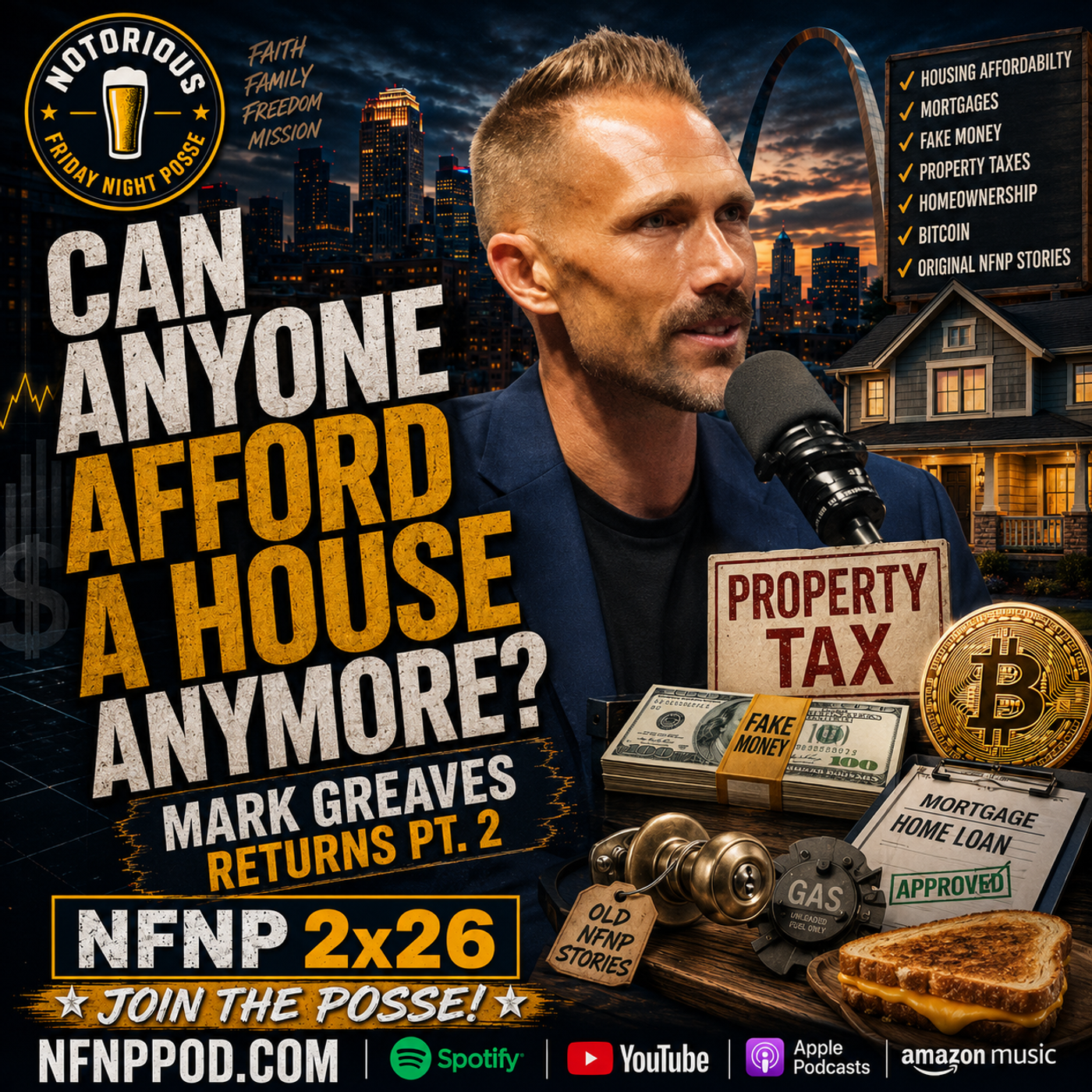
NFNP 2x26 — Mark Greaves Returns Pt. 2
There used to be a simple life path in America. Graduate school. Get a job. Meet someone. Buy a house. Mow the lawn. Complain about the water bill. Stand in the garage with your hands on your hips and say, “Well, that’s not good.” Become your father slowly and then all at once. That was the deal.
Nobody said it was glamorous. Nobody said it was easy. But it was at least possible. Now the path looks more like this:
Graduate school. Get student loans. Rent forever. Watch home prices go vertical. Watch mortgage rates double. Watch insurance companies light your escrow account on fire. Watch property taxes sneak into your mailbox wearing a ski mask. Open Zillow. Laugh. Close Zillow. Open it again five minutes later because pain is apparently a hobby now.
That is where NFNP 2x26 begins. Original Posse member Mark Greaves returned for Part 2, and this time we finally got into the housing conversation: home prices, mortgage rates, first-time buyers, student loans, inflation, insurance, HELOCs, property taxes, fake money, Bitcoin, goldbacks, and the uncomfortable question hiding underneath all of it.
Can anyone actually afford a house anymore? The official answer is: yes, technically.
The NFNP answer is: yes, but apparently you need a co-signer, a side hustle, a dead relative, a friendly lender, a Bitcoin wallet, two goldbacks, a second job, a prayer candle, and the emotional resilience of a pioneer woman crossing Missouri in a covered wagon.
So, not ideal.
The housing market did not get expensive. It became a hostage situation. Bright opened the episode by comparing 2019 to today, which is always dangerous because 2019 now feels like a fantasy novel where groceries were affordable, mortgage rates were normal, and people still thought a two-week lockdown sounded plausible.
The numbers are brutal. In June 2026, the National Association of REALTORS reported a median existing-home sales price of $440,600. That is not a typo. That is the middle of the market now. Not a mansion. Not a compound. Not a home with a wine cave, secret library, and a butler named Reginald. Just the median existing home. NAR also reported June 2026 existing-home sales at 4.09 million and inventory at 4.6 months, which is better than the inventory panic years but still not exactly “come one, come all, the houses are cheap and plentiful.”
Back in 2019, the median existing-home price was roughly in the low-to-mid $270,000 range. In the episode, Bright used about $275,000 as the comparison point. That means the median home went from “painful but possible” to “please submit your blood type and emotional support animal” in about seven years.
And price is only half the beating. Freddie Mac reported that as of July 23, 2026, the 30-year fixed mortgage rate averaged 6.58%, while the 15-year averaged 5.96%. In 2019, rates were hanging around the high 3s and low 4s, which now feels like finding an old McDonald’s receipt where a full meal cost $6 and realizing society has collapsed quietly in the background.
So yes, the house costs way more. And yes, the money to buy the house also costs way more. That is the part that breaks people. A $275,000 house at around 4% was not easy, but it was at least in the realm of “two normal adults with jobs can maybe figure this out.” A $440,000 house at 6.5% is a different animal. That is not a mortgage payment. That is a monthly hostage note from the economy.
Using common assumptions — 20% down, 30-year fixed, principal and interest only — the 2019-style payment on a $270,000-ish house sits around $1,000 to $1,250 a month. The 2026-style payment on a $440,600 house at 6.58% lands around $2,250 a month before taxes, insurance, maintenance, repairs, and the surprise $900 dishwasher that dies the week after closing.
That is how the American Dream became a subscription service.
Income went up, but the house ran away. One of the classic lines people use when talking about inflation is, “Well, wages went up too.” Sure. Technically.
The Census Bureau reported median household income at $68,703 in 2019 and $83,730 in 2024. That is real growth, but it is not “home prices jumped 55 to 60 percent while rates also doubled” growth. It is not even close. That is the whole problem.
Your paycheck got a raise. The housing market got into a stolen Dodge Charger and fled the state.
The old rule of thumb was that a home around three to four times household income was manageable. That rule now belongs in a museum next to Blockbuster cards, MapQuest printouts, and the belief that a college degree automatically meant financial stability.
The country still talks about homeownership like the math is basically the same. It is not. A household making $80,000 can look responsible on paper and still feel completely locked out. Not because they are reckless. Not because they are buying too many lattes. Not because they have failed Dave Ramsey in their hearts. Because the starter home became a $400,000 starter castle with a roof from 1997 and a basement that smells like “minor water issue.”
First-time buyers are no longer first-time buyers. They are full-grown adults with back pain. The stat that may hurt the most is the first-time homebuyer age. According to NAR’s 2025 Profile of Home Buyers and Sellers, first-time buyers fell to a record-low 21% share of buyers, while the typical first-time buyer age climbed to 40. Forty! Not 25. Not 28. Not “we just got married and bought a cute little starter home.” Forty!
Forty is not “starter home” age. Forty is “I already own three air fryers and know which knee makes noise when it rains” age. Forty is “my doctor said I need more fiber” age. Forty is “I have strong opinions about deck stain” age. And now that is the median first-time buyer.
Mark’s explanation was simple and brutal: young people are coming out of school already carrying debt that feels like a mortgage before they ever get near a mortgage. Student loans, rent, car payments, food, childcare, insurance, utilities, subscriptions, and general life costs swallow the first decade of adulthood. There is not much left to save.
And that creates the new divide. Not just rich versus poor. Not just renter versus owner. But people with family help versus people without it.
Mark said the quiet part out loud: if a young buyer does not have gift money from parents or relatives, they may be completely boxed out. Not because they are lazy. Not because they do not work. Because the market increasingly assumes you have access to accumulated family equity from a previous era. In other words, the new starter-home strategy is:
- Step 1: Be born to parents who bought in 1998.
- Strong plan. Very scalable. Great public policy. No notes.
Renting is cheaper, which is both true and spiritually annoying. Duds pointed out the obvious alternative: if people are not buying, they are renting or living with family.
And renting has its own little horror show. Realtor.com reported that in March 2026, renting a starter home was cheaper than buying one in all 50 of the largest U.S. metros, with the monthly cost of buying averaging $920 higher than renting. That is not a small gap. That is a car payment, groceries, a youth soccer season, and maybe one medium popcorn at a CITY match if the stadium is feeling generous.
So yes, renting is cheaper month-to-month. But renting also builds zero equity. That is the trap. Buying is expensive enough to crush you. Renting is cheaper enough to trap you.
And every month you rent, you are paying for shelter but not ownership. You are building a landlord’s equity while trying to save for your own down payment in a market where the goalposts keep moving like they are controlled by DraftKings.
That is why housing feels so broken. It is not just that buying is expensive. It is that every option feels like losing, just in different fonts. Buying says: “Congratulations, you are house poor.” Renting says: “Congratulations, you are not building equity.” Living with family says: “Congratulations, your mother still knows what time you got home.”
There is no clean win.
Insurance and taxes are the bonus boss fights. A lot of people talk about mortgage payments like principal and interest are the full story. They are not. Principal and interest are the cover charge. Taxes and insurance are the bouncers who meet you inside and say, “Actually, there’s more.”
Homeowners insurance is one of the quiet killers in this whole conversation. The Insurance Information Institute’s NAIC-based data puts the average U.S. homeowners premium at $1,272 in 2019. LendingTree research later found regulator-approved home insurance rates rose 45.8% nationally from 2020 through 2025, outpacing inflation over that stretch.
That means even people who bought before the current madness are not fully safe. The mortgage might be fixed, but the escrow account is out here doing parkour. Your interest rate may be locked. Your insurance company is not. Your property taxes are not. Your utility company is absolutely not.
Mark brought up property taxes from his own life in Ohio, saying he pays around $14,000 a year — over $1,000 a month — and that the figure has climbed sharply since he built his house in 2016. Missouri looks relatively gentle by comparison, but the larger point stands: even when the mortgage is paid off, the meter keeps running.
That led to the most uncomfortable moment of the entire episode. Mark told the story of explaining taxes to his ten-year-old son. He told him that even if the house is paid off, you still have to pay property taxes or the government can take it.
His son asked: “So do you really own it then?”
That is the clip. That is the whole episode. That is the kind of question adults spend thirty years avoiding because the answer makes everyone want to stare quietly at a wall.
Do you really own it? Well. You own it in the same way you own your phone after paying it off, except if you stop paying a yearly phone tax, the county can seize your kitchen.
So yes. But also no. But legally yes. But spiritually absolutely not.
Mark’s answer is not despair. It is experience. The best thing about Mark in this episode is that he does not simply show up to say everything is broken and then disappear into a bunker holding goldbacks.
He is honest about the pain, but he also knows the system well enough to say: people can still buy houses. It is just harder, more complicated, and much more dependent on having the right guidance.
That is where his mortgage experience matters.
Mark talked about one of the most complicated Missouri deals of his career: agricultural zoning near the Missouri-Arkansas border, 23 acres, two houses on one parcel, multiple outbuildings, part steer and part crop farm, and a buyer relocating from Illinois using future income from a job he had signed for but not yet started. Most lenders hear that description and fake a dropped call. Mark got it done.
That story matters because it shows the difference between “computer says no” and “experienced human knows where this file belongs.”
Mark’s big advice for first-time buyers was not sexy, but it was useful:
- Do not just use whoever your realtor recommends.
- Shop around.
- Talk to a small local bank.
- Talk to a mortgage broker.
- Talk to a retail lender if you want.
But understand that the big names with the stadium naming rights often have the biggest marketing budgets, and those budgets do not pay for themselves with good vibes and a firm handshake. That does not mean every big lender is bad or every small lender is magic. It means buyers should not treat the first quote like scripture.
The lending box, according to Mark, is much bigger than people realize. There are conventional loans, FHA, VA, portfolio loans, state programs, down-payment help, area median income incentives, local-bank flexibility, wholesaler relationships, and all kinds of weird corners that inexperienced loan officers may not know how to navigate.
In NFNP terms: The mortgage world is not one box. It is a giant warehouse full of boxes, and some of them are labeled “normal family,” some are labeled “doctor moving states,” and at least one is labeled “23 acres, cows, crops, two houses, future income, good luck.”
You want someone who knows where the weird boxes are.
The down payment is not always the final boss, but it sure looks like one. One of the more helpful Mark points was that people do not always need the giant down payment they assume they need.
There are programs. There are state-level options. There are incentives for borrowers below certain income thresholds. There may be ways to access funds for a primary residence depending on the situation. But this is exactly where “talk to an experienced professional” matters, because personal finance advice from a podcast blog should be treated like gas station sushi: maybe interesting, but do not build your life around it without checking with someone qualified.
Still, the broader point matters. Some buyers think they are disqualified before they ever ask. Some lenders only know the cleanest, simplest version of the lending box. Some realtors send everyone to the same preferred person. Some buyers never compare rates, fees, programs, or structures.
In a normal market, that might cost you a little. In this market, that can cost you years. The market is hard enough. Do not also walk into it blindfolded because a realtor said, “I have a guy.”
Everyone has a guy. Some guys are great. Some guys are just a link in a referral chain wearing a fleece vest.
Fake money is the NFNP housing rabbit hole, and Mark brought a shovel. Of course, because this is NFNP, the conversation about home prices eventually turned into M1, M2, the Federal Reserve, debt, bonds, fractional reserve banking, Richard Werner, Bitcoin, goldbacks, and whether the entire monetary system is just a vibes-based group project with a flag on it.
Mark’s view is that housing cannot be separated from money itself. If the money supply expands, if dollars buy less, if people cannot save in cash without losing purchasing power, then hard assets start looking like lifeboats.
- Homes.
- Land.
- Stocks.
- Bitcoin.
- Gold.
Anything that feels sturdier than a dollar sitting in a savings account getting nibbled to death by inflation like a deer carcass in the woods.
The Federal Reserve Bank of St. Louis’ FRED database tracks M2, and Mark was pointing listeners toward that kind of chart when he talked about the money supply going parabolic around 2020. FRED’s M2 series is exactly the type of data that makes normal people say, “Wait, that line is not supposed to do that, right?”
This is also where the banking conversation got interesting.
Mark argued that people misunderstand how loans create money. That is not just a fringe internet take. The Bank of England’s 2014 paper on money creation says modern money creation differs from the popular misconception that banks simply lend out existing deposits from savers. It explains that most money in the modern economy is in the form of bank deposits created by commercial banks themselves when they make loans. Richard Werner’s 2014 empirical work also tested whether banks create credit “out of nothing” when extending loans.
Now, this is where every economist on the internet starts cracking their knuckles. Good. Let them.
NFNP is not claiming to settle monetary theory between sips of beer. Mark is explaining his view of how debt, banking, money supply, mortgages, and housing affordability connect. And even if listeners disagree with parts of the framing, the emotional truth lands hard:
Everything feels more expensive because everything is more expensive. And the dollar in your account does not feel like it holds the same weight it used to.
- That is why Bitcoin comes up.
- That is why goldbacks come up.
- That is why real estate comes up.
That is why people who used to talk about backyard patios now talk like bunker economists after two Busch Lights. Something changed. Everybody feels it. Mark is just willing to say the weird part out loud.
Goldbacks are what happens when your kids understand inflation too early. One of the funniest side roads in the episode was Mark talking about his kids preferring goldbacks to dollars. This is either genius parenting or the first scene in a documentary where the children become tiny Austrian economists.
Mark said his kids have learned about inflation and Bitcoin, and now they would rather receive goldbacks than dollars for chores, gifts, or birthday money. He described goldbacks as physical currency-like pieces containing small amounts of gold, with values that move based on the price of gold.
Bright’s kids, meanwhile, still have piggy banks. So we have two parenting paths here:
- Mark’s kids are calculating silver content.
- Bright’s kids are shaking coins and declaring themselves rich because volume equals wealth when you are seven.
Both are valid. But Mark’s story hits the larger theme again: people are looking for stores of value because they do not trust cash. That used to sound extreme. Now it sounds like a family birthday card strategy. Grandma used to slip you a $20. Now apparently the advanced move is one tiny gold rectangle and a lecture on fiat currency.
Happy birthday, kid. The empire is unstable.
HELOCs are back, because everyone is sitting on house wealth they cannot eat. The episode also got into home equity lines, and this is where Mark was very practical. A lot of homeowners are sitting on huge equity gains from the last several years. On paper, they look wealthier. In real life, they still have bills.
That is the strange part of housing wealth. Your house can be worth $200,000 more than it used to be, but unless you sell it, borrow against it, or die and let your kids fight about it, that equity is mostly theoretical.
You cannot take a bite of equity. You cannot pay Ameren with “my Zestimate went up.” You cannot walk into Schnucks and say, “Good news, my house appreciated 47%.”
They will still ask for actual money.
Mark said HELOCs and home equity products have become simpler and faster in some cases because technology can verify income, link bank accounts, use automated valuation models, and move more quickly than traditional mortgage processes. He gave an example of a Texas borrower pulling equity from a free-and-clear home to buy a condo, comparing fees and break-even points between options.
That part of the conversation is useful because it cuts through the moralizing. Some people treat debt like sin. Some people treat debt like free candy. The truth is more annoying: debt is a tool, and tools can build a deck or remove a finger.
A HELOC can be smart. A HELOC can be stupid. It depends what you are doing, why you are doing it, what the rate is, what the fees are, what the repayment looks like, and whether you are using home equity to solve a real financial problem or to finance a boat named “Bad Idea.”
Again: talk to a professional. And maybe do not name the boat that.
Investors are part of the story, but not the whole villain. No housing conversation is complete without someone yelling about BlackRock, Airbnb, corporate landlords, and investors buying every starter home in America. There is truth in the investor frustration, but the details matter.
Redfin reported that real estate investors purchased 19% of homes sold in the first quarter of 2026, down slightly from 20% a year earlier, while investor purchases fell to their lowest level since 2020. That “investor” category includes more than giant institutions; it can include smaller investors and landlords too.
So yes, investors matter. Yes, they can crowd out regular buyers in some markets. Yes, short-term rentals can wreck local neighborhoods and make normal residents feel like they live inside someone else’s bachelor party. But nationally, investors are not the only reason housing is broken.
The deeper problem is the full cocktail:
- Underbuilding.
- Low inventory.
- Low-rate lock-in.
- Higher rates.
- Higher prices.
- Higher insurance.
- Higher taxes.
- Higher student debt.
- Wages lagging housing.
- Local zoning.
- Migration patterns.
- Investor activity.
- Short-term rentals.
- Construction costs.
And the fact that everybody still wants a house with a yard, a garage, a decent school district, and enough distance from their neighbors that they cannot hear a leaf blower at 7:03 AM.
The housing crisis is not one villain twirling a mustache. It is a whole committee of villains, and apparently they meet monthly.
Mark’s real message is not “give up.” It is “get smarter.” This is the part that saves the episode from pure doom. Because yes, the numbers are bad. Yes, first-time buyers are older. Yes, rent is expensive. Yes, insurance is gross. Yes, the dollar feels weird. Yes, property taxes make homeownership feel like a lease with better landscaping.
But Mark did not say people should give up. He said the opposite. People can still buy homes.
They just need to understand that the path is not as clean as it used to be. You may need more guidance. You may need to shop lenders. You may need to compare programs. You may need family help. You may need down-payment assistance. You may need a local bank. You may need a broker. You may need someone who has handled weird files before. You may need patience, creativity, and a willingness to admit that the first answer you get may not be the final answer.
That is probably the most useful takeaway from the episode. The American housing market is ridiculous. But ridiculous does not mean impossible. It means you need someone who knows how ridiculous it is.
So, can anyone afford a house anymore? The clean answer is yes.
The honest answer is yes, but the system has gotten much harder on normal people. The 2019 version of buying a house was already stressful. The 2026 version feels like someone took the same process, doubled the payment, raised the insurance, aged the first-time buyer by a decade, added student loans, made renting cheaper, then handed everyone a motivational quote about discipline.
The math is worse. The pressure is worse. The margin for error is worse. And yet, people still want homes because homes still mean something.
A home is not just an asset. It is where your kids grow up. It is where your dog ruins the yard. It is where you host Thanksgiving and pretend the turkey is not dry. It is where you stand in the garage at 10 PM holding a flashlight like you know what you are doing.
That still matters. But we should stop pretending the road there looks the same. It does not. The market changed. The money changed. The debt changed. The age changed. The insurance changed. The taxes changed. The whole thing changed.
And if policymakers, lenders, builders, buyers, sellers, and voters do not admit that, we are going to keep telling 40-year-old first-time buyers that the problem is they ate too much avocado toast.
That was always stupid. Now it is insulting.
The NFNP thesis is that housing is where all the broken systems meet. Inflation shows up in the grocery aisle, but it also shows up in the down payment. Student loans show up in your monthly budget, but they also show up in your debt-to-income ratio. Insurance costs show up in your escrow payment. Property taxes show up after you thought the mortgage was the hard part. Money creation shows up in asset prices. Low rates show up in home values. High rates show up in monthly payments. Investors show up in starter-home competition. Rent shows up as the thing you have to keep paying while trying to save enough to escape rent.
Everything meets at the front door. That is why housing feels different. It is not just a market. It is the scoreboard for whether normal life still works. And right now, a lot of people are looking at the scoreboard and saying:
Wait. Who changed the rules?
NFNP 2x26 does not solve the housing crisis. Obviously. We are a podcast, not the Federal Reserve, and frankly, based on some of our old stories, you should not give us that kind of authority.
But Mark Greaves helped make the mess understandable. Housing is still possible. But it is not simple. Money is still money. But it is weirder than people think. Homeownership still matters. But property taxes make the word “own” feel a little suspicious.
And the American Dream is still alive. It just needs a better loan officer, a cleaner balance sheet, a rate drop, lower insurance, more inventory, less student debt, a time machine to 2019, and maybe one goldback from grandma.
Listen to Can Anyone Afford a House Anymore? Mark Greaves Returns Pt. 2 | NFNP 2x26 now.
Join the Posse: NFNPPOD.com

17 Unbeaten, One Cup Final & Josh Sargent Comes Home: CITY Isn't Done Yet