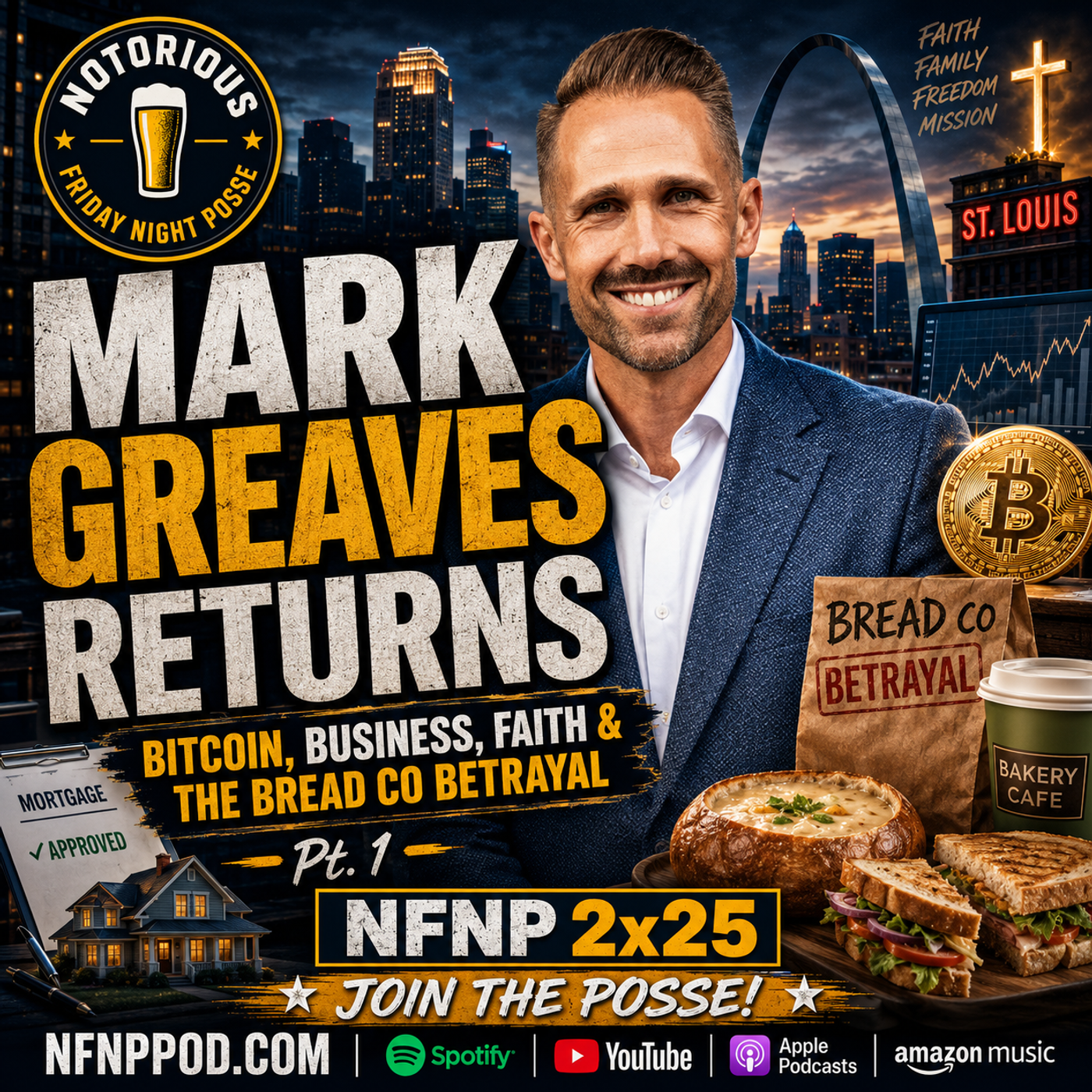
Mark Greaves Returns: Bitcoin, Business, Faith & the Bread Co Betrayal
NFNP 2x25 — Pt. 1
Every once in a while, the NFNP brings on a guest.
This time, we brought back a founding artifact.
Mark Greaves returned to the Posse for NFNP 2x25, and technically he was the guest, but it did not really feel like a guest episode. It felt more like somebody unlocked an old memory vault labeled “Catholic school, bad decisions, and things we probably should not say into microphones.”
Mark is a childhood friend, original NFNP member, Ohio State volleyball alum, mortgage expert, business owner, podcaster, founder of Tithe Lending, Bitcoin believer, Rush fan, husband, dad, and apparently a man with multiple stories that have not yet been disclosed to his wife.
So naturally, the episode begins with him admitting there may still be “open investigations” from the original NFNP era.
That is how you know the vibes are right.
This is Part 1 of a two-part conversation. Part 2 drops Friday, August 7, and that is where we get into the real housing and mortgage meat: home prices, interest rates, first-time buyers, student loans, property taxes, HELOCs, how money gets created out of thin air, and whether anyone can actually afford to buy a house anymore.
Also, because Mark is an original NFNP member, Part 2 includes old stories involving broken braces, broken fingers, poker nights, stolen gas caps, and teenage stupidity that makes you deeply thankful podcasting did not exist in the early 2000s.
For Part 1, though, we started where all responsible adult conversations start:
With Rush, Bitcoin, crony capitalism, faith, business burnout, and the slow death of St. Louis Bread Co.
So, a normal Friday.
Mark Greaves came back like he never left. Bright and Duds have known Mark since grade school, which means there is no “getting to know you” phase. There is only immediate harassment.
Mark left St. Louis for Ohio State, played volleyball, met his wife, built a life in Columbus, and never really came home. He even admitted that when he visits St. Louis now, he still needs Apple Maps to get around.
This is both understandable and deeply shameful.
You can move away from St. Louis. You can build a career. You can raise a family. You can become a successful business owner. But needing GPS in the city where you grew up? That is how St. Louis revokes your toasted ravioli privileges.
Still, Mark fell right back into the Posse. He knew the rhythm immediately: mock yourself before the guys can, tell the truth, go too deep, get sidetracked, and somehow make the sidetrack more interesting than the original point.
That is basically the NFNP operating system.
The Rush section was not planned, but it made perfect sense. Bright and Mark both showed up wearing Rush shirts, because apparently two grown men can still coordinate emotionally through Canadian prog rock.
Mark had just seen Rush in Chicago with his sons, which turned into one of the more unexpectedly wholesome parts of the episode. His oldest son drums, knows the songs, and got to experience the show with him. That is not just a concert story. That is dad stuff.
And then, because this is NFNP, the conversation immediately went from “beautiful father-son memory” to Geddy Lee vocals, Neil Peart books, Auschwitz survivors, and whether fleeing to Canada makes sense.
That is the show in one paragraph.
Bitcoin entered the chat, and Duds immediately found his people. The minute Mark mentioned Bitcoin, Duds lit up like someone had opened a bunker door and revealed shelves of canned goods, hard wallets and emergency silver.
Mark explained Bitcoin in the way Bitcoin people always do: once you see it, you cannot unsee it. Then you want to tell everybody. Then everybody around you wonders why a conversation about mini golf is now about monetary policy.
Bright admitted Mark had already done this to him once over dinner and drinks. Mark had apparently talked Bitcoin so much that the evening became less “old friends catching up” and more “financial apocalypse seminar with appetizers.”
But that is also what made the conversation work. Mark and Duds are in the Bitcoin bunker. Bright is not fully inside, but he is near the entrance, holding a flashlight and pretending he is just there to look around.
The guys talked dollar-cost averaging, institutional buying, retail getting dumped on, and the classic “if I had only bought Bitcoin ten years ago” regret spiral. Everyone has one of those stories now. Someone told you. You ignored them. They were either a visionary or a lunatic. Unfortunately, history keeps proving that sometimes the lunatic was early.
The real theme was not just Bitcoin. It was broken trust. The Bitcoin conversation naturally turned into crony capitalism, inflation, big tech, politics, suppressed content, government distrust, and the feeling that regular people are playing a different game than the connected class.
That has become a recurring NFNP theme lately: people are not necessarily mad at capitalism. They are mad at the version where the rules bend for big players and snap shut on normal people.
Mark put it bluntly: a lot of people are frustrated because what we call capitalism does not feel pure, fair or merit-based anymore. It feels like the rich keep pulling away, the middle keeps getting squeezed, and the system keeps pretending the scoreboard is normal.
That tied directly back to the previous NFNP conversation about crony capitalism. The problem is not that somebody succeeds. The problem is when some people succeed by writing rules, buying influence, getting bailed out, and then telling everyone else to stop complaining and work harder.
That is not capitalism.
That is capitalism with backstage passes.
Mark’s business story was the strongest serious section of Part 1. Mark walked through his career in mortgages, starting almost by accident after Ohio State and eventually helping grow major mortgage operations. At one point, the company he was part of scaled to thousands of employees, carried national brands, and even put its name on the Columbus Crew stadium.
That sounds glamorous from the outside.
From the inside, Mark described it more like being strapped to a rocket made of spreadsheets, venture capital expectations and neck pain.
The most intense moment came when he described the stress of that executive life: trying to feed the machine, manage growth, keep the marketing engine moving, hit expectations, handle venture pressure, and still be a husband and father. He described being so physically wrecked by stress that he had to get through a company Christmas party while his body was basically waving a white flag.
That is the part of success nobody puts in the LinkedIn post.
The internet version is: “Excited to announce our next chapter.”
The real version is: “My neck is sideways, I have not seen my kids, and I am one quarterly report away from becoming a cautionary tale.”
Mark’s takeaway was simple: you can scale a huge business if you are willing to sacrifice almost everything else on the altar of business.
The altar of business, by the way, has terrible lighting and no refund policy.
Tithe Lending is Mark’s answer to the machine. After stepping away from the giant mortgage world, Mark and his business partner built Tithe Lending intentionally smaller and mission-driven. The company’s own mission page says that with every mortgage it completes, the first 10% of transaction proceeds flows to the Tithe Foundation. Tithe Foundation also announced in July 2026 that it had distributed more than $700,000 in grants to local nonprofits, with more than 40 businesses participating in the broader giving network.
That matters because Mark’s story is not just “guy leaves big company and starts smaller company.”
It is “guy sees the greed machine from inside the cockpit and tries to build the opposite thing.”
Tithe Lending’s idea is simple: yes, help people get mortgages, but also connect each transaction to something beyond the transaction. Help someone buy a house and help someone in need. Make money, but do not make money the only god in the room.
That is where the faith conversation came in.
Duds brought up the sense that more people are looking for faith, community and something more stable than politics, social media, sports gambling, endless streaming services and whatever panic the algorithm is serving for breakfast.
Mark agreed and said people are looking for something sturdier, something that can actually withstand the weight of life.
That phrase stuck.
Something sturdier.
Because that might be the whole episode.
Bitcoin people are looking for sturdier money.
Families are looking for sturdier communities.
Business owners are looking for sturdier purpose.
St. Louis people are looking for sturdier local identity.
And regular people are looking around at politics, inflation, corporate relocations, AI, gambling apps, broken institutions and $18 sandwiches thinking:
Is anything around here actually built to hold weight?
The Bread and Circuses section was accidentally perfect. The guys eventually drifted into sports, gambling, NIL money and entertainment as distraction. Mark talked about ancient civilizations and stadiums. Duds talked about how COVID broke his relationship with sports. Bright admitted he still loves going to CITY matches, which is fair, because there is a difference between “bread and circuses” and “a Saturday night beer with your buddy while CITY tries to keep climbing the table.”
That is called culture.
Or denial.
Maybe both.
The point was not that sports are bad. The point was that modern society has built a giant entertainment machine around people who are increasingly stressed, broke, lonely, distracted and looking for escape.
Streaming. Gambling. Cheap TVs. Stadiums. Fantasy sports. NIL. Betting markets. Social media. Scroll, bet, watch, repeat.
At some point, the circus is not a break from the system.
It is part of the system.
And yes, we understand the hypocrisy of saying that on a podcast while promoting a soccer podcast.
NFNP is self-aware enough to know it is also part of the circus. We are just the tent where somebody keeps yelling about Bitcoin and Bread Co.
Then came the Bread Co betrayal. After Mark jumped off, Bright and Duds hit the big St. Louis story of the week: Panera is moving its headquarters out of the St. Louis region to Weston, Massachusetts, in the Boston metro area. Restaurant Dive reported that the new headquarters is expected to open in July 2027 as part of the Panera RISE turnaround plan, while Panera plans to maintain a St. Louis support center but move many St. Louis support center and remote roles to Weston.
Around here, of course, this is not just “Panera relocates headquarters.”
This is Bread Co leaving.
And yes, we know the corporate name is Panera. We know the national brand is Panera. We know the app says Panera. We know the sign outside most of America says Panera.
But if you were raised correctly in St. Louis, it is Bread Co.
You did not meet at Panera.
You met at Bread Co.
You did not grab soup at Panera.
You grabbed Bread Co.
You did not sit in a booth with a Bacon Turkey Bravo and pretend to study for finals at Panera.
You did that at Bread Co, while somebody you knew from high school worked behind the counter and maybe, just maybe, accidentally forgot to charge you.
The St. Louis Bread Company was founded by Ken and Linda Rosenthal in Kirkwood in 1987 and expanded to 20 St. Louis-area locations before Au Bon Pain bought it in 1993. Four years later, in 1997, Au Bon Pain renamed the concept Panera Bread as it expanded nationally.
That is why this one feels personal. Bread Co was not just another chain. It was one of ours that became one of theirs.
And now the headquarters is leaving too.
The Boston move is where the local pride turns into relocation math. Bright’s big question was simple: why Boston?
If you are trying to run a business efficiently, St. Louis offers a lower cost of living, a strong workforce, major universities, good professional talent and a market where corporate salaries can go further. Boston offers history, talent, prestige, traffic, housing costs and the privilege of paying $19 for a sandwich that St. Louis would at least have the decency to overcharge you for under a familiar name.
According to First Alert 4, most affected Panera employees are being offered a 10% salary increase, some are being offered up to $50,000 in relocation assistance, and those who decline relocation are being offered voluntary severance. The same report noted that one employee described the move as a “quiet layoff” and cited Zillow data showing the average home price in Weston at about $2.3 million. Zillow’s own June 2026 data listed Weston’s average home value at $2,311,502.
That is not a relocation package.
That is a coupon for emotional damage.
Yes, $50,000 sounds like a lot of money. In St. Louis, that is meaningful. In Weston, Massachusetts, that is a down payment on a foyer.
Expatistan’s July 2026 comparison estimated Boston’s overall cost of living at 42% higher than St. Louis, with housing 67% higher. It also estimated that someone would need roughly $10,247 in Boston to maintain the same standard of living they could have with $7,200 in St. Louis.
So when Duds says a 10% raise is not going to cut it, that is not just a gut feeling. The math backs him up.
A 10% raise does not solve a 42% cost-of-living jump.
A $50,000 relocation package does not make a $2.3 million housing market normal.
And asking St. Louis employees to move 1,200 miles northeast so they can pay more for housing, groceries, transportation, childcare, restaurants, taxes and stress does not feel like a growth strategy for those employees.
It feels like a corporate cleanse dressed in a Patagonia vest.
Bright’s hot take: this might be downsizing with better PR. The official explanation is about collaboration, culture and transformation. Fine. That is what the memo says.
But the NFNP read is a little more skeptical.
Maybe this is not just about Boston.
Maybe this is about reducing headcount without saying “we are reducing headcount.”
Maybe this is about relocating jobs to a place where many current employees cannot realistically follow.
Maybe this is about AI, outsourcing, smaller corporate footprints and the kind of “voluntary severance” that feels less voluntary when the alternative is uprooting your entire life to chase soup headquarters into one of the most expensive housing markets in America.
We are not saying that is definitely the plan.
We are saying that if the plan were to quietly shrink the St. Louis workforce while avoiding the phrase “mass layoffs,” it would probably look a lot like this.
Corporate America does not always fire people anymore.
Sometimes it just moves the office to a place you cannot afford and calls your resignation “a personal decision.”
This is why losing Bread Co hurts more than it should. On paper, it is one company moving headquarters.
Emotionally, it is another St. Louis name drifting away.
The guys compared it to Anheuser-Busch. Growing up in St. Louis, everybody knew somebody connected to the brewery. There was pride in that. Local companies were not just logos. They were part of the family tree.
Bread Co was like that too.
Everybody knew someone who worked there. Everybody had a meeting there. Everybody had a teenage sandwich hookup there. Everybody had some moment where Bread Co was just part of the background of life in St. Louis.
And yes, the food is not Michelin-star material. Nobody is pretending a bread bowl is fine dining. It is soup inside bread. That is both brilliant and insane.
But local identity is not always about the product.
Sometimes it is about the shared language.
The rest of America says Panera.
St. Louis says Bread Co.
That is the whole thing.
St. Louis still loves itself, even when it roasts itself. The Bread Co conversation eventually turned into a broader St. Louis love letter, which is exactly how this city works.
We complain because we care.
We bash the city because we want it to be better.
We laugh at the “where did you go to high school?” thing because it is ridiculous, but also because it is true, and also because within four minutes of meeting someone you really can build a full social map based on their answer.
St. Louis is a small big city. Everybody knows somebody who knows somebody. That can be annoying. It can also be kind of beautiful.
The city has problems. Real ones. Everybody knows it. But people stay here because family is here, history is here, cost of living still makes some sense, and despite everything, there is a stubborn pride that refuses to die.
Even when companies leave.
Even when the streets flood.
Even when the same pothole survives three mayors and a federal infrastructure bill.
Even when Bread Co becomes Panera and Panera becomes Boston.
St. Louis people still look around and say:
Yeah, but this is ours.
And yes, CITY had to make an appearance. Because this is NFNP, the episode could not end without a City SC Posse crossover.
Bright and Duds teased the Saturday night match against Real Salt Lake, with CITY climbing the table and trying to keep the unbeaten run alive. Duds became Bright’s date for the match after the babysitter situation fell apart, which is either a friendship milestone or a cry for help.
Probably both.
The City SC Posse momentum also got mentioned earlier in the episode, with Bright joking that the soccer show has started to eclipse NFNP in some ways.
That is not a problem.
That is network growth.
That is cross-promotion.
That is also how Duds slowly gets radicalized into caring about MLS standings.
The thesis of Part 1 is simple: people are looking for something sturdier. That is what tied the whole episode together.
Mark left the giant business machine to build something mission-driven.
Duds and Mark see Bitcoin as an answer to broken money.
Bright sees St. Louis losing Bread Co as another local identity hit.
Everyone sees cost of living, inflation and corporate decisions squeezing normal people.
And underneath all of it is the same question:
What can you actually trust?
Can you trust the dollar?
Can you trust the system?
Can you trust big business?
Can you trust the algorithm?
Can you trust your city to keep its companies?
Can you trust a 10% raise to move you from St. Louis to Boston?
Can you trust Bread Co not to become Panera and then pack up for Massachusetts?
Apparently not.
So maybe that is where faith comes in.
Maybe that is where Bitcoin comes in.
Maybe that is where local pride comes in.
Maybe that is where old friends come in.
Maybe that is where podcasts come in, even dumb ones like this.
Because sometimes you need people who remember who you were before the résumé, before the mortgage, before the business, before the burnout, before the relocation memo, before the algorithm, before everything became content.
Sometimes you just need an original Posse member to come back, tell a few stories, talk fake money, and remind everyone that the system is weird, but at least we still have each other.
And for now, we still have Bread Co.
Even if corporate says otherwise.
Part 2 with Mark Greaves drops Friday, August 7. Next week, we get into the housing market, mortgage rates, first-time buyers, property taxes, home equity, HELOCs, how money gets created out of thin air, and whether anyone can actually afford to buy a house anymore.
Plus, the old NFNP stories finally come out:
The doorknob incident.
Broken braces.
Broken fingers.
Grilled cheese.
Poker nights.
Stolen gas caps.
And the kind of teenage stupidity that makes you realize the original NFNP was never a podcast.
It was a warning label.
Listen to Part 1 now and join the Posse:
NFNPPOD.com
THE GREAT AMERICAN DEBT RESET - Act 1